The Great Countertop Mystery: Is Quartz Actually Natural?
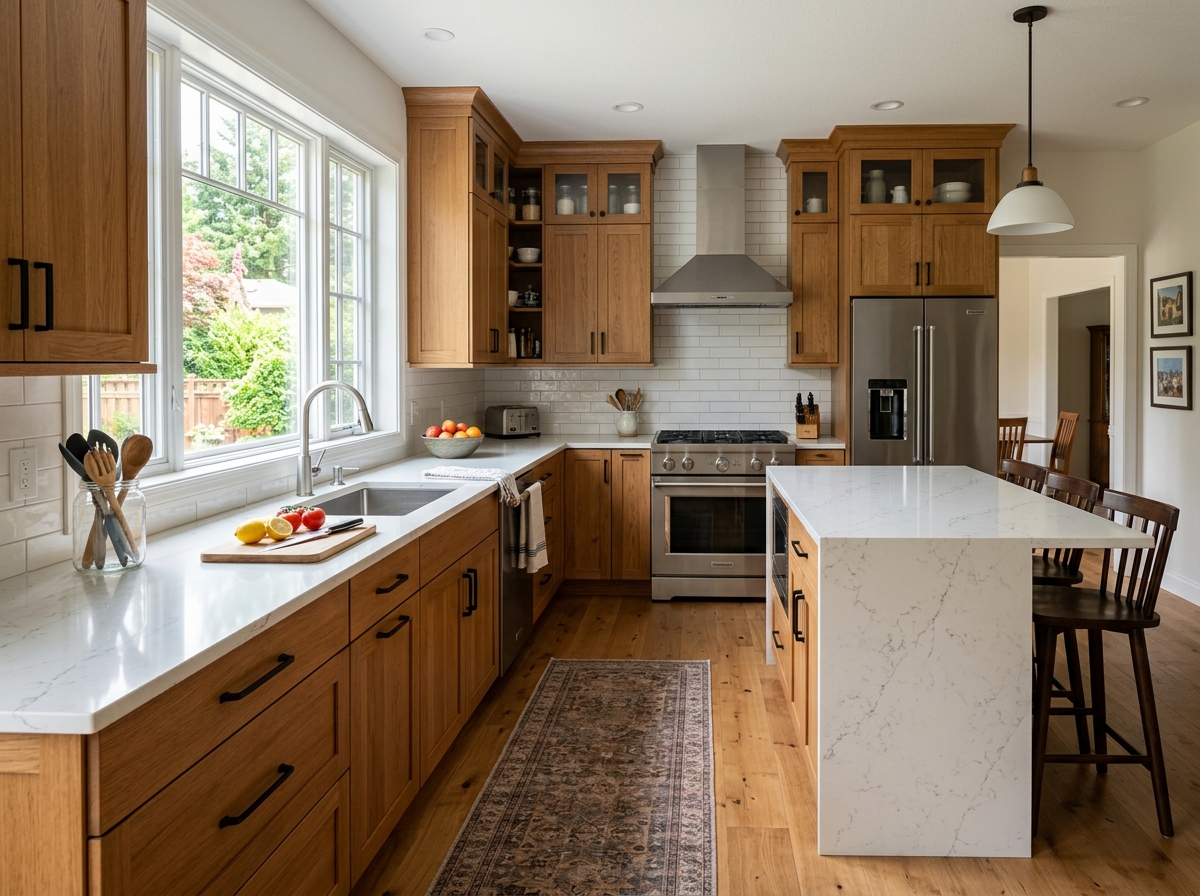
The Quick Answer: Are Quartz Countertops Natural Stone?
Are quartz countertops natural stone? No — but they’re not entirely artificial either.
Here’s the short version:
| Feature | Quartz Countertops |
|---|---|
| Natural material? | Partially — 90–95% natural quartz mineral |
| Man-made? | Yes — engineered in a factory |
| Classified as natural stone? | No — classified as engineered stone |
| Needs sealing? | No |
| Porous? | No |
Quartz countertops are made by taking one of Earth’s most abundant natural minerals and binding it together with resins and pigments to form a slab. The result is a surface that looks like natural stone but is manufactured — not quarried.
So if you’ve been standing in a showroom wondering whether you’re looking at something pulled from the ground or built in a factory, the answer is: a little of both.
This distinction matters more than most people realize. It affects how the surface performs, how you care for it, and whether it’s the right choice for your kitchen or bathroom renovation. The confusion is understandable — quartz countertops often carry names like Mont Blanc or Taj Mahal, borrowed directly from natural stone slabs. That naming overlap has left plenty of homeowners unsure what they’re actually buying.
In this guide, we’ll cut through the confusion and give you the full picture — from what’s actually inside a quartz slab to how it stacks up against granite, marble, and natural quartzite.

Are Quartz Countertops Natural Stone or Man-Made?

To settle the debate: quartz countertops are an engineered stone. While they are primarily composed of natural minerals, they do not occur in nature as a solid slab. Unlike granite or marble, which are sliced directly from the earth in massive blocks, quartz surfaces are a hybrid creation—a marriage of natural strength and human ingenuity.
The primary ingredient is the mineral quartz, which is chemically known as silicon dioxide (SiO2). It is one of the most abundant and hardest minerals found in the Earth’s crust. However, to transform these loose crystals into a functional kitchen island, they must be processed. This is why many industry experts and geologists argue that calling them “natural stone” is a bit of a stretch.
As noted by the Natural Stone Institute in their discussion on Is Quartz Natural Stone?, “natural stone” refers to materials that are used exactly as they are found in nature, with nothing added. Since engineered quartz requires a “glue” to hold it together, it falls into its own unique category. For homeowners in the Chicago area, understanding this distinction is the first step in deciding if a quartz countertop fits their lifestyle.
The Mineral Composition of Are Quartz Countertops Natural Stone
When we talk about the “recipe” for these surfaces, the ratios are fairly consistent across the industry. Most premium slabs, such as q quartz countertops, follow a specific formula:
- 90-95% Natural Quartz: This is the “aggregate.” It consists of crushed quartz crystals ranging from fine dust to larger pebbles.
- 5-10% Polymer Resins: Usually polyester resin, this acts as the binder that holds the crystals together, making the slab non-porous.
- Pigments and Additives: These provide the color and the realistic veining that mimics marble or granite.
Because quartz ranks at a 7 on the Mohs hardness scale, it provides incredible scratch resistance. However, because that 5-10% of the slab is essentially plastic (resin), the surface behaves differently than a 100% mineral slab when exposed to high heat or UV light.
The 10-Step Manufacturing Process
How does a pile of rocks become a sleek, polished countertop? At our facility in Elk Grove Village, we see the results of a sophisticated 10-step industrial process:
- Crushing: Raw natural quartz is ground into various sizes.
- Blending: The quartz is mixed with the precise ratio of resin and pigments.
- Mold Pouring: The slurry is poured into a giant slab mold (typically 120 x 55 inches).
- Vacuum Vibration: This is a critical step where air bubbles are sucked out while the mold vibrates, ensuring a high-density, void-free material.
- Pressure Pressing: The slab is compressed under over 100 tons of pressure.
- Industrial Curing: Slabs are baked in an oven at roughly 194°F (90°C) to harden the resin.
- Cooling: The slabs are moved to a cooling rack to stabilize.
- Leveling: The back of the slab is gauged to ensure a uniform thickness (usually 2cm or 3cm).
- Polishing: The top surface is polished to a high gloss or honed to a matte finish.
- Inspection: Every slab is checked for “resin pooling” or color inconsistencies before shipping.
Quartz vs. Quartzite: Why the Names Cause Confusion
This is the “Great Mystery” mentioned in our title. Many homeowners walk into our Naperville or Chicago showrooms asking for “quartzite,” thinking it’s just a fancy word for quartz. They are completely different materials.
Quartzite is a 100% natural metamorphic rock. It started as sandstone and, through intense heat and pressure within the Earth’s crust, transformed into a solid stone. It is quarried in slabs, just like granite.
The confusion stems from marketing. Because quartzite is often white and veined like marble but hard like granite, it is highly desirable. Quartz manufacturers often name their engineered products after famous natural quartzites to capitalize on that aesthetic. As explained in Natural Quartzite and Engineered Quartz: What’s the Difference?, the two materials have very different care requirements.
| Feature | Engineered Quartz | Natural Quartzite |
|---|---|---|
| Origin | Factory-made | Earth-quarried |
| Composition | Quartz + Resin | 100% Mineral |
| Sealing | Never required | Required annually |
| Heat Resistance | Moderate (Resin can melt) | High |
| UV Resistance | Low (Indoor only) | High (Indoor/Outdoor) |
| Uniqueness | Consistent/Repeatable | One-of-a-kind |
Comparing the Durability of Are Quartz Countertops Natural Stone to Granite
Granite has been the king of the kitchen for decades, but quartz is a formidable challenger. When asking are quartz countertops natural stone, the comparison to granite is inevitable.
- Porosity: Granite is a natural volcanic rock. It has tiny pores that can soak up red wine or oil if not sealed. Quartz is “engineered” to be non-porous, meaning it essentially has a 0% water absorption rate.
- Pattern Consistency: If you are doing a large kitchen with multiple seams, quartz is your best friend. Because it’s made from a mold, the pattern is consistent. With granite, every slab is a unique piece of art, which can make “book-matching” or hiding seams more difficult.
- Impact Strength: Because of the resin binders, quartz is slightly more flexible than granite, making it less likely to chip if you accidentally bang a heavy cast-iron skillet against the edge.
For a deeper dive into how these materials handle the chaos of a real kitchen, check out our quartz countertops vs marble countertops kitchen showdown. You can also see more on the 4 advantages of quartz countertops to see why it has become the top choice for busy Chicago families.
Performance Showdown: Pros and Cons of Engineered Surfaces
Every material has its “Kryptonite,” and quartz is no exception. While it is incredibly durable, it isn’t invincible.
The Pros:
- Antimicrobial: Because it’s non-porous, bacteria and mold have nowhere to hide. This makes it a very hygienic choice for food prep.
- Stain Resistance: You can leave a coffee ring or a lemon juice spill on the surface overnight without worrying about permanent damage.
- Style Variety: From white quartz countertops for your kitchen that look like Carrara marble to solid industrial concrete looks, the design options are nearly limitless.
The Cons:
- Heat Sensitivity: This is the big one. The resins used in quartz can withstand some heat, but a pot straight off the stove can cause “thermal shock,” leading to permanent yellowing or even cracking.
- UV Instability: If you have a sun-drenched kitchen in the Chicago suburbs, be careful. Long-term exposure to direct sunlight can cause the resins in quartz to fade or discolor.
- Indoor Use Only: Because of the UV issue, we never recommend quartz for outdoor kitchens.
Cost and Value Considerations
In the Chicago market—from Naperville to the city—quartz typically costs between $50 and $120 per square foot installed.
Pricing usually falls into three tiers:
- Entry-Level: Often solid colors or simple “salt and pepper” patterns ($45–$55/sq. ft.).
- Mid-Range: More sophisticated patterns and better brand recognition ($55–$70/sq. ft.).
- Premium/Luxury: High-end brands like caesarstone countertops or silestone countertop that feature complex, realistic veining ($75–$120+/sq. ft.).
While the upfront cost can be higher than some granites, the long-term ROI is excellent. Because you never have to pay for professional sealing or restoration, the maintenance cost is effectively zero. Plus, at Global Stone Inc., our lifetime warranty adds a layer of value that “off-the-shelf” solutions can’t match.
Maintenance and Care: Keeping Your Surfaces Pristine
One of the biggest selling points of quartz is how little it asks of you. Unlike natural stone countertops that need a fresh coat of sealer every year, quartz is “set it and forget it.”
However, “low maintenance” doesn’t mean “no maintenance.” Here are our expert tips for keeping your slabs looking new:
- Daily Cleaning: Use mild dish soap and warm water. Avoid harsh chemicals like bleach or oven cleaners, which can break down the bond between the quartz and the resin.
- pH-Neutral Cleaners: If you want a dedicated spray, look for something labeled pH-neutral. For more details, see our guide on how to clean quartz countertops.
- Trivet Use: We can’t stress this enough—always use a hot pad. Brands like lg viatera countertops are tough, but they aren’t fireproof.
- Avoid Abrasives: Don’t use steel wool or scouring pads. While quartz is hard, the resin can be dulled by aggressive scrubbing.
Frequently Asked Questions about Quartz
Can quartz countertops be used outdoors?
No. We strongly advise against using engineered quartz for outdoor applications in Illinois. Our harsh winters and sunny summers are a recipe for disaster. The resin binders will eventually yellow and become brittle when exposed to constant UV rays. If you want an outdoor kitchen, we recommend natural stone countertops like granite or quartzite.
Do quartz countertops stain?
Technically, they are highly stain-resistant, not stain-proof. Because the surface is non-porous, liquids stay on the surface rather than sinking in. However, if a substance like permanent marker or certain industrial dyes is left for a long time, it can potentially bond with the resin. For 99% of household spills like wine, coffee, and oil, quartz is virtually bulletproof.
Are quartz countertops heatproof?
No, they are heat resistant. There is a big difference! Most quartz can handle temperatures up to about 150°F–300°F briefly, but “thermal shock” can occur if a very hot object is placed on a cold surface. Always use a trivet to protect your investment. If you are looking for a brand known for its durability, cambria countertops offer some of the best performance specs in the industry.
Conclusion
So, are quartz countertops natural stone? We’ve learned they are a brilliant hybrid—taking the best minerals from the earth and enhancing them with modern technology. They offer the beauty of marble without the “etching” nightmares and the strength of granite without the need for annual sealing.
At Global Stone Inc., we have over 20 years of experience helping Chicago homeowners navigate these choices. Whether you are looking for the consistent elegance of a quartz countertop or the raw, unique beauty of natural granite, our in-house designers and fabricators in Elk Grove Village are here to help.
We don’t just sell slabs; we provide a lifetime warranty and a seamless installation process from Naperville to the North Side. Start your kitchen transformation today and let us help you solve your own countertop mystery!