
Why Quartz Usually Wins the Durability Battle Against Marble
The Durability Dilemma Every Homeowner Faces When Choosing Countertops
Is quartz more durable than marble? Yes — in most practical ways, quartz outperforms marble on durability.
Here’s a quick comparison:
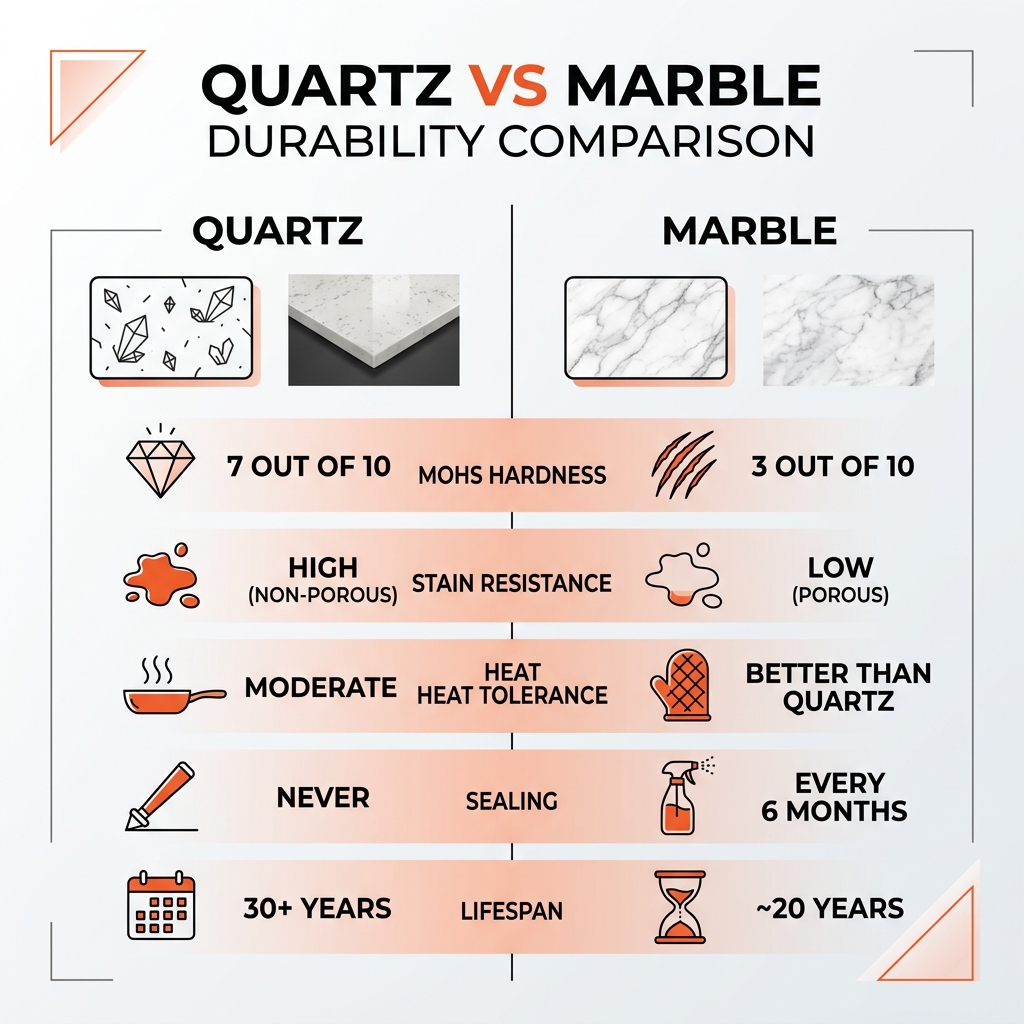
| Durability Factor | Quartz | Marble |
|---|---|---|
| Hardness (Mohs Scale) | 7 out of 10 | 3 out of 10 |
| Scratch Resistance | High | Low |
| Stain Resistance | High (non-porous) | Low (porous) |
| Etching from Acids | Resistant | Highly vulnerable |
| Heat Resistance | Moderate (up to ~300°F) | Better than quartz |
| Sealing Required | Never | Every 6 months |
| Expected Lifespan | 30+ years | ~20 years |
Quartz wins on almost every durability measure — except heat resistance, where marble has a slight edge.
That said, marble has been a prized countertop material for centuries, and for good reason. It’s stunning. Many homeowners still choose it knowing the trade-offs.
So the real question isn’t just which is more durable — it’s which is right for your kitchen or bathroom and how you actually live.
This guide breaks down every key durability factor so you can make a confident, informed choice.
Is Quartz More Durable Than Marble? A Hardness and Composition Comparison
When we talk about whether is quartz more durable than marble, we have to start with the “bones” of the material. Marble is a natural metamorphic rock, born from limestone that has been subjected to immense heat and pressure within the earth. Its primary component is calcite, which is a relatively soft mineral.
Quartz, on the other hand, is an engineered stone. While it contains about 90% to 93% natural quartz crystals (one of the hardest minerals on earth), those crystals are bound together with high-quality polymer resins and pigments. This “recipe” creates a surface that is structurally different from a slab pulled straight from a quarry.
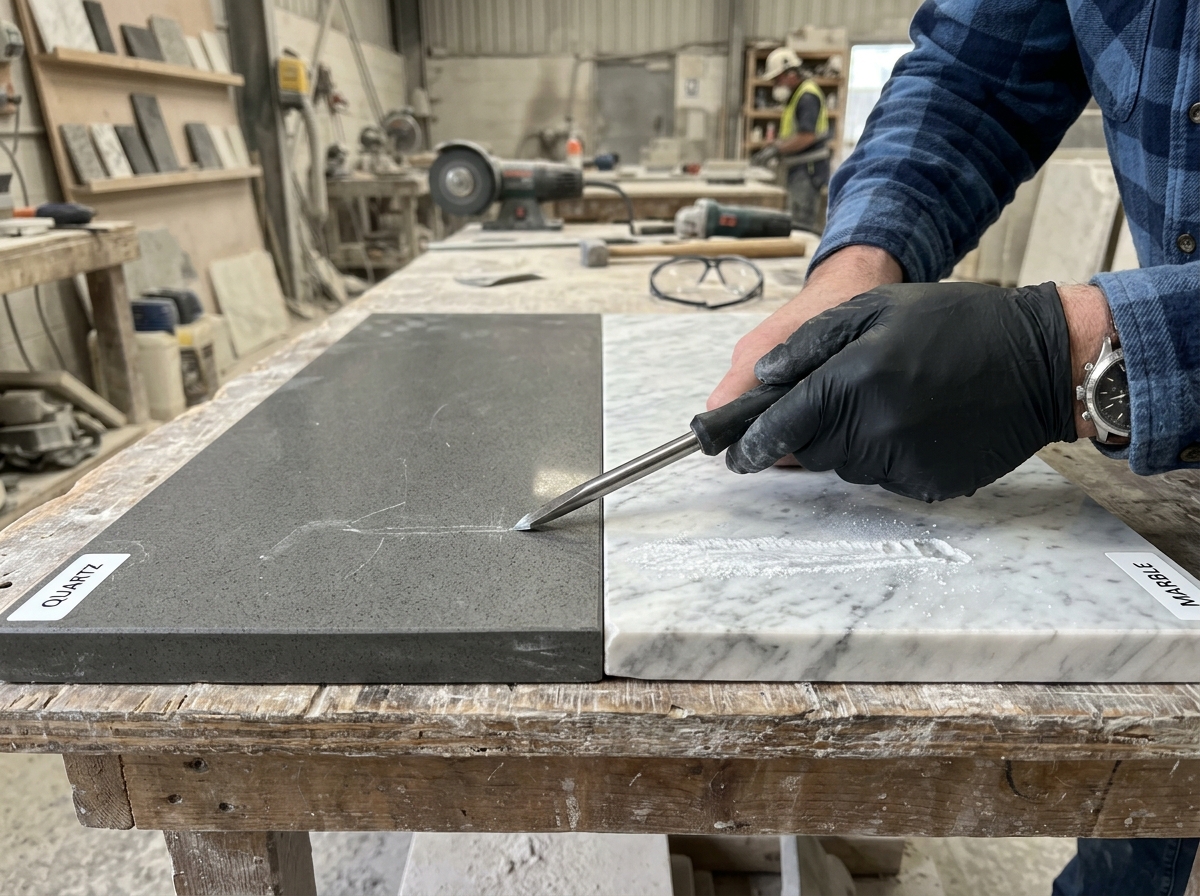
The most objective way to measure this is the Mohs Scale of Mineral Hardness. This scale ranks minerals from 1 (softest, like talc) to 10 (hardest, like diamond).
- Quartz rates a 7. This makes it harder than a steel knife blade.
- Marble rates a 3. This makes it softer than a copper penny.
Because of this massive gap in scientific hardness ratings for quartz and marble, marble is significantly more susceptible to scratches and “stunning.” A “stun mark” happens when a heavy object is dropped on marble, creating a white, cloudy bruise within the stone that cannot be wiped away. Quartz’s engineered composition makes it much tougher to bruise or scratch during the chaos of daily life.
Why is quartz more durable than marble in high-traffic kitchens?
In a busy Chicago kitchen—where grocery bags are dragged across the island and heavy cast-iron pans are moved from the stove to the counter—impact resistance is everything. The resin binders used in quartz give the slab a tiny bit of “flex” that natural stone lacks. This makes quartz less brittle and more resistant to chipping or cracking if a heavy pot slips from your hand.
Furthermore, the uniform nature of quartz means there are no hidden fissures or weak points, which can sometimes occur in natural marble slabs. For families with kids who love to “help” in the kitchen, these 4-advantages-of-quartz-countertops provide peace of mind that the investment won’t be ruined by a dropped juice glass or a sliding appliance. When asking Quartz vs. Marble Kitchen Countertops: Which Is Better?, the answer usually comes down to how much “living” happens on your counters.
When is quartz more durable than marble for bathroom vanities?
Bathrooms present a different set of durability challenges: moisture, humidity, and chemical exposure. Marble is a “thirsty” stone; its porous nature means it can soak up water, leading to discoloration or the growth of mold within the stone if not perfectly sealed.
Quartz is essentially waterproof. It stands up better to the “chemical warfare” of a bathroom—think of spilled nail polish remover, toothpaste, or harsh soap scum. While marble can be etched (dull spots caused by chemical reactions) by some hair products or acidic cleaners, quartz remains unfazed. This makes the quartz-countertops-vs-marble-countertops-kitchen-showdown equally relevant in the master bath, where quartz often wins for its sheer resilience against staining agents.
Porosity and Stain Resistance: The Non-Porous Advantage
One of the biggest headaches for marble owners is porosity. Because marble is a natural stone, it contains millions of tiny microscopic pores. If you spill red wine or drop a slice of lemon on an unsealed marble surface, the liquid travels down into those pores.
| Feature | Quartz | Marble |
|---|---|---|
| Porosity | Non-porous (Engineered) | Highly Porous (Natural) |
| Liquid Absorption | Near Zero | High |
| Acid Sensitivity | None | High (Etching) |
| Bacteria Resistance | Excellent | Requires Sealing to be Hygienic |
This leads to two problems: staining and etching. Staining is when the color of the liquid (like wine) stays in the stone. Etching is a chemical reaction where the acid in things like lemon juice or vinegar actually eats away at the calcium carbonate in the marble, leaving a dull, matte spot.
Quartz is non-porous. The resins fill every possible gap between the quartz crystals, creating a surface that liquids simply cannot penetrate. This makes quartz much more hygienic, as it doesn’t provide a home for bacteria or viruses to hide. Knowing how-to-clean-quartz-countertops is easy because you don’t have to worry about the surface “drinking” your cleaning solution.
Heat Resistance and Structural Integrity
If there is one area where marble puts up a fight, it is heat. Because marble was formed in the literal “oven” of the earth, it has a very high tolerance for heat. You can generally set a hot pot on marble without the stone melting (though we still don’t recommend it due to the risk of thermal shock).
Quartz has a “kryptonite,” and that is extreme heat. Because quartz slabs are held together by polymer resins (essentially a type of plastic), they can be damaged by temperatures exceeding 300 degrees Fahrenheit. If you take a pan directly from a 450-degree oven and set it on quartz, you risk melting the resin and leaving a permanent scorch mark.
However, in terms of structural integrity, quartz is often more flexible. Natural stone can be brittle; if a house settles or if the cabinets aren’t perfectly level, marble is more likely to develop a stress crack. The resin in quartz provides a level of structural flexibility that helps prevent these types of cracks over time. As noted in Marble Vs. Quartz: Which is Better?, the “best” material often depends on whether you’re more likely to drop a pot (choose quartz) or forget a trivet (choose marble).
Long-Term Maintenance and Lifespan Requirements
Durability isn’t just about what happens today; it’s about how the material looks in ten or twenty years. This is where the maintenance requirements truly separate the two.
Marble is a high-maintenance relationship. To keep it looking its best, you generally need to apply a professional-grade sealer every 6 to 12 months. Without this, the stone is wide open to damage. Even with the best 4-essential-marble-countertop-maintenance-tips, marble will eventually develop a “patina”—a collection of small scratches and etch marks that change the look of the stone over time. Some people love this aged, European look; others find it frustrating.
Quartz is the “set it and forget it” option. It never needs to be sealed. Its appearance on day one is exactly how it will look in year thirty. Because of this, quartz typically has a longer expected lifespan in a functional home—often 30 years or more—compared to marble’s average of 20 years before it might need significant restoration or replacement. Staying on top of countertop-maintenance is simply much easier when the material is doing half the work for you.
Frequently Asked Questions About Stone Durability
Does quartz chip easier than marble?
No. In fact, quartz is much more chip-resistant. Because marble is a natural, brittle stone with internal fissures, it is much more likely to chip if hit on the edge with a heavy object like a vacuum cleaner or a large pot. Quartz’s resin binders act like a glue that holds the structure together under impact.
Can you put hot pans directly on quartz?
We strongly advise against it. While quartz is “heat resistant,” it is not “heat proof.” The resins can discolor or melt at high temperatures. Always use a trivet or hot pad to protect your investment. Marble handles heat better, but even then, thermal shock (a rapid change in temperature) can cause any stone to crack.
How often does marble really need to be sealed?
For a high-use kitchen in the Chicago area, we recommend sealing marble every 6 months. For a guest bathroom that doesn’t see much action, you might get away with once a year. A good test is the “water drop test”: drop a bit of water on the counter; if it beads up, the sealer is working. If it soaks in and darkens the stone, it’s time to reseal.
Conclusion
When we look at the facts, the answer to is quartz more durable than marble is a clear yes. Quartz offers superior hardness, better stain resistance, and significantly lower maintenance requirements. It is built to withstand the rigors of a modern, busy household without requiring the constant “TLC” that marble demands.
However, at Global Stone Inc., we know that durability isn’t the only factor. Some homeowners in Naperville or Elk Grove Village simply fall in love with the timeless, one-of-a-kind veining of a natural marble slab, and they are happy to perform the maintenance to keep it beautiful.
Whether you choose the “durability champion” in quartz or the “timeless beauty” of marble, we are here to help. With over 20 years of experience serving the Chicago area, our in-house designers and fabricators ensure your countertops are installed to the highest standards. Plus, we offer a lifetime warranty to give you total peace of mind.
Ready to see the materials in person? Explore our marble countertop options or visit our Elk Grove Village facility to find the perfect fit for your home.