Detailed Guide to Bathroom Countertops
Why Choosing the Right Bathroom Countertops Matters More Than You Think
Choosing the right bathroom countertops is one of the most important decisions in any renovation — and one of the most overwhelming.
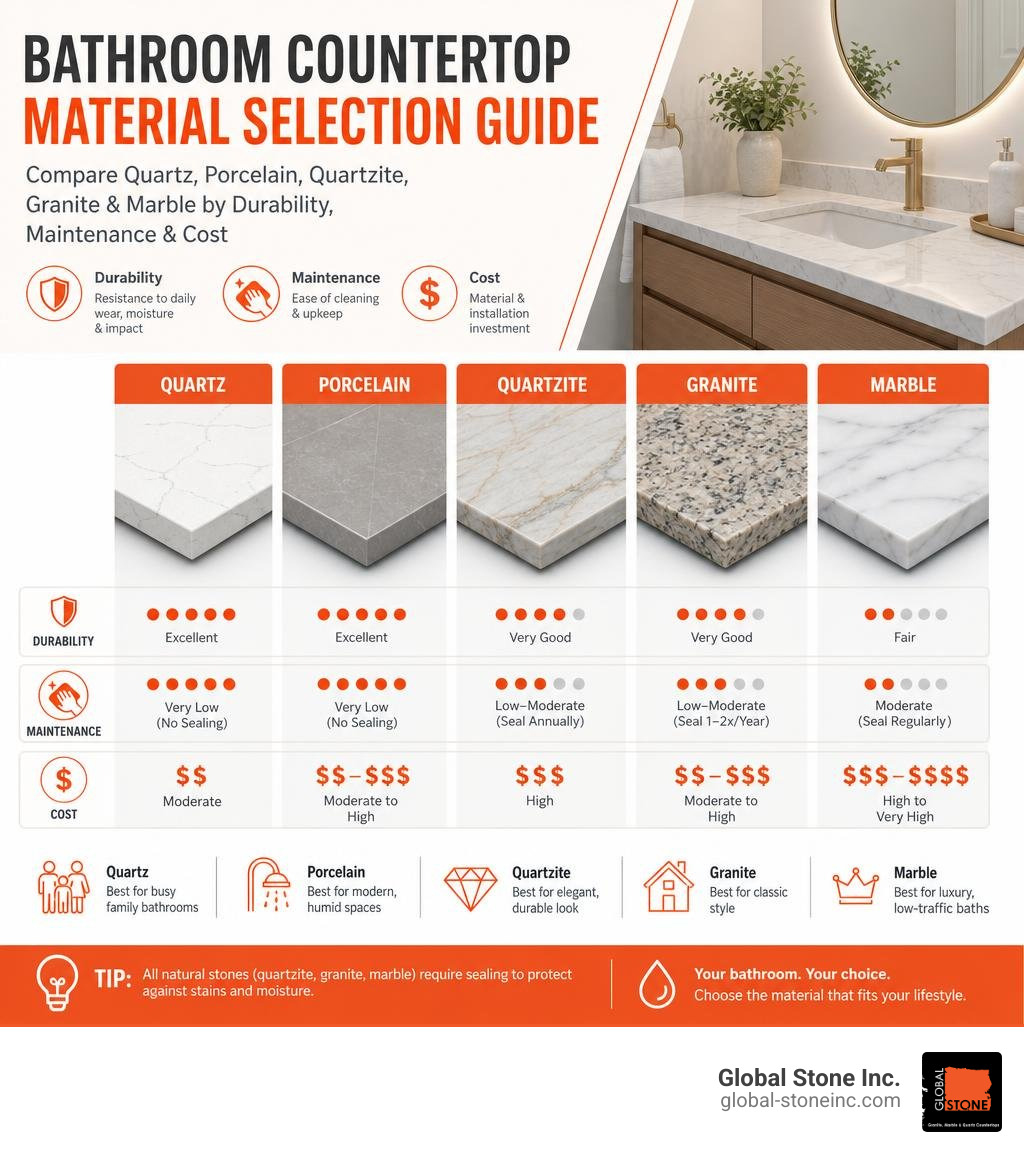
Quick answer: The best bathroom countertop materials in 2026 are:
| Material | Best For | Maintenance | Sealing Required |
|---|---|---|---|
| Quartz | Busy family bathrooms | Very low | No |
| Porcelain | Modern, humid spaces | Very low | No |
| Quartzite | Elegant, durable look | Low–moderate | Yes, annually |
| Granite | Classic style | Low–moderate | Yes, 1–2x/year |
| Marble | Luxury, low-traffic baths | Moderate | Yes, regularly |
Your bathroom is the most moisture-heavy room in the house. Countertops face steam, standing water, hair dye, nail polish remover, and daily cleaning products — every single day.
The wrong material can stain, crack, or degrade within years. The right one can last decades with minimal effort.
Quartz is currently the most popular choice, making up roughly 62% of all bathroom vanity top sales in the U.S. — and for good reason. But it isn’t the right fit for every bathroom or design style.
This guide breaks down every major material, what it costs, how it performs, and how to choose the one that fits your home and lifestyle.
I’m Greg Zamarski, founder of Global Stone Inc., with over 20 years of experience fabricating and installing bathroom countertops in the Chicago area. In that time, I’ve helped thousands of homeowners find the right stone for their space — and I’ll share everything I’ve learned here.
Bathroom countertops terms to remember:
Key Factors to Consider When Choosing Bathroom Countertops
Unlike kitchen counters that primarily face knives and hot pans, bathroom surfaces live in a unique, humid ecosystem. When evaluating different materials for your vanity, we recommend looking beyond mere cosmetics.
Here are the key factors we tell our Chicago clients to keep in mind:
- Moisture and Steam Resistance: High humidity and splashing water are constants. Porous materials will absorb moisture over time, leading to warping, discoloration, or mold growth.
- Chemical and Stain Exposure: Think about what actually lands on your vanity. Toothpaste, hairspray, makeup, nail polish remover (acetone), and harsh bathroom cleaners can easily etch or stain delicate stones.
- Heat Tolerance: If you use curling irons, flat irons, or hair dryers, your surface needs to handle localized high heat. Some engineered materials can scorch or crack under extreme thermal shock.
- Traffic and Usage Patterns: Is this vanity going into a high-traffic kids’ bathroom where toothpaste spills will sit for hours? Or is it a powder room meant to impress guests? For high-use areas, prioritize low-maintenance durability. For a master ensuite, you can lean into luxury stones.
To help you narrow down your aesthetic preferences alongside these practical considerations, check out our 5 Tips for Choosing Bathroom Countertops That Radiate Style.
Comparing the Top Bathroom Countertop Materials
To help you visualize how the leading materials stack up, we have compiled a direct comparison of the top four options we fabricate and install:
| Feature | Quartz | Quartzite | Porcelain | Granite |
|---|---|---|---|---|
| Composition | Engineered stone & resin | 100% Natural sandstone | Kiln-fired clay & minerals | Natural igneous rock |
| Durability | High | Extremely High | Extremely High | High |
| Moisture Protection | Excellent (Non-porous) | Good (Porous) | Excellent (Non-porous) | Very Good (Porous) |
| Sealing Required | Never | Yes (Annually) | Never | Yes (1–2x per year) |
| Heat Resistance | Moderate (Up to 300°F) | Excellent | Outstanding | Outstanding |
| Average Installed Cost | $55 – $175 / sq. ft. | $75 – $250 / sq. ft. | $55 – $150 / sq. ft. | $50 – $200 / sq. ft. |
Quartz: The Low-Maintenance Favorite for Bathroom Countertops
Engineered quartz is the undisputed heavyweight champion of the modern bathroom. It is manufactured by combining roughly 90% to 94% crushed natural quartz minerals with polymer resins and pigments.
Because it is engineered, quartz is completely non-porous. This means it rejects moisture, blocks bacteria, and resists stains without ever needing a drop of sealer. It is the ultimate “set it and forget it” option for busy family bathrooms.
However, because of the resin binders, quartz has a lower heat tolerance than natural stone. Leaving a blazing-hot flat iron directly on the surface can cause permanent discoloration.
If you want to dive deeper into why this material dominates the market, read our guide on why Built to Last: Why Your Next Bathroom Counter Should Be Quartz.
Quartzite: Natural Elegance and Strength
Do not confuse quartz with quartzite. Quartzite is a 100% natural metamorphic stone that began its life as sandstone. Under intense heat and pressure deep within the earth, it recrystallizes into one of the hardest natural stones available.
Quartzite is highly prized because it offers the soft, elegant veining of marble but with far superior scratch and etch resistance. It handles heat beautifully, making it perfect for primary master suites.
Because it is a natural stone, quartzite is slightly porous. It requires periodic sealing (typically once a year) to maintain its stellar moisture and stain protection.
Porcelain Slabs: Modern and Indestructible
Porcelain slab countertops are rapidly growing in popularity across the Chicago area. Made from clay fired at incredibly high temperatures, these large-format slabs are virtually indestructible.
Porcelain is entirely non-porous, meaning it stands up to bathroom humidity, steam showers, and soaking tubs better than almost any other material. It is also completely UV-resistant and highly chemically inert — even spilled nail polish remover won’t dull its finish.
One of porcelain’s coolest design tricks is its ability to be fabricated into ultra-thin profiles for a sleek, modern look. It also allows for gorgeous integrated sinks, where the countertop material seamlessly flows directly down into the sink basin.
Granite: Classic Durability
Granite is a classic natural stone that remains a staple of high-end home design. Formed from cooled magma, it is incredibly dense, hard, and heat-resistant.
Every single granite slab is a unique piece of natural art. If you love deep, complex patterns, shimmering mineral flecks, and rich earthy tones, granite is hard to beat. It shrugs off hot styling tools without a sweat.
To keep granite looking pristine, it does require periodic sealing — usually once or twice a year for lighter colors, and every couple of years for darker varieties.
Sizing, Design Trends, and Care for Bathroom Surfaces
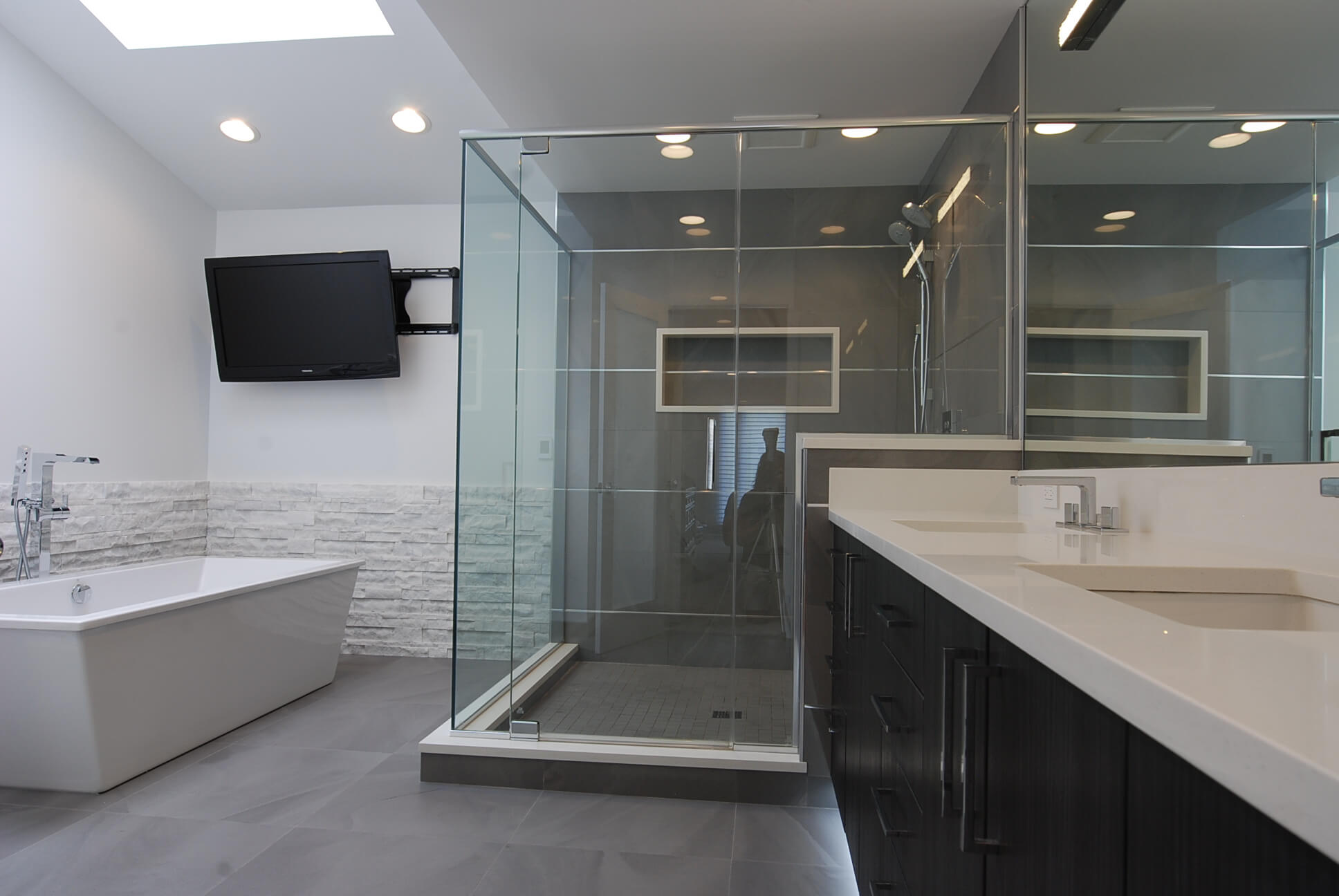
Selecting your material is only half the battle. To ensure your new bathroom countertops look and function beautifully for years, you need to understand how they integrate into your overall bathroom design, how they are sized, and how to care for them.
If you are planning a full remodel, we always recommend securing professional Bathroom Countertop Installation to protect your investment.
Popular Aesthetics and Finishes for Bathroom Countertops
Bathroom design trends have shifted away from stark, sterile whites toward warmer, more organic atmospheres. Here are the trends we are seeing dominate in 2026:
- Matte and Honed Finishes: While highly polished stone is still popular, honed (matte) and leathered finishes are taking over. These velvety textures are incredible at hiding water spots, dried soap residue, and fingerprints.
- Warm Neutrals: Soft beiges, creamy off-whites, and warm greys are replacing cold, blue-toned greys to create a calming, spa-like environment.
- Integrated Sinks and Seamless Designs: Eliminating the seam between the sink and the countertop removes a notorious hiding spot for mold and grime, creating an ultra-clean, minimalist look.
- Waterfall Edges: Once reserved exclusively for kitchen islands, waterfall edges — where the countertop material drops vertically down the side of the vanity cabinet — are making a dramatic entrance into modern master bathrooms.
Sizing and Installation Considerations
Bathrooms present tighter spaces and more challenging plumbing configurations than kitchens. A minor measurement error that might go unnoticed in a large kitchen can cause a massive headache on a compact vanity.
That is why we use digital laser templating for every project. This ensures that we cut your stone with sub-millimeter precision, accounting for walls that aren’t perfectly square and plumbing pipes that require exact alignments.
Whether you are working with a compact powder room or a sprawling double vanity, we can craft custom solutions. If you are dealing with awkward dimensions, read our guide on 59-Inch Bathroom Countertop Solutions: From Custom Cuts to Trimming Down.
For standard sizing, you will want to choose your stone layout carefully:
- Single vs. Double Sinks: Smaller vanities (usually under 48 inches) are ideal for single-sink setups. Larger vanities (60 to 72 inches and up) easily accommodate double sinks.
- Pre-cut vs. Custom Fabricated: Budget-friendly, mass-produced options like the TOLKEN countertop, white marble effect/foliated board, 67×211/2″ – IKEA or the TOLKEN countertop, gray stone effect/foliated board, 37×211/2″ – IKEA offer quick, lightweight solutions for DIY-friendly laundry rooms or guest baths. IKEA also offers options like the TOLKEN countertop, grey stone effect/foliated board, 162×49 cm – IKEA Norway , the TOLKEN countertop, marble effect, 62×49 cm – IKEA Ireland , and the bamboo-based ÅLSKEN countertop, bamboo/veneer, 102×49 cm – IKEA . However, these foliated and veneer boards lack the lifetime durability, heat resistance, and luxurious resale value of professional, custom-fabricated natural stone or engineered quartz.
- Faucet Hole Configurations: Always confirm your faucet style (single-hole, 4-inch centerset, or 8-inch widespread) before fabrication so we can pre-drill the stone perfectly.
For detailed size-specific advice, read our comprehensive guides on the Countertop Chronicles: Choosing Your 54-Inch Bathroom Vanity Top and The Homeowner’s Guide to the 37 x 22 Bathroom Vanity Top.
Care and Maintenance for Long-Lasting Surfaces
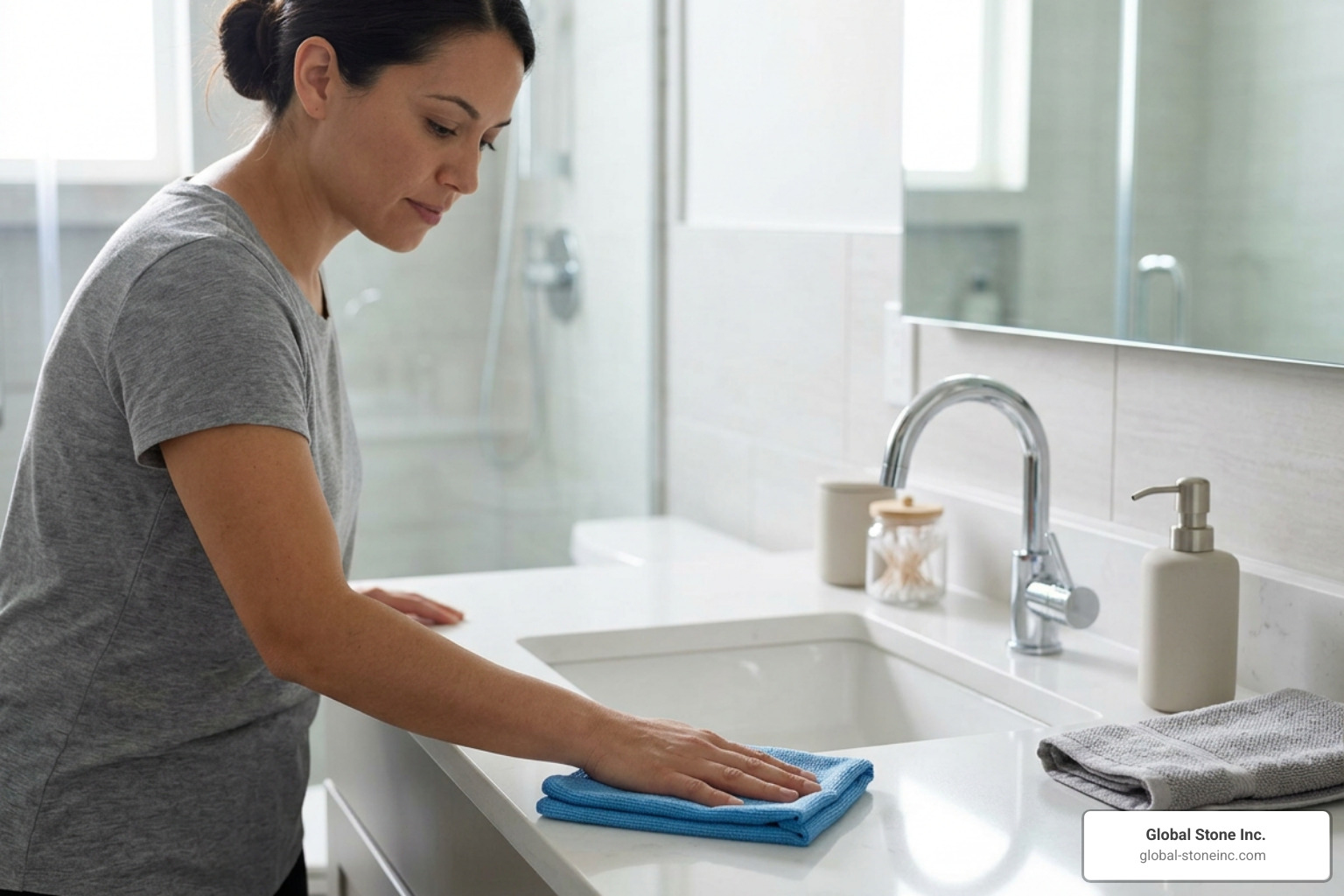
To keep your surfaces looking brand new, follow these simple best practices:
- Clean Daily with Mild Soap: Avoid abrasive scrubs, scouring pads, and harsh chemicals like bleach or tub-and-tile cleaners. A soft microfiber cloth, warm water, and a drop of gentle dish soap are all you need.
- Wipe Away Standing Water: Try to wipe up splashes around the faucet base daily to prevent hard water deposits from forming.
- Use Heat-Resistant Mats: Even if your stone is highly heat-resistant, using a silicone mat for curling irons protects the surface from thermal shock and keeps your warranty fully intact.
- Secure Your Top Properly: A shifting or unstable vanity top can crack caulking seams, leading to water leaks behind your cabinets. Learn how to prevent this with our guide to Stop the Wobble: How to Secure Your Bathroom Vanity Top.
Frequently Asked Questions About Bathroom Countertops
We hear a lot of the same questions from homeowners visiting our showrooms. Here are the facts you need to know.
What is the most durable material for a bathroom vanity?
Porcelain and quartzite are the hardest, most scratch-resistant materials available. However, when you factor in moisture resistance, stain resistance, and ease of maintenance, engineered quartz is widely considered the most practical and durable choice for busy family bathrooms because it never needs to be sealed.
Do natural stone bathroom countertops need to be sealed?
Yes. Natural stones like granite, marble, and quartzite are naturally porous. Without a high-quality sealer, they can absorb water, cosmetics, and oils, leading to stains or harbor bacteria. We recommend sealing natural stone once every 6 to 12 months for lighter stones, and every 1 to 2 years for darker, denser stones.
How do I choose the right size countertop for my vanity?
Start by measuring the exact width and depth of your vanity cabinet. Your countertop should typically have a 1/2-inch to 1-inch overhang on the front and any exposed sides. You also need to confirm your sink type (undermount, drop-in, or vessel) and faucet spacing before the stone is cut.
For compact spaces, check out our guide on How to Choose the Right 22-Inch Vanity Top.
Conclusion
Choosing the perfect bathroom countertops is all about balancing your personal design style with the practical needs of your household. Whether you fall in love with the zero-maintenance ease of quartz, the sleek modernism of porcelain, or the breathtaking natural beauty of quartzite and granite, investing in quality materials will elevate your home’s comfort and resale value.
At Global Stone Inc., we have spent over 20 years helping homeowners across the Chicago area bring their design dreams to life. Because we handle everything in-house — from design and fabrication to the final installation — we are proud to offer an industry-leading lifetime warranty on our craftsmanship.
If you want to compare materials in person, we invite you to visit our state-of-the-art showroom in Elk Grove Village, IL, or connect with our teams serving Naperville and Chicago. Seeing full-size slabs under natural light is the absolute best way to choose the perfect stone for your home.
To view our complete stone collection and schedule your free, in-home design consultation, visit the Global Stone Inc. Countertops main portal today!