
Best Epoxy for Soapstone: Don’t Let Your Kitchen Fall Apart
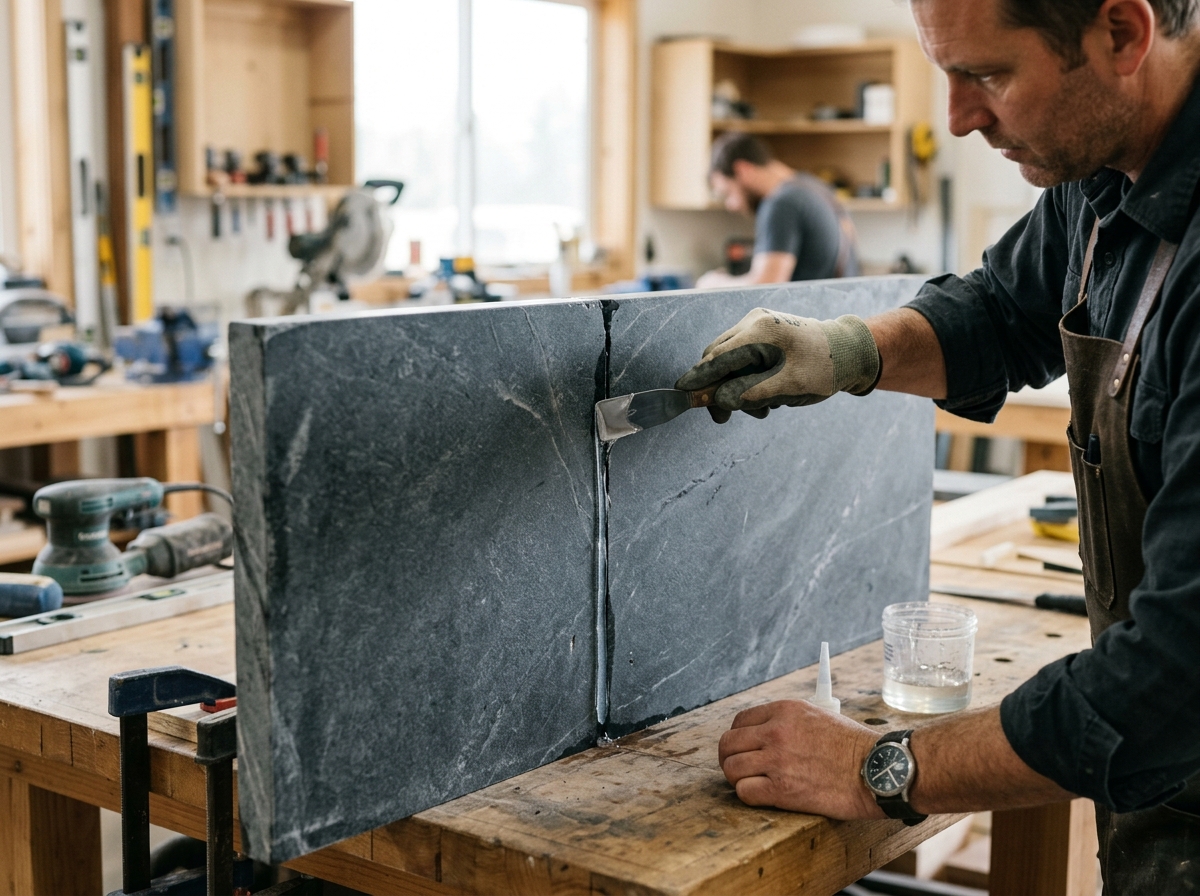
Why Soapstone Needs a Different Kind of Adhesive
The best epoxy for soapstone is not the same as what you’d use on granite or quartz — and using the wrong one can mean cracked seams, failed repairs, or a countertop that doesn’t hold up.
Here’s a quick answer to help you choose:
| Product | Best For | Mix Ratio | Handling Time |
|---|---|---|---|
| Multibond Soapstone (Tenax) | Seaming & bonding | 10:1 | 5-10 min de-rope |
| Infinity Seam Pearl 845 | Color-matched seams | 10:1 | 30 min |
| Touchstone Clear Gel Epoxy | Repairs & lamination | 2:1 | 2-3 hrs |
| Touchstone Penetrating Epoxy | Fissure strengthening | 2:1 | 6-8 hrs |
| Premium Soapstone FX Poxy | Surface transformation | Included | 36 hrs |
Soapstone is a metamorphic rock with a high talc content. That makes it softer and more machinable than granite — you can even cut it with woodworking tools. But that same softness means it needs an adhesive that bonds firmly without cracking the stone or leaving a visible seam.
It’s also naturally non-porous and highly heat resistant, which affects how adhesives cure and bond to its surface.
Choosing the right epoxy comes down to three things: what you’re doing (seaming, repairing, or strengthening), how fast you need it to set, and whether color matching matters.
I’m Greg Zamarski, founder of Global Stone Inc. and a stone fabrication expert with over 20 years of experience installing soapstone countertops in the Chicago area — and finding the best epoxy for soapstone is one of the most common questions I help homeowners answer. In the sections below, I’ll walk you through the top products and exactly how to use them.

Why You Need the Best Epoxy for Soapstone Projects
When we talk about soapstone countertops and why they are the goat of kitchen design, we often focus on their silky texture and incredible heat resistance. However, from a fabrication standpoint, soapstone is a unique beast. Because it is rich in talc, it is significantly softer than granite or quartz. This “machinability” is a double-edged sword: it’s easy to shape, but it requires an adhesive that respects its physical properties.
Using a generic hardware store glue on a soapstone countertop is a recipe for disaster. Soapstone has a different rate of thermal expansion than other stones. If your epoxy is too rigid or doesn’t bond deeply, the seam can pop when you place a hot pot near it. Furthermore, because soapstone is non-porous, the epoxy must rely on a superior chemical bond rather than soaking into the stone like it might with a porous marble.
For natural stone countertops, structural integrity is everything—especially when supporting heavy undermount sinks. We’ve seen DIY projects fail because the adhesive couldn’t handle the weight or the vibration of a garbage disposal. The best epoxy for soapstone ensures that structural fissures are reinforced and that seams remain tight for the life of the kitchen.

Top Rated Products: Finding the Best Epoxy for Soapstone
In our Elk Grove Village facility, we’ve tested dozens of formulations. For soapstone, we generally look at two categories: traditional epoxies and modern Methacrylate adhesives (MMA). MMAs, like Multibond and Infinity Seam, have become industry favorites because they offer incredible strength with much faster cure times than old-school resins.
The Heavy Hitters: MMA Adhesives
If you are looking for the absolute best epoxy for soapstone seaming, methacrylate adhesives are the gold standard.
- Multibond Soapstone: This is a 10:1 ratio system that is famous for its “de-roping” time. Within 5-10 minutes, the excess glue reaches a rubbery state where it can be sliced off cleanly with a razor, saving hours of sanding. It achieves nearly 90% of its ultimate strength in just minutes.
- Infinity Seam Pearl 845: Specifically designed for green and dark soapstone, this product uses Exact Color Match Technology (ECMT). It accounts for how light refracts through the stone, ensuring the seam disappears. It offers a 30-minute handling strength, which is perfect for installs.
Professional Grade Epoxies
For repairs and lamination, traditional epoxies still hold their ground:
- Bonstone Touchstone Clear Gel Knife Grade Epoxy: This has a “Vaseline-like” consistency. It won’t sag on vertical surfaces, making it the best epoxy for soapstone edge laminations.
- Touchstone Clear Epoxy Resin: A versatile 2:1 ratio resin that is UV stable and non-yellowing. This is crucial if your kitchen gets a lot of Chicago sunlight, as cheaper epoxies will turn an ugly amber color over time.
Best Epoxy for Soapstone Seams and Joints
When seaming two slabs, you need a “dripless” or “non-sag” variant. Products like Stone Coat Countertop Epoxy are fantastic for surface coats, but for the actual joinery, we prefer cartridge-based systems. These use a mixing nozzle that ensures the 10:1 or 2:1 ratio is perfect every time. This eliminates the “human error” of manual mixing, which often leads to sticky, uncured seams. Our services team relies on these cartridges to ensure that every install meets our lifetime warranty standards.
Best Epoxy for Soapstone Repairs and Strengthening
Sometimes, a slab arrives with a natural fissure or a “dry” vein that needs reinforcement.
- Penetrating Epoxy | Bonstone Materials: This water-thin liquid “wicks” into microscopic cracks. It can increase the stone’s strength by up to 40%, acting as an invisible insurance policy against future cracks.
- Chip Repair: For small chips, a knife-grade gel mixed with a bit of stone dust is the way to go. If you are dealing with a major surface overhaul, the Premium Soapstone FX Poxy Countertop Kit provides a scratch resistance of 15,000 psi—that’s five times stronger than concrete! This is an excellent option for those looking to repair or even create a “faux” soapstone look over existing damaged surfaces. Proper countertop-maintenance starts with using the right materials during the repair phase.
Professional Application Techniques for Soapstone Adhesives
Applying the best epoxy for soapstone requires more than just “gluing and sticking.” Here is the professional workflow we use at Global Stone Inc.
- Surface Prep is King: Never use acetone on soapstone before gluing; it can leave a residue that interferes with the bond. Instead, use 91% isopropyl alcohol. Scrub the edges where the epoxy will be applied to remove any talc dust or oils.
- Temperature Control: Epoxy is finicky about weather. Ideally, your workspace should be between 65°F and 85°F. If it’s too cold (common in Chicago winters!), the epoxy will take forever to cure. If it’s too hot, it might “flash cure” and become brittle.
- Tooling: Since soapstone is soft, you can use high-quality woodworking tools. However, always use carbide-tipped router bits. When working with countertops, we recommend a slow feed rate to prevent the stone from chipping.
- Avoid Over-Clamping: A common mistake is tightening the clamps so hard that all the glue is squeezed out. This creates a “starved joint” which is prone to failure. You want a thin, consistent line of epoxy, not a dry one.
- The Sealing Debate: Should you use epoxy or mineral oil to seal? Soapstone is non-porous, so it doesn’t need a sealer for protection. Mineral oil is used to darken the stone for aesthetics. However, if you want a permanent dark look without the maintenance of oiling, some penetrating epoxies can provide a “wet look” finish that never fades.
Frequently Asked Questions about Soapstone Epoxy
Can I use regular woodworking tools with soapstone and epoxy?
Yes! This is one of the reasons we love natural stone countertops like soapstone. You can use a standard circular saw with a diamond blade or even a router with carbide-tipped bits to clean up an epoxy seam. The trick is to wait until the epoxy is fully cured (usually 24 hours for traditional resins, or 30-60 minutes for MMAs). Once cured, you can sand the epoxy flush with the stone using 400-grit sandpaper to achieve that signature honed soapstone finish.
Is epoxy better than mineral oil for sealing soapstone?
They serve different purposes. Mineral oil is a temporary topical treatment that darkens the stone. Epoxy, specifically penetrating resins, is a permanent structural enhancement. If you are repairing a crack, epoxy is the only choice. For general maintenance, we usually recommend mineral oil or specialized waxes, as they are food-safe and maintain the stone’s natural feel. However, always ensure your chosen epoxy is FDA-compliant for food contact if it’s used on the surface. Check our guide on countertop-maintenance for more details.
How do I achieve a seamless color match?
The secret is in the “activator.” Modern systems like Infinity Seam pigment the activator side of the cartridge. This allows you to see the color immediately and ensures 100% catalysis. For soapstone, you usually want a “Translucent Green” or “Charcoal” tint. Because soapstone darkens when oiled, we always recommend matching the epoxy to a wet sample of the stone. This ensures that when you eventually oil your counters, the seam doesn’t stand out as a light grey line.
Conclusion
At Global Stone Inc., we’ve spent over 20 years perfecting the art of stone fabrication in the Chicago area. Whether you are visiting our Elk Grove Village facility or having us install a custom piece in your Naperville home, we know that the “little things”—like using the best epoxy for soapstone—make the difference between a kitchen that lasts five years and one that lasts a lifetime.
Soapstone is a magnificent, durable, and “goat-level” material, but it demands the right chemistry to stay together. Don’t settle for “all-purpose” adhesives. Use the professional-grade MMAs and epoxies that the experts use.
Ready to upgrade your kitchen with the timeless beauty of soapstone? Explore Soapstone Countertop Options with our design team today and see why we are Chicago’s trusted name in natural stone.