
Quick Start Guide to Countertop Installation Quotes
What You Need to Know About Countertop Installation Before Getting a Quote
Countertop installation is one of the highest-impact upgrades you can make to a kitchen or bathroom — and getting it right starts with understanding the process before anyone picks up a measuring tape.
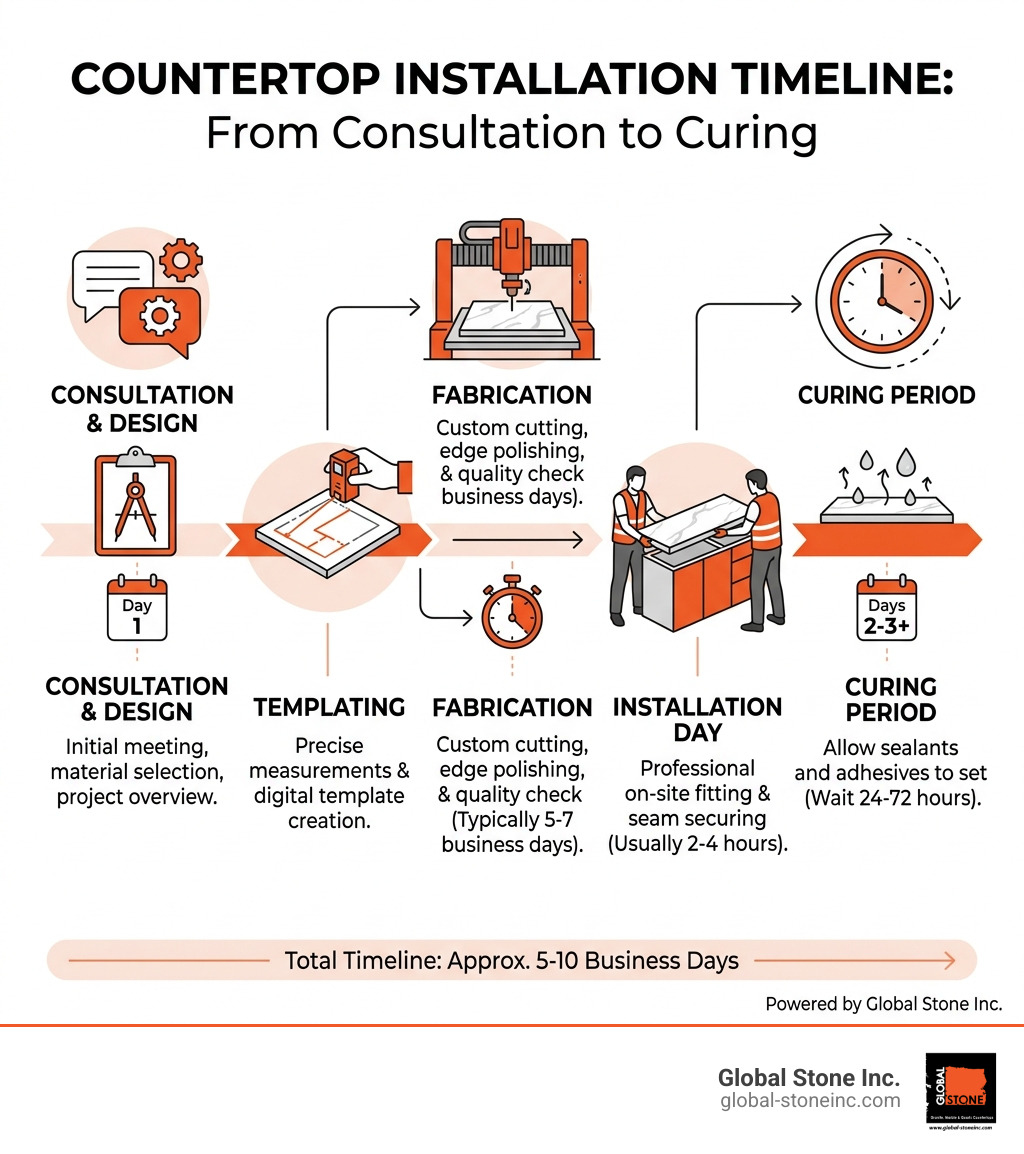
Here’s a quick overview of what countertop installation involves:
- Choose your material — granite, quartz, marble, laminate, butcher block, or solid surface
- Get a measurement appointment — a pro templates your space for a precise fit
- Wait for fabrication — typically 5 to 7 business days after templating
- Installation day — on-site install usually takes 2 to 4 hours for an average kitchen
- Curing period — wait 24 to 72 hours before full use, depending on material
The total timeline from first consultation to finished countertop runs about 5 to 10 business days for most projects.
Costs vary widely by material and complexity. Professional installation averages $200 to $500 per linear foot, while DIY materials alone run $150 to $350 per linear foot — though the savings come with real risks if you’re working with heavy stone slabs.
This guide walks you through everything: material choices, measuring, prep, the installation process itself, and how to maintain your new surface for years to come.
I’m Greg Zamarski, and I’ve been fabricating and installing granite, marble, and quartz countertops at Global Stone Inc. since 2004 — with over 20 years of hands-on countertop installation experience across hundreds of kitchens and bathrooms in the Chicago area. Whether you’re planning your first renovation or your fifth, this guide will help you ask the right questions and avoid costly mistakes.
Choosing the Right Material for Your Countertop Installation
Selecting the right material is the most significant decision in your renovation journey. In the April 2026 market, homeowners are increasingly leaning toward materials that offer a blend of aesthetic “wow factor” and long-term durability.
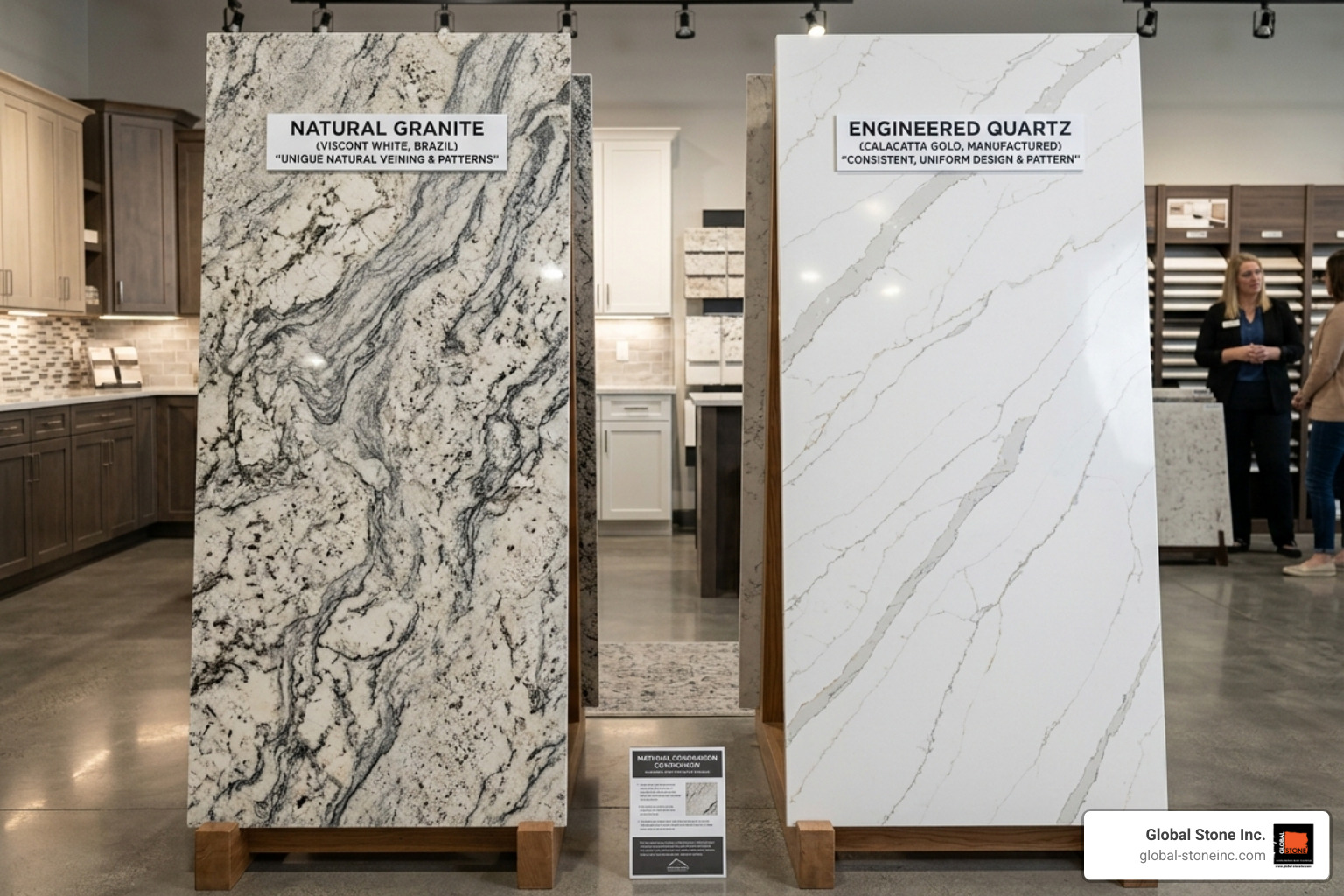
At Global Stone Inc., we see a constant tug-of-war between natural stone and engineered surfaces. Engineered quartz has surged in popularity because it is non-porous and virtually maintenance-free. It consists of roughly 90–95% natural quartz crystals bound by resins. On the other hand, natural granite remains a timeless favorite for its unique patterns, though it is slightly porous and requires annual sealing to prevent staining.
For those looking for a warmer, more organic feel, butcher block is a fantastic choice, though it requires a 72-hour acclimation period in your home before installation to prevent warping. If budget is the primary driver, laminate offers the most affordability, while solid surface materials (like Corian) provide the benefit of being repairable; scratches can often be sanded out by a professional.
To help you decide, we’ve put together a quick comparison of the most common materials we handle in the Chicago area:
| Material | Avg. Cost (Installed/sq ft) | Maintenance | Weight (per sq ft) |
|---|---|---|---|
| Quartz | $70 – $120+ | Low (No sealing) | 25 lbs |
| Granite | $50 – $150 | Moderate (Annual seal) | 20 – 25 lbs |
| Marble | $80 – $150+ | High (Prone to etching) | 20 – 25 lbs |
| Laminate | $15 – $40 | Low | 5 lbs |
| Butcher Block | $40 – $100 | High (Oiling/Sealing) | 10 – 15 lbs |
For a deeper dive into engineered stone, check out this Quartz Countertop Installation: Step-By-Step Guide.
Factors Influencing Countertop Installation Costs
When you receive a quote for countertop installation, the price isn’t just about the stone itself. Several variables can shift the final number:
- Linear Footage and Layout: The total area is the baseline, but “L” or “U” shaped kitchens require more complex cuts and seaming.
- Edge Profiles: A standard “eased” edge is typically included, but premium profiles like Ogee or Bullnose add labor time and cost.
- Material Tiers: Most fabricators group stones into “levels” or “tiers.” Level 1 might be a common granite like Uba Tuba, while Level 5 could be a rare exotic quartzite.
- Fabrication Complexity: Items like undermount sink cutouts, cooktop holes, and faucet drillings are usually priced per item.
- Zip Code Logistics: In a high-traffic area like downtown Chicago, parking permits and elevator access can add “logistics fees” compared to a driveway access in Elk Grove Village.
For more details on local pricing, see our Countertop Installation Near Me Guide.
Comparing DIY Materials vs. Professional Service Fees
It is tempting to look at the 20-30% cost savings of a DIY project and think, “I can do that.” However, the risks often outweigh the rewards when dealing with heavy stone. A single standard quartz slab can weigh between 300 and 600 pounds.
Professional fees (averaging $200-500 per linear foot) include more than just muscle. They cover:
- Specialty Tools: Digital templating lasers and diamond-tipped wet saws can cost thousands.
- Labor Warranties: If a pro breaks a slab during install, they replace it. If you break it, you’re out of luck.
- Precision: Professionals ensure seams are 1/16 of an inch or less and color-matched perfectly.
Essential Steps for Planning and Measuring
The secret to a flawless countertop installation isn’t what happens on install day—it’s what happens during the measurement phase. We use digital laser templating to create a “map” of your cabinets that is accurate to within a fraction of a millimeter.
Before we arrive to template, your cabinets must be permanently installed and secured. We follow the industry standard: cabinets must be within 1/4-inch of level across the entire run. If they aren’t, the stone (which does not bend) will be under constant stress, leading to cracks later on.
During this phase, we also look for:
- Wall Scribing: Walls are rarely perfectly straight. We “scribe” the back of the countertop to follow the curves of your drywall.
- Appliance Specs: We need the make and model of your stove, dishwasher, and fridge to ensure proper clearances.
- Sink Templates: If you’ve purchased a new sink, we need the physical unit or the manufacturer’s template to ensure the cutout is perfect.
Learn more about our process in our guide on How to Measure Countertops.
Preparing Your Space for Professional Countertop Installation
To ensure a smooth day for our crew and a safe environment for your family, a little prep goes a long way.
- Clear the Decks: Remove everything from your existing countertops. We also recommend emptying top drawers, as dust can find its way inside during the removal of old surfaces.
- Disconnect Plumbing: A licensed plumber should disconnect your sink and gas lines before we arrive. If you’re doing a New Bathroom Sink Installation in Chicago, ensure the vanity is ready for the new top.
- Electrical: If you are moving outlets or adding a “waterfall” edge that covers existing sockets, have an electrician finish the rough-in before the stone arrives.
- Access and Safety: Clear a path from the driveway to the kitchen. Keep pets and small children in a separate area to avoid accidents with heavy slabs.
Support and Reinforcement for Large Overhangs
If your design includes a breakfast bar or a large island overhang, structural support is non-negotiable. A standard overhang is 1.5 inches beyond the cabinet face. Anything more requires help.
- Bracket Intervals: Support brackets should be installed at 16-inch intervals along the cabinet tops.
- Material Thickness: 2cm stone is thinner and lighter but requires more support (often a full plywood sub-top) compared to 3cm stone.
- Corbels and Steel: For overhangs exceeding 10-12 inches, we typically require corbels or hidden steel plates to prevent the stone from tipping or snapping under pressure.
Securing your surfaces is vital, especially in the bathroom. Check out our tips on how to Stop the Wobble: How to Secure Your Bathroom Vanity Top.
The Professional Countertop Installation Process
On the day of the countertop installation, our team arrives with the fabricated slabs. The process begins with the careful removal of your old surfaces. Once the base is clear, we perform a “dry-fit.” This means we place the slabs on the cabinets without adhesive to ensure every joint and wall-scribe is perfect.
Once satisfied, we apply silicone adhesive beads (spaced about 6-12 inches apart) to the cabinet frames. For the seams, we use a color-matched epoxy resin. We use specialized seam suction tools (vacuum seam setters) to pull the pieces together tightly while the epoxy cures.
For bathroom-specific projects, see our guide on Bathroom Countertop Installation. The curing process is critical; you should avoid putting weight on the counters or using the sink for at least 24 hours.
Handling Sink Cutouts and Appliance Integration
The most delicate part of the install involves the cutouts. For undermount sinks, we use heavy-duty undermount sink clips and a high-grade silicone seal to ensure the sink never pulls away from the stone.
For more on this, visit our Sinks Installation page.
When it comes to appliances, we take extra precautions:
- Cooktop Clearance: We ensure a 1/4-inch gap around cooktops to allow for the natural expansion of the appliance when heated.
- Heat Protection: For butcher block or laminate near dishwashers, we apply heat-conductive aluminum flashing or moisture barrier tape to the underside to prevent steam damage.
Finishing Touches and Post-Installation Care
After the stone is secured, we perform a final edge polishing to ensure every surface is smooth to the touch. We then clean the entire area with pH-neutral cleaners.
If you’ve chosen granite or marble, we apply a professional-grade sealer. For our customers in the Countertop Installation Elk Grove area, we recommend an annual “water drop test” to see if it’s time to reseal.
To keep your counters looking new:
- Avoid Thermal Shock: Never place a pot straight from the stove onto quartz or granite; always use a trivet.
- Scratch Management: While stone is hard, it is not diamond. Always use a cutting board.
- Buffing: Use a clean microfiber cloth to buff away fingerprints and keep the shine.
Frequently Asked Questions about Countertop Installation
How long does the typical installation take from start to finish?
The on-site countertop installation usually takes 2 to 4 hours for a standard kitchen. However, the “start to finish” timeline includes the 5 to 7 business days required for fabrication in our Elk Grove Village facility after we take the final templates.
Do I need to provide my own sink and faucet for the installers?
Most homeowners prefer to choose their own fixtures to match their style. We just need the physical fixtures (or their exact specs) at the time of templating to ensure the holes are drilled correctly. We handle the mounting of the sink to the stone, but a plumber is required for the final pipe hookups. You can find more info at Countertop Installation Near Me.
What is the industry standard for cabinet leveling before installation?
The industry standard is a variance of no more than 1/4-inch across the entire installation area. Our installers use high-quality shims to correct minor dips, but the cabinets must be structurally sound and “coplanar” (sitting on the same flat plane) to support the weight of the stone.
Conclusion
At Global Stone Inc., we believe that a great countertop installation is the heart of a successful home remodel. With our Elk Grove Village facility, over 20 years of experience serving the Chicago, Naperville, and Elk Grove areas, and our unique lifetime warranty, we take the stress out of the process.
Because we use our own in-house designers, fabricators, and installers, we maintain total control over the quality of your project from the first slab selection to the final polish.
Ready to transform your space? Get a Quote for Your Countertop Installation today and let us help you build the kitchen or bathroom of your dreams!