Why Artificial Marble Countertops are the Smart Choice for Your Home
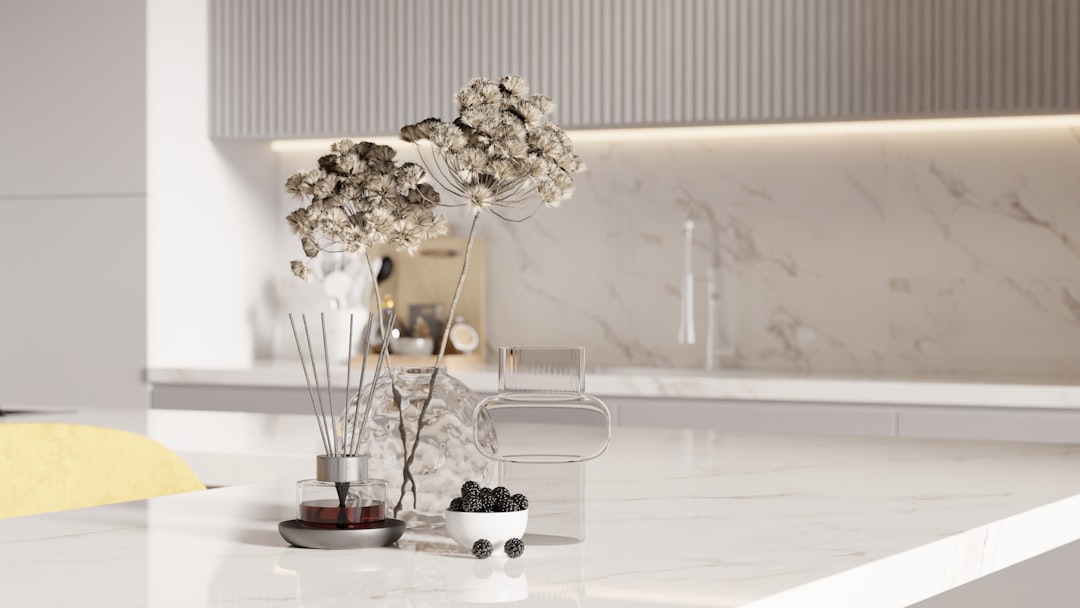
Why an Artificial Marble Countertop Might Be the Smartest Upgrade You Make This Year
An artificial marble countertop gives you the elegant look of natural stone — without the high cost or demanding upkeep that usually comes with it.
Quick answer: What is an artificial marble countertop?
| Feature | Details |
|---|---|
| What it is | An engineered surface made from marble dust or quartz particles mixed with resin and pigments |
| Also called | Cultured marble, engineered marble, synthetic marble, faux marble |
| Main uses | Bathroom vanities, kitchen countertops, shower surrounds, laundry rooms |
| Key benefits | Non-porous, low maintenance, customizable, significantly cheaper than natural stone |
| Typical cost | Up to 50% less than entry-level natural marble or granite |
| Best for | Homeowners who want a marble look with easier day-to-day care |
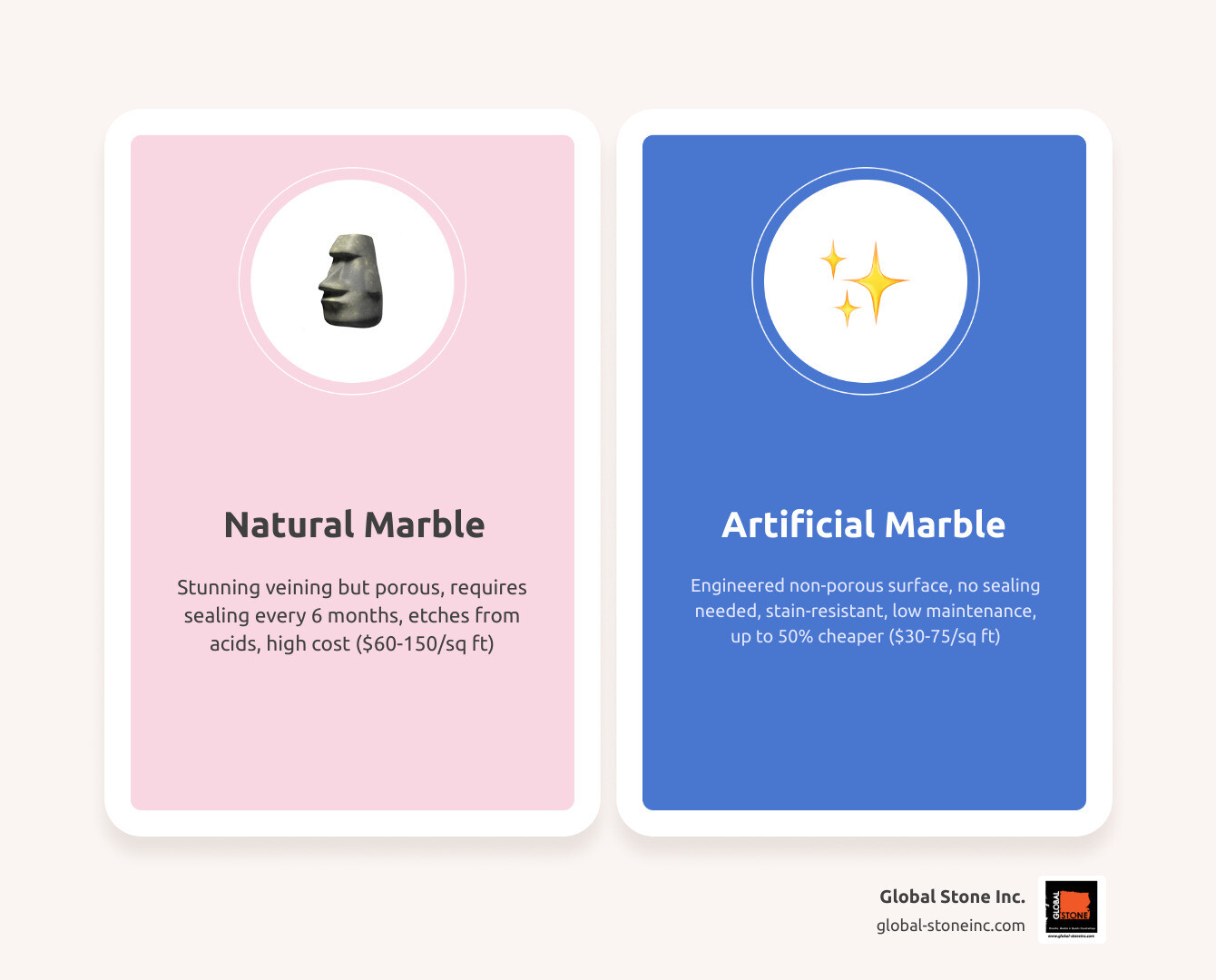
Natural marble is stunning. But many homeowners quickly discover that the cost — and the regular sealing, etching risks, and careful upkeep — makes it impractical for real life. Artificial marble solves that problem.
It delivers the same visual appeal: the crisp white backgrounds, the flowing grey veins, the polished or matte finish you’ve been picturing. But it’s engineered to be more forgiving. No resealing every six months. No panic when you spill coffee. And in many cases, it comes with an integrated sink already built in, making installation faster and cleaner.
Whether you’re renovating a master bath, updating a powder room, or refreshing a kitchen, understanding what artificial marble actually is — and what it can and can’t do — will help you make a confident decision.
I’m Greg Zamarski, founder of Global Stone Inc., with over 20 years of experience fabricating and installing countertops across the Chicago area, including artificial marble countertop projects in both residential and commercial settings. In this guide, I’ll walk you through everything you need to know — from materials and costs to installation and long-term care.
Quick artificial marble countertop terms:
What an Artificial Marble Countertop Is and How It’s Made
When we talk about an artificial marble countertop, we are usually referring to a category of “engineered” stones. These aren’t sliced out of a mountain in Italy; instead, they are meticulously crafted in a controlled environment to replicate the beauty of nature while fixing its flaws.
What Is an artificial marble countertop?
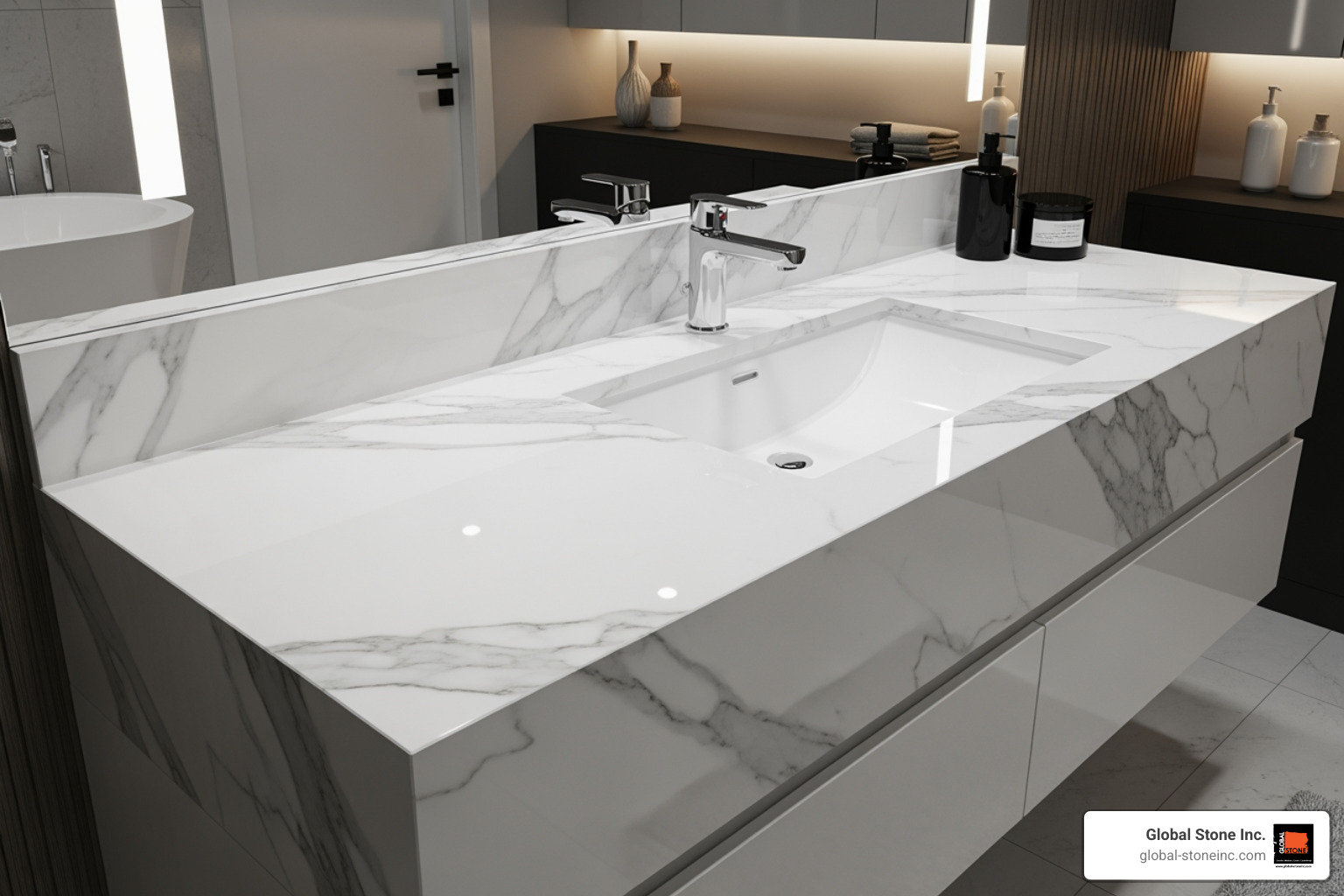
At its simplest, an artificial marble countertop is a man-made surface. Depending on who you talk to, you might hear it called cultured marble, faux marble, or composite marble. Unlike natural stone, which is porous and prone to staining, these surfaces are engineered to be non-porous. This means they don’t absorb liquids, making them a favorite for bathroom vanity tops and laundry rooms where moisture is always present. One of the coolest features we often install in Chicago homes is the integrated sink—where the bowl and the countertop are one continuous, seamless piece of material.
Main materials used in cultured marble and engineered marble
The recipe for these countertops is quite fascinating. Cultured marble typically consists of approximately 75 percent real marble dust (essentially recycled scraps from natural stone processing) mixed with liquid polyester resin. To get those beautiful swirls, pigments are added during the mixing phase.
For higher-end “artificial marble” that we often use in kitchens, the composition shifts toward quartz. These quartz-based slabs are often composed of over 90% quartz particles mixed with resin. This difference in ingredients is why some artificial marbles feel like heavy plastic (cultured marble) while others feel almost exactly like cold, hard stone (quartz-based marble).
How artificial marble countertops are manufactured
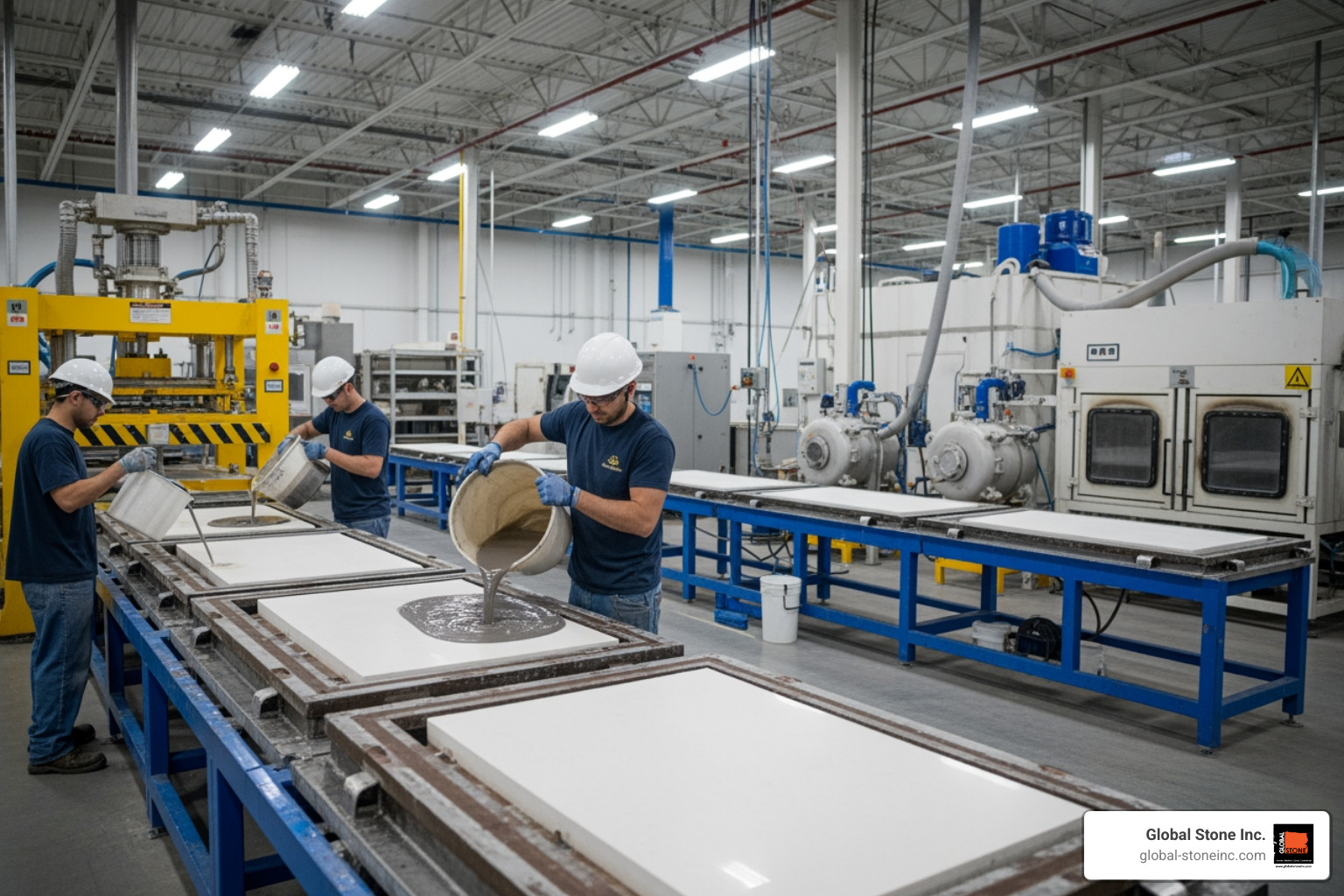
The manufacturing process is a blend of chemistry and craftsmanship:
- Mixing: The marble dust or quartz particles are combined with resins, pigments, and additives.
- Molding/Casting: For vanity tops with integrated sinks, the mixture is poured into a specific mold. For slabs, it is poured into large rectangular forms.
- Vacuum Pressing: To ensure there are no air bubbles (which cause weak spots), the material is vacuum-pressed under high pressure.
- Curing: The resin needs time to harden. This curing process usually takes between 3 to 4 hours in a temperature-controlled environment.
- Finishing: Once hard, the surface is polished to a high gloss or honed to a matte finish. A clear “gel coat” is often applied to cultured marble to provide that signature shine and protective barrier.
Cultured marble vs quartz-based artificial marble
It’s important to know which “artificial” stone you’re buying. Cultured marble is softer, easier to scratch, and primarily used in bathrooms. Quartz-based artificial marble, however, is a powerhouse. It boasts a Mohs hardness of Grade 6-7 and a water absorption rate lower than 0.06%. While cultured marble is fantastic for a guest bath, we usually recommend quartz-based options for high-traffic kitchens because they handle heat and knives much better.
Artificial Marble Countertop vs Natural Marble, Quartz, and Laminate
Choosing a surface is often a balancing act between your “dream look” and your “real-world budget.” Here is how the artificial marble countertop stacks up against the competition.
Appearance and realism: veining, color consistency, and finish options
In the past, “faux marble” looked, well, fake. But by May 2026, technology has advanced so much that even a trained eye can struggle to tell the difference. You can get a Calacatta-style slab with crisp, bold veining or a soft Carrara look with subtle grey shadows.
The big advantage here is consistency. If you pick a sample of an artificial marble countertop, the slab that arrives at your home will look exactly like that sample. With natural marble, you might get a slab with a giant brown spot right in the middle that you didn’t expect!
Durability and daily performance in kitchens and bathrooms
Natural marble is a “soft” stone—it chips and scratches easily. Artificial marble is much more resilient. It has high impact strength and is naturally resistant to mildew and moisture. However, it isn’t invincible. While it resists stains better than natural stone, you still need to use trivets for hot pans and avoid dropping heavy cast-iron skillets on the edges.
Maintenance differences and long-term care needs
This is where artificial marble wins by a landslide. Natural marble requires resealing every 6 to 12 months to prevent liquids from seeping into the stone. Artificial marble never needs sealing. You just wipe it down with mild soap and water. If you’re curious about how much work the real stuff is, check out our 4 essential marble countertop maintenance tips to see why many of our Naperville clients choose the engineered route instead.
Cost comparison and value for homeowners
Budget is usually the deciding factor. Cultured marble countertops are typically at least 50% cheaper than entry-level natural stone. Because they are often molded with integrated backsplashes and sinks, you also save significantly on labor costs. It’s the ultimate “budget remodel” hack that still looks like a million bucks. You can read more about this in our quartz countertops vs marble countertops showdown.
| Material | Cost | Maintenance | Durability |
|---|---|---|---|
| Artificial Marble | Low – Mid | Very Low | High |
| Natural Marble | High | High | Moderate |
| Quartz | Mid – High | Low | Very High |
| Laminate | Very Low | Low | Low |
Benefits and Drawbacks of Choosing an Artificial Marble Countertop
We want you to love your kitchen or bath for decades, so we always give it to you straight: artificial marble is great, but it isn’t perfect for every single scenario.
Biggest advantages for homeowners
- Affordability: You get the high-end aesthetic for a fraction of the price.
- Seamless Design: No grout lines and integrated sinks mean fewer places for mold to hide.
- Stain Resistance: Spilled wine or makeup won’t ruin your morning.
- Customization: We can fabricate these to almost any size or shape.
Potential disadvantages and limitations to know before buying
The main “con” is heat sensitivity. The resins used to bind the marble dust can melt or discolor if you put a 450-degree hair straightener or a boiling pot directly on them. Also, if you use an artificial marble countertop in a sun-drenched outdoor kitchen, the UV rays can cause the gel coat to yellow over time unless a specific UV-resistant resin is used.
Best applications: bathrooms, kitchens, laundry rooms, and outdoor limits
- Bathrooms: This is the “Goldilocks” zone for artificial marble. Vanity tops, shower surrounds, and tub decks are perfect applications.
- Laundry Rooms: Great for folding clothes and resisting detergent spills.
- Kitchens: We recommend the quartz-based versions for kitchens. Traditional cultured marble is a bit too soft for heavy-duty cooking.
- Outdoor: Generally a no-go in the Chicago climate unless specifically rated for UV exposure.
Who should choose artificial marble and who should consider another surface
If you have a busy household with kids, or if you’re renovating a rental property, artificial marble is a no-brainer. It’s tough and easy to clean. However, if you are a “purist” who loves the way natural stone develops a patina over time, you might prefer the real thing. You can explore why quartz usually wins the durability battle against marble if you’re still on the fence.
Costs, Sizes, Colors, and Custom Options
When you’re planning a renovation in Elk Grove Village or downtown Chicago, the “nitty-gritty” details matter.
Typical artificial marble countertop prices and what affects them
Prices can range from $50 for a small, pre-cut vanity top to over $1,000 for large, custom double-sink configurations. Factors that drive the price up include:
- Thickness: 20mm and 30mm are standard; thicker slabs cost more.
- Edge Profiles: A simple eased edge is standard, while a complex Ogee edge adds to the fabrication time.
- Custom Cutouts: Extra holes for soap dispensers or high-end faucets.
Common vanity top sizes and sink configurations
If you’re buying a standard vanity, you’ll likely choose from these common widths:
- Powder Rooms: 19, 21, or 25 inches.
- Standard Baths: 31, 37, 43, or 49 inches.
- Master Suites: 61, 73, or 85 inches (usually double sink).
Popular colors, styles, and finishes
White remains the king of the Chicago market. Whether it’s a pure white marble slab or a Calacatta Grey, these light colors make small bathrooms feel massive. You can also find “granite-look” patterns and solid tones like cream or beige. For a modern look, many of our clients are moving away from high-gloss and choosing “honed” or matte finishes. You can see more artificial marble countertop options here.
Can artificial marble be customized?
Absolutely. Because it starts as a liquid mixture, we can create custom sizes, extended lengths, and variable depths. If you have a weirdly shaped corner in your Naperville Victorian home, we can mold a top to fit it perfectly. We can even match veining across multiple slabs for a “waterfall” island effect.
Installation, Cleaning, and Maintenance Tips That Extend Lifespan
Even the best material will fail if it’s installed poorly or cleaned with the wrong chemicals.
How professionals install vanity tops and integrated sinks
When we arrive at your home, the process looks like this:
- Dry Fit: We place the top on the cabinets to ensure it’s level and flush against the wall.
- Scribing: If your walls aren’t perfectly straight (and in Chicago, they never are!), we “scribe” the back of the stone to fit the curve of the wall.
- Adhesive: We apply beads of specialized marble adhesive to the cabinet tops.
- Sealing: We use 100% silicone sealant to create a waterproof barrier between the countertop and the wall (the backsplash).
Daily cleaning and stain prevention
The golden rule: Avoid vinegar and bleach. These are too acidic or harsh and can dull the gel coat over time. Stick to mild dish soap and warm water. For tough makeup stains or grease, a little denatured alcohol on a soft cloth usually does the trick.
Scratch, heat, and UV protection best practices
- Use Trivets: Even if the manufacturer says it’s heat resistant up to 300 degrees, why risk it?
- Cutting Boards: Don’t chop veggies directly on the surface; it will dull your knives and eventually scratch the finish.
- Waxing: Applying a specialized countertop wax (or even a high-quality car wax) once a year can help the surface shed water and soap scum even better.
Can scratches, chips, or dull spots be repaired?
Yes! This is one of the best parts about an artificial marble countertop. Small scratches can often be buffed out with a fine-grit polishing compound. If you have a deeper chip, we can often fill it with a matching resin and sand it down until it’s invisible. For more help, see our 10 tips to upgrade your kitchen.
Frequently Asked Questions About Artificial Marble Countertops
Is an artificial marble countertop good for kitchens?
It’s a great choice if you choose a quartz-based version. It handles the spills and “oops” moments of a busy kitchen much better than natural marble. However, for a high-heat professional chef’s kitchen, we might steer you toward granite.
How long does an artificial marble countertop last?
With proper care, these tops can easily last 20 to 30 years. The main thing that “ages” them is abrasive cleaners that slowly wear away the shine. If you treat the surface gently, it will stay looking new for decades.
What should buyers check before ordering?
- Faucet Spacing: Is it a single hole, 4-inch center, or 8-inch spread?
- Sink Location: Make sure the sink bowl won’t hit the internal drawers of your vanity.
- The “Feel”: Visit a showroom! You should touch the material to make sure you like the texture and warmth.
Conclusion
An artificial marble countertop is a smart, stylish, and budget-friendly investment for any Chicago homeowner. It bridges the gap between the luxury aesthetic we all want and the durability we actually need. By choosing engineered stone, you get to spend more time enjoying your beautiful home and less time worrying about sealing and staining.
At Global Stone Inc., we’ve spent over 20 years helping homeowners in Naperville, Elk Grove Village, and the surrounding Chicago areas find the perfect surfaces. Our in-house designers and fabricators handle everything from the first measurement to the final polish, and we stand behind our work with a lifetime warranty.
Ready to see how an artificial marble countertop can transform your space? Check out our natural stone and engineered countertop options or visit us today to start your renovation journey!