Countertop Materials Compared: A Complete Guide
The Homeowner’s Guide to Choosing Countertops by Material
Choosing countertops by material is one of the most important decisions in any kitchen or bathroom remodel. The material you pick affects how your space looks, how much work it needs to stay clean, and even what your home is worth when you sell.
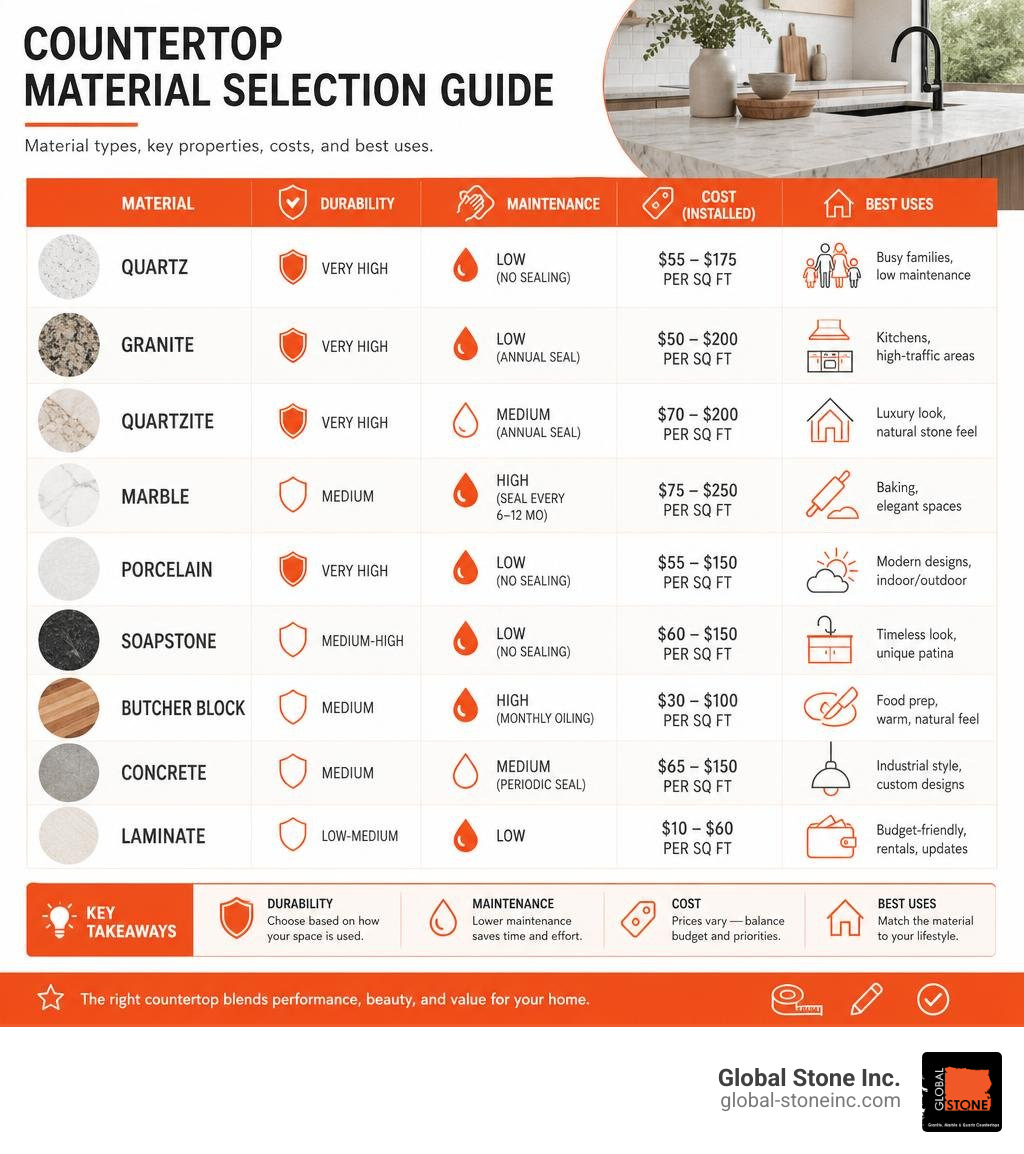
Here is a quick overview of the most common countertop materials to help you compare at a glance:
| Material | Durability | Maintenance | Installed Cost (per sq ft) |
|---|---|---|---|
| Quartz | Very High | Low (no sealing) | $55 – $175 |
| Granite | Very High | Low (annual seal) | $50 – $200 |
| Quartzite | Very High | Medium (annual seal) | $70 – $200 |
| Marble | Medium | High (seal every 6-12 mo) | $75 – $250 |
| Porcelain | Very High | Low (no sealing) | $55 – $150 |
| Soapstone | Medium-High | Low (no sealing) | $60 – $150 |
| Butcher Block | Medium | High (monthly oiling) | $30 – $100 |
| Concrete | Medium | Medium (periodic seal) | $65 – $150 |
| Laminate | Low-Medium | Low | $10 – $60 |
There is no single best material. The right choice depends on how you cook, how much maintenance you are willing to do, and your budget. A serious baker may love marble’s cool surface. A busy family will likely prefer low-maintenance quartz. A homeowner focused on resale value will lean toward granite or quartz.
This guide walks you through every major countertop material — what it costs, how it performs, and who it is best suited for.
I’m Greg Zamarski, founder of Global Stone Inc., a full-service stone fabrication and installation company serving the Chicago area since 2004 — giving me over 20 years of hands-on experience helping homeowners navigate countertops by material across thousands of kitchen and bathroom projects. If you want to skip straight to speaking with our team, you can reach us at (847) 718-1418 — otherwise, read on for everything you need to make a confident decision.
Comparing Premium Countertops by Material: Natural Stone vs. Engineered Surfaces
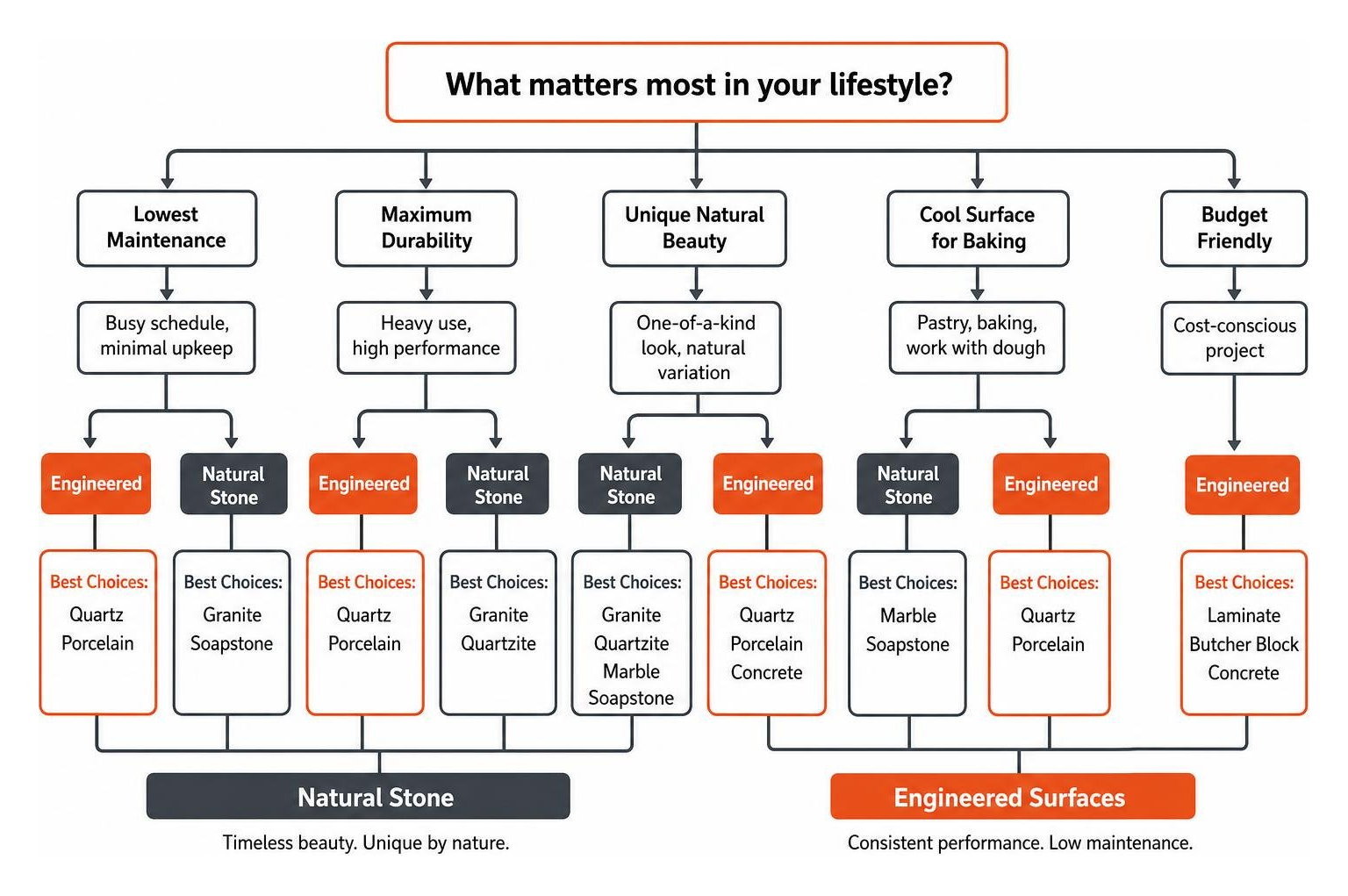
When you begin looking at premium countertops, the options split into two main camps: natural stone quarried directly from the earth, and engineered surfaces manufactured in a factory. Both have loyal followings, but they serve different lifestyles and design goals.
Understanding the differences between these categories is the first step to narrowing down your search. To see how these materials stack up directly across several performance metrics, you can explore this complete Countertop Material Comparison — All 9 Materials Side-by-Side — Countertop Advisor .
Natural Stone Countertops by Material: Granite, Quartzite, and Marble
Natural stone is the undisputed gold standard for homeowners who want a one-of-a-kind, luxury aesthetic. Because these slabs are sliced straight from mountain quarries, no two pieces are identical. Your kitchen island will have a completely unique pattern that cannot be replicated anywhere else in the world.
- Granite: As an igneous rock formed from cooling magma deep within the earth, Granite Countertops are incredibly dense and hard. Granite ranks at a 6 to 7 on the Mohs hardness scale. This geological toughness means it laughs at hot pots, resists scratches from kitchen knives, and handles heavy-duty daily cooking without flinching. It does require an annual sealer to keep liquids from seeping into its microscopic pores, but it remains one of the most reliable workhorses for busy families.
- Quartzite: Not to be confused with engineered quartz, natural Quartzite Countertops are formed when sandstone undergoes intense heat and pressure beneath the earth’s crust. This metamorphic process makes quartzite even harder than granite, registering a whopping 7 to 8 on the Mohs hardness scale. It offers the elegant, flowing veining of marble but with the durability of granite. It is highly resistant to acids and heat, though like granite, it requires periodic sealing.
- Marble: The epitome of classic luxury, Marble Countertops have been prized for centuries. Derived from limestone, marble is a softer metamorphic stone, registering a 3 to 4 on the Mohs scale. This softness makes it susceptible to scratching and chemical “etching”—a dull spot left behind when acidic liquids like lemon juice, vinegar, or wine react with the calcium carbonate in the stone. While marble requires diligent care and sealing every 6 to 12 months, many homeowners in areas like Naperville and Oak Brook choose it because they love the natural, aging patina it develops over time.
Engineered Countertops by Material: Quartz and Porcelain Slabs
If your priority is a uniform pattern, zero sealing, and minimal maintenance, engineered surfaces are designed exactly for you.
- Quartz: Engineered Quartz Countertops are manufactured by combining roughly 90% to 94% ground natural quartz crystals with 6% to 10% polymer resins and color pigments. Because the resin fills every microscopic void, quartz is completely non-porous. This means it never needs to be sealed, resists stains from coffee, wine, and oils effortlessly, and is highly hygienic. However, because of those polymer resins, quartz is sensitive to extreme heat (usually anything over 300°F) and can yellow if exposed to direct, prolonged UV sunlight outdoors.
- Porcelain Slabs: Rising rapidly in popularity, porcelain countertops are crafted from clay and natural minerals fired at temperatures exceeding 2,000°F. There are many 5 Advantages of Porcelain Countertops, including extreme heat resistance, scratch resistance, and complete UV stability. Unlike quartz, porcelain will not scorch or fade under the hot sun, making it the perfect choice for outdoor kitchens in the Chicago area. The main trade-off is that porcelain patterns are printed on the surface (skin-deep). This means that if you chip an edge, the plain interior clay beneath the pattern may show through, requiring a skilled fabricator to create mitered edges to conceal the seam.
Specialty and Alternative Natural Stone Materials
While granite, quartz, and marble dominate most kitchen design conversations, there is a whole world of specialty natural stones that offer distinct textures, historical charm, and striking visual elements.
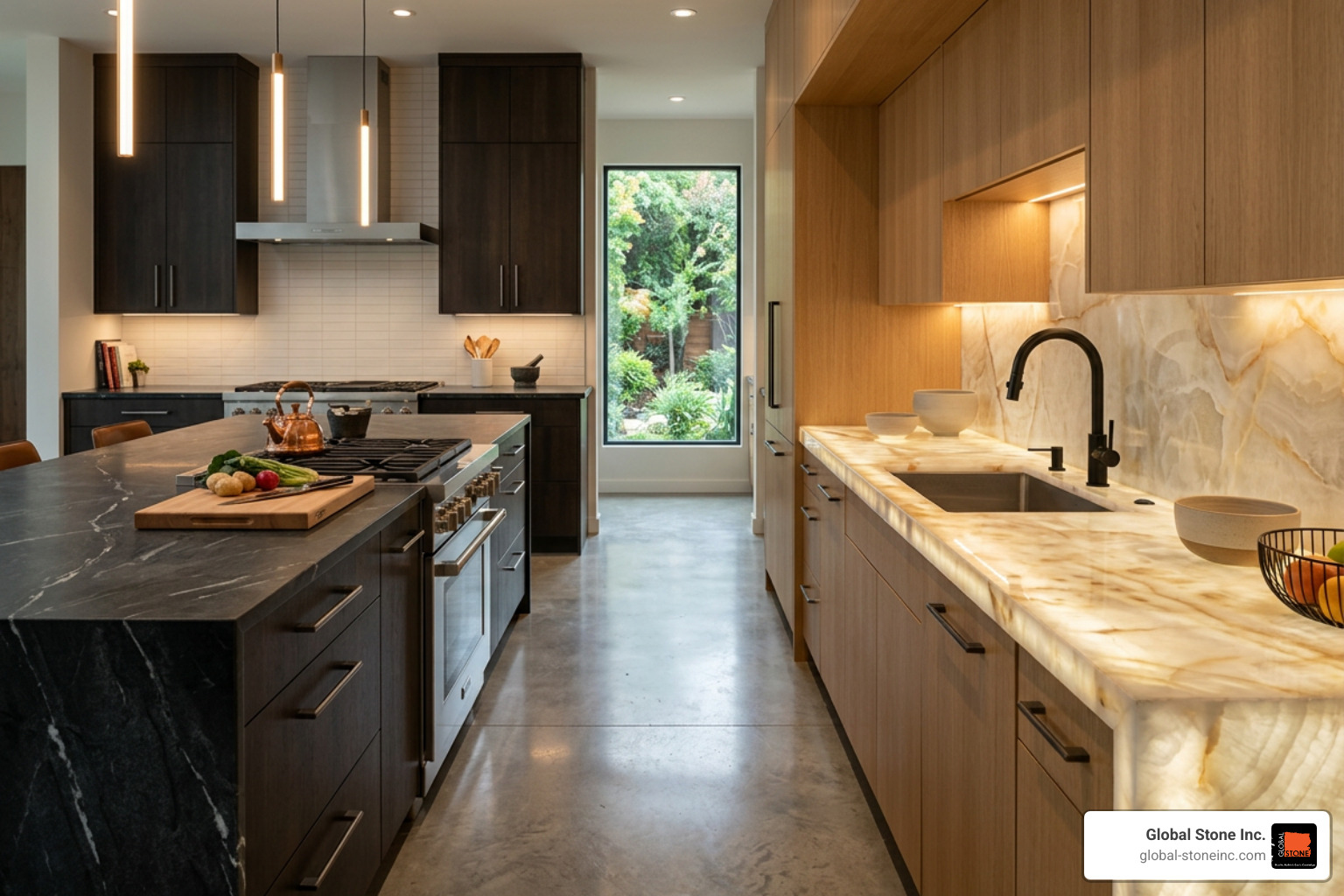
Soapstone, Limestone, Slate, and Onyx
For homeowners who want to step away from mainstream trends, these alternative natural stones provide unique practical and aesthetic properties:
- Soapstone: Composed primarily of talc, Soapstone Countertops have a distinctively soft, soapy, and matte feel. Soapstone is chemically neutral and completely non-porous, meaning it is naturally antibacterial and entirely stain-resistant. It does not require sealing, but many homeowners apply mineral oil periodically to encourage a dark, rich, and even patina. Because it is physically soft, it scratches easily, but those scratches can easily be sanded out at home with a bit of sandpaper and mineral oil.
- Limestone: If you love a warm, earthy, and organic aesthetic, Limestone Countertops offer soft beige, gray, and tan tones. Because limestone is a sedimentary rock, it often contains beautifully preserved fossils and shells embedded within the surface. However, like marble, limestone is highly porous and sensitive to acids, making it best suited for light-use areas or elegant bathroom vanities.
- Slate: Renowned for its rustic texture and deep, moody color palette, Slate Tile Countertops are highly resistant to heat, stains, and scratches. High-quality slate slabs are non-porous and incredibly durable, though they can be prone to minor chipping along the edges if struck by a heavy cast-iron pan.
- Onyx: For a show-stopping, dramatic look, Onyx Countertops feature striking, translucent bands of color. Because light can pass right through onyx, it is often back-lit with LED panels to create a glowing focal point on home bars or powder room vanities. Onyx is very soft and fragile, requiring professional reinforcement during fabrication and careful, low-impact daily use.
To see how these specialty stones stack up against mainstream choices in performance and popularity, check out the Best Countertop Materials Ranked for Real Kitchens (2026) | SlabWise .
Performance Metrics: Heat, Scratch, and Stain Resistance
When you are in the middle of preparing a holiday meal, the last thing you want to worry about is whether your countertop can handle the heat of a baking sheet or a splash of lemon juice. Understanding how different countertops by material react to daily kitchen hazards will save you years of frustration.
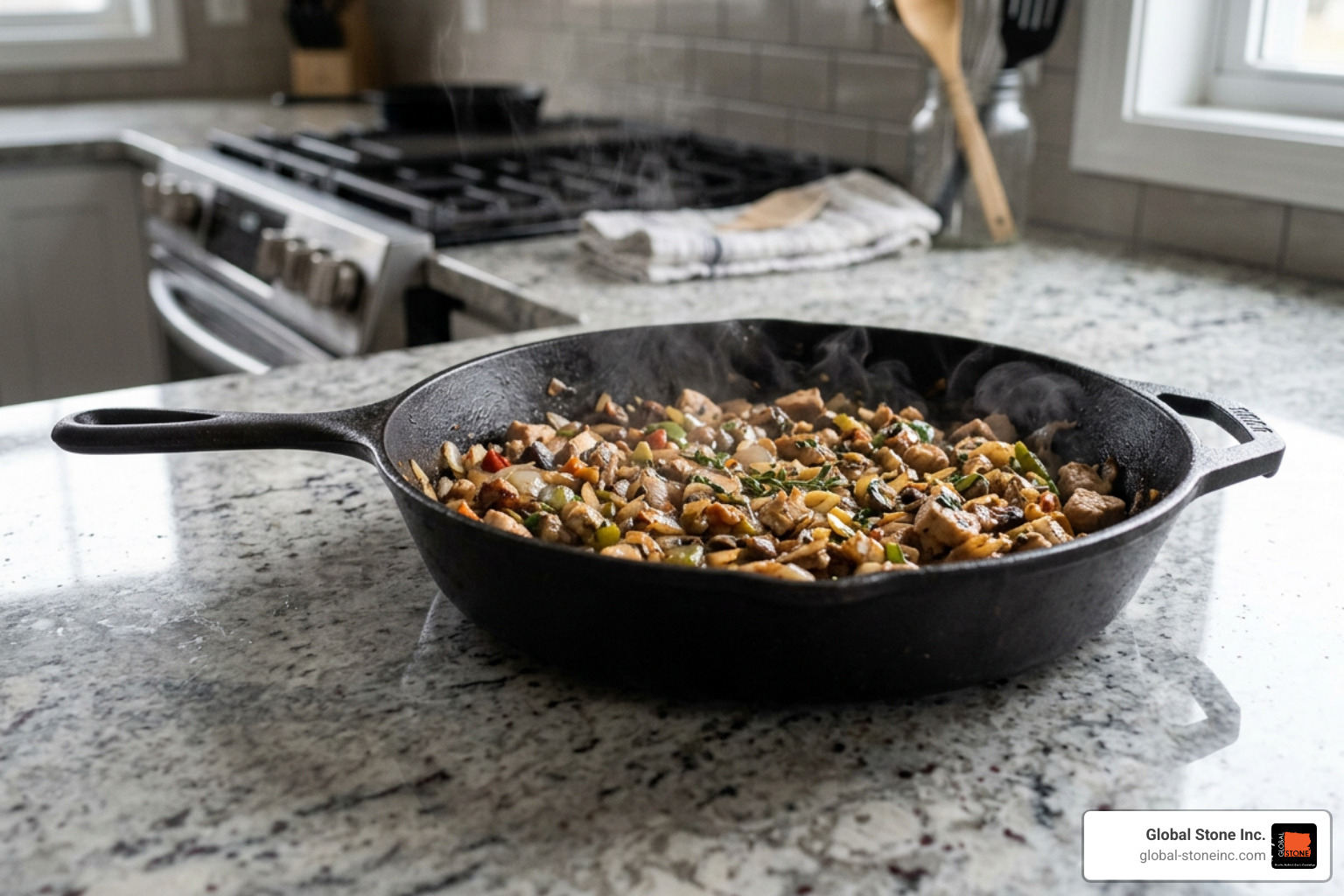
Heat Resistance and Thermal Shock
Heat resistance is one of the most misunderstood aspects of countertop ownership. While some stones can handle direct contact with a hot pan, others can suffer permanent damage.
- Natural Stones (Granite, Quartzite, Soapstone): These materials are formed under volcanic heat or intense geological pressure, meaning they can easily withstand temperatures up to 1,000°F or more. You can set a hot cast-iron skillet directly onto granite or soapstone without scorching the stone.
- Engineered Quartz: Because quartz contains roughly 7% to 10% polymer resin, it is vulnerable to thermal shock. Placing a hot pot directly on quartz can melt or yellow the resin, leaving a permanent ring. We always advise using trivets or hot pads on quartz surfaces.
- Porcelain and Ultra-Compact Surfaces: Materials like porcelain and Ultra-Compact Countertops are fired at extreme temperatures, making them nearly immune to heat damage. They can easily handle hot pans without scorching, though rapid, localized temperature changes (thermal shock) can occasionally cause cracking if the slab is thin.
Scratch and Stain Resistance
How easily a countertop scratches or stains depends heavily on its mineral hardness and porosity.
- Porosity and Staining: Porous stones like marble, limestone, and light-colored granites act like dense sponges. If left unsealed, liquids like red wine, coffee, or olive oil will seep into the stone, creating deep, stubborn stains. Non-porous materials like quartz, porcelain, and soapstone keep liquids on the surface, making them incredibly easy to wipe clean with simple soap and water.
- Acids and Etching: This is where marble and limestone are most vulnerable. Acidic foods react chemically with the calcium carbonate in these stones, physically dissolving a microscopic layer of the surface. This leaves a dull, hazy mark known as an “etch.” Sealing prevents staining (liquid absorption), but it does not prevent etching (acid damage).
- Hardness and Scratching: Hard natural stones like quartzite (Mohs 7-8) and granite (Mohs 6-7) are incredibly difficult to scratch. You are more likely to dull your kitchen knives than scratch the stone. On the other hand, soapstone (Mohs 2-3) and marble (Mohs 3-4) can be scratched by keys, rings, or sliding heavy ceramic plates.
Cost and Resale Value: Maximizing Your Kitchen Investment
A kitchen remodel is a significant financial investment, and your choice of countertop material plays a massive role in both your upfront costs and your home’s long-term resale value.
Installed Cost per Square Foot Breakdown
When you receive a countertop quote, the “square foot” price of the raw slab is only one part of the equation. A complete, realistic budget must account for several essential fabrication and installation line items. For a transparent look at real-world pricing structures, review the Countertop Cost & Budget — 2026 Real Installed Prices — Countertop Advisor .
Here is what typically makes up your final countertop quote:
- Material Grade: Slabs are categorized into tiers, from standard, widely available patterns (Level 1) to rare, exotic stones with dramatic veining (exotics).
- Fabrication Labor: Cutting, polishing, and shaping stone slabs requires specialized CNC machinery and skilled craftsmen. Harder stones like quartzite and delicate materials like porcelain require slower cutting speeds and specialized diamond tooling, which increases labor costs.
- Edge Profiles: Standard eased or beveled edges are usually included in the base price. Premium profiles like Ogee, bullnose, or dramatic waterfall edges (where the stone flows vertically down the side of the cabinet to the floor) add to the labor cost.
- Cutouts and Prep: Every sink, cooktop, and faucet hole requires precise cutting and polishing. Undermount and farmhouse sinks require polished inner edges, which generally cost between $150 and $400 per cutout.
- Demolition and Plumbing: Removing your old countertops, hauling them away, and disconnecting/reconnecting plumbing lines are crucial steps that professional installers handle to ensure a seamless transition.
Best Countertop Materials for Home Resale Value
If you plan to sell your Chicago, Naperville, or Elk Grove Village home in the next few years, buyer psychology should heavily influence your material choice.
Buyers view premium countertops as a sign of a well-maintained, high-quality home. They instantly recognize materials like granite and quartz and associate them with luxury. Cheap, temporary fixes like laminate or highly high-maintenance options like butcher block can sometimes backfire, as buyers may view them as projects they will have to replace immediately.
To maximize your return on investment, we recommend:
- Choosing Quartz or Granite: These are the safest, most universally appealing options for resale. They offer the perfect balance of durability, luxury appeal, and low maintenance.
- Leaning Toward Neutral Colors: Whites, soft grays, and warm beiges appeal to the widest range of potential buyers. Bold, highly personalized colors can limit your market.
- Investing in Professional Installation: Even the most expensive stone will look cheap if the seams are thick, misaligned, or poorly polished. Working with an experienced, in-house fabrication team ensures flawless execution.
To explore how different materials impact your home’s long-term market appeal, read our full breakdown on The Best Materials for Residential Countertops.
Frequently Asked Questions about Countertop Materials
Which countertop material is the easiest to maintain?
Engineered quartz and porcelain are the easiest countertop materials to maintain. Because they are non-porous, they never require sealing, resist staining from daily spills, and can be cleaned with simple soap and warm water. Unlike natural stones, you do not have to worry about acidic foods etching the surface or liquids leaving permanent marks.
What is the difference between quartz and quartzite?
The main difference is that quartz is a man-made, engineered surface, while quartzite is a 100% natural metamorphic stone. Quartz is made in a factory by binding ground quartz crystals with polymer resins, resulting in a non-porous slab that never needs sealing but is sensitive to high heat. Quartzite is quarried directly from the earth, offers incredible heat resistance and hardness, but requires periodic sealing to protect against stains.
Can you put hot pans directly on quartz countertops?
No, you should never place hot pans directly on quartz countertops. While the natural quartz crystals inside the slab can withstand high heat, the polymer resins used to bind the material together can melt, scorch, or discolor at temperatures above 300°F. Always use trivets, hot pads, or cutting boards to protect your quartz surfaces from thermal damage.
Conclusion
Choosing the right countertops by material is all about finding the perfect harmony between your daily lifestyle, your design aesthetic, and your budget. Whether you fall in love with the unmatched, organic drama of natural granite, the timeless elegance of quartzite, or the worry-free reliability of engineered quartz, your countertops will serve as the functional heart of your home for decades to come.
At Global Stone Inc., we make the selection and installation process completely stress-free. With over 20 years of experience serving homeowners across Chicago, Naperville, and Elk Grove Village, we manage your entire project under one roof. From hand-selecting your slab in our yard to custom fabrication and professional installation, our in-house team ensures sub-millimeter precision. Plus, we stand behind our craftsmanship with an industry-leading lifetime warranty.
Ready to find the perfect stone for your home? Explore our comprehensive guide on The Best Materials for Residential Countertops, visit our showroom, or contact our team today to schedule your custom consultation!