
A – Z Guide to Bathroom Vanity Top Materials & Sizes
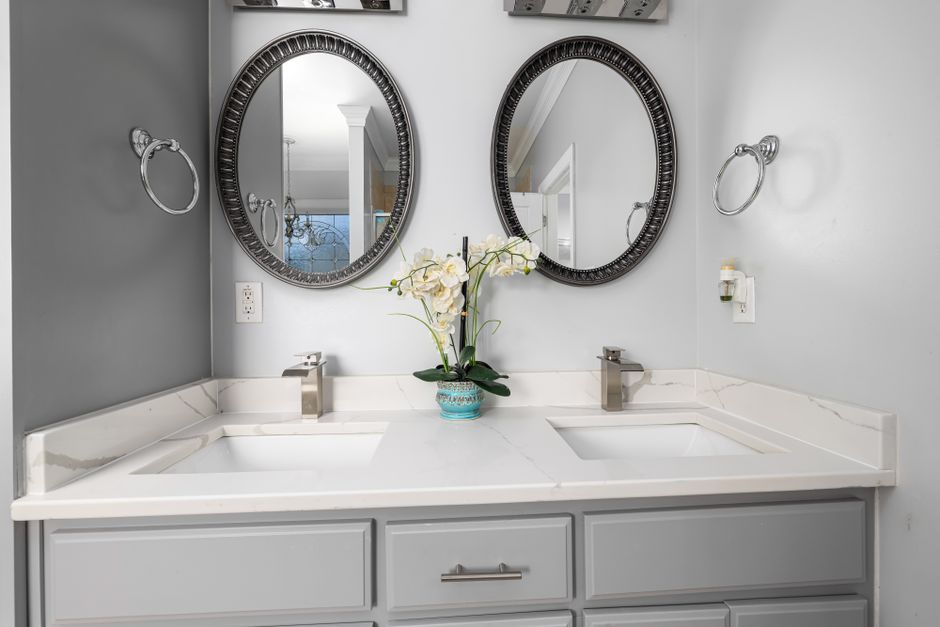
Choosing the Perfect Bathroom Vanity Top for Your Home
A bathroom vanity top is the countertop surface that sits on top of your vanity cabinet — and it’s one of the hardest-working surfaces in your home. It deals with daily water splashes, makeup spills, toothpaste, hairspray, and heat from styling tools, all while needing to look great.
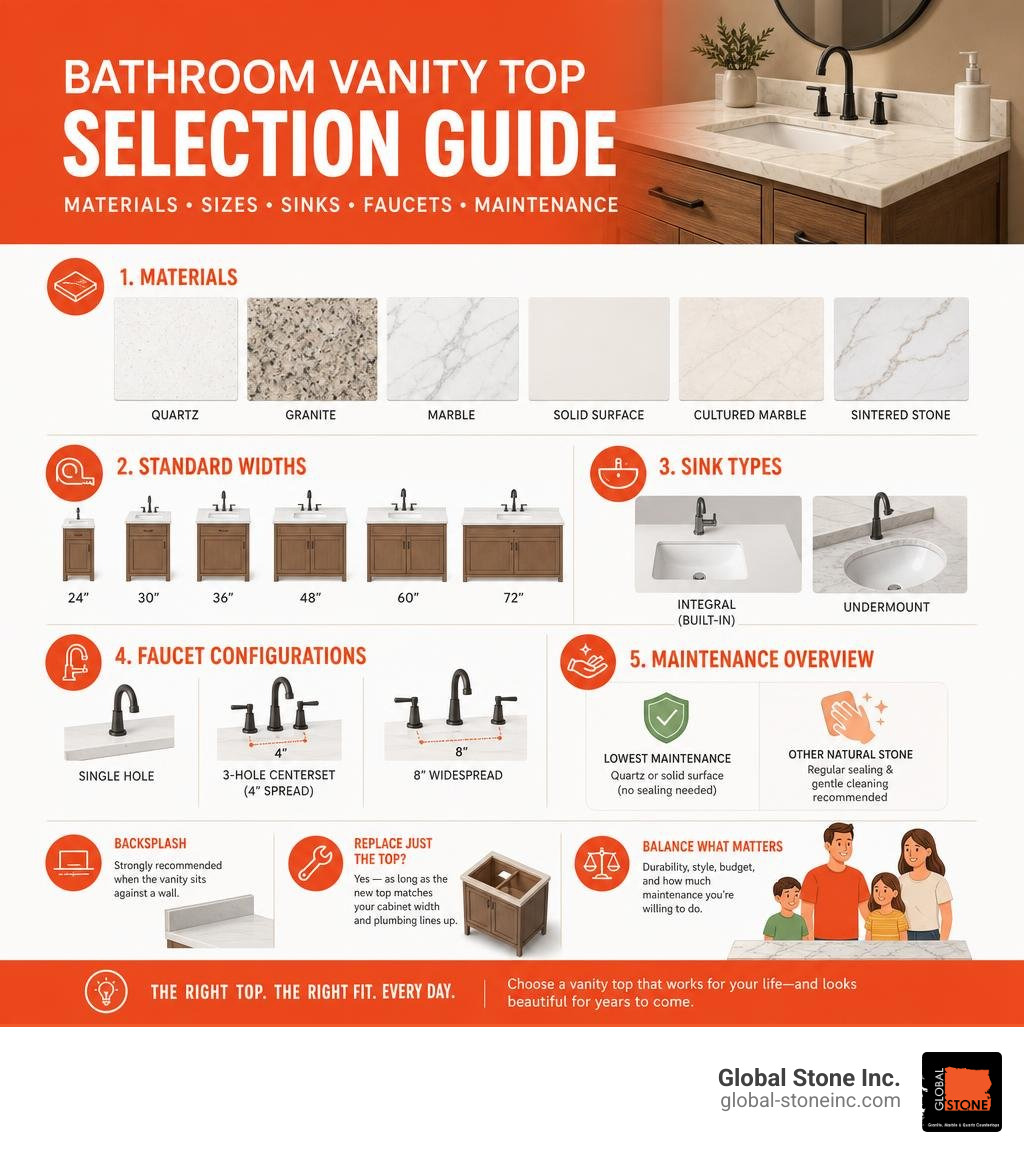
Quick answer — what to know about bathroom vanity tops:
| Topic | Key Facts |
|---|---|
| Common materials | Quartz, granite, marble, solid surface, cultured marble, sintered stone |
| Standard widths | 24″, 30″, 36″, 48″, 60″, 72″ |
| Sink types | Integral (built-in) or undermount |
| Faucet configs | Single hole, 3-hole centerset (4″ spread), 8″ widespread |
| Lowest maintenance | Quartz or solid surface (no sealing needed) |
| Backsplash | Strongly recommended when the vanity sits against a wall |
| Can I replace just the top? | Yes — as long as the new top matches your cabinet width and plumbing lines up |
Choosing the right top means balancing durability, style, budget, and how much maintenance you’re willing to do. A quartz top in a busy kids’ bathroom is a very different decision than a marble slab in a low-traffic powder room.
I’m Greg Zamarski, founder of Global Stone Inc., a Chicago-area stone fabrication and installation company with over 20 years of experience helping homeowners find the right bathroom vanity top material for their space. In this guide, I’ll walk you through everything — from materials and sizes to sinks, faucets, and care tips — so you can make a confident, informed choice.
Selecting a brand-new bathroom vanity top can feel a bit like dating: some options look absolutely stunning on paper but require way too much high-maintenance drama in real life, while others are incredibly reliable, low-key, and easy to live with every single day.
When you begin your search, it helps to understand that a bathroom environment is fundamentally different from a kitchen. In a kitchen, you are primarily worried about heavy pots, sharp knives, and high heat. In a bathroom, the enemies are different: pooled water, high humidity, toothpaste, hair dye, and acidic grooming products like nail polish remover or stubborn cosmetics.
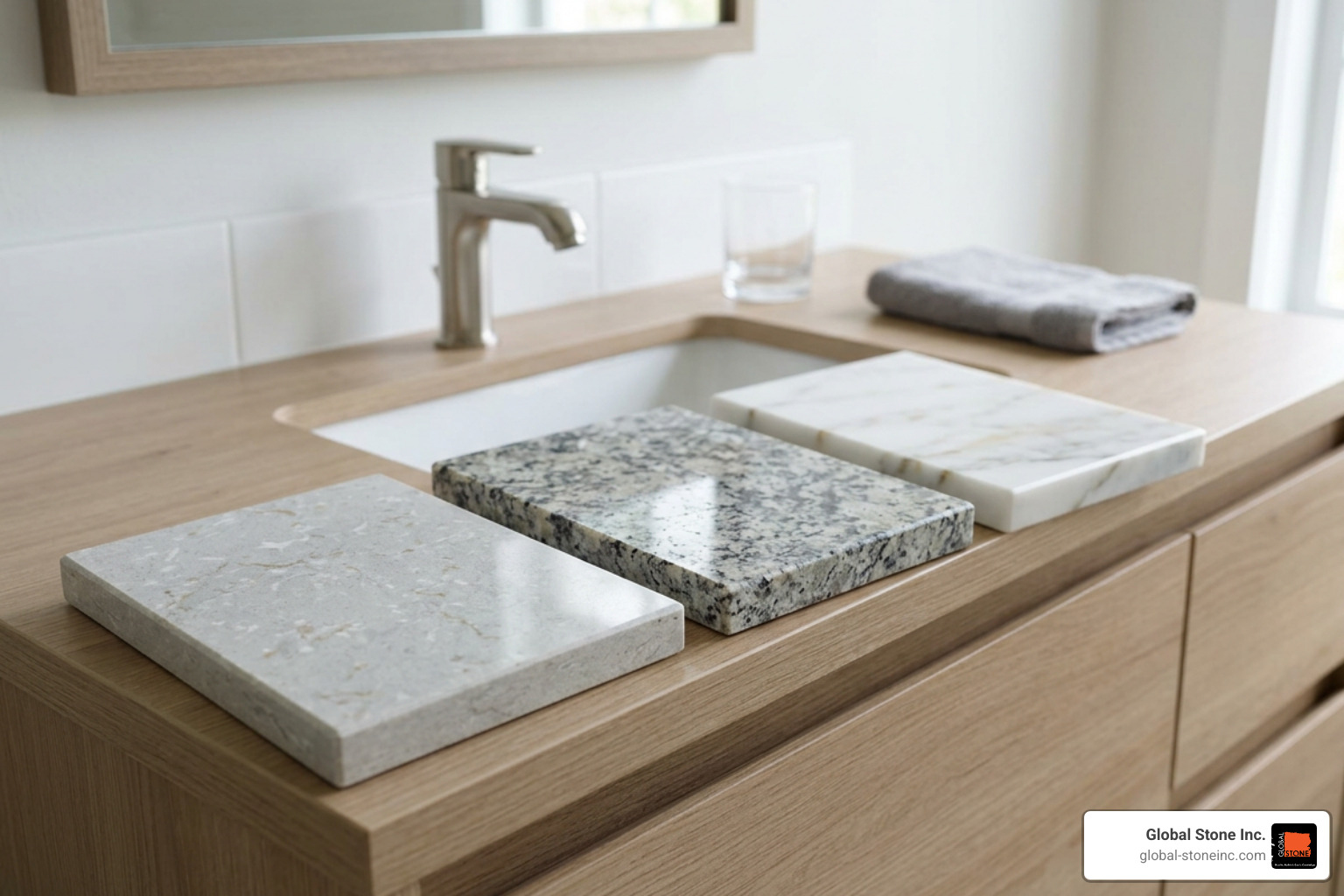
To ensure your investment stands the test of time, you need to weigh durability against the level of maintenance you are realistically willing to perform. Professional bathroom countertop installation ensures that whatever material you select is perfectly leveled, securely anchored, and properly sealed against moisture infiltration.
Low-Maintenance Bathroom Vanity Top Materials
If your ideal Sunday morning does not involve meticulously sealing stone surfaces, or if you have kids who treat the bathroom sink like a personal science lab, low-maintenance engineered materials are your best friend.
Engineered Quartz
Engineered quartz is a dominant favorite for modern bathrooms, and for good reason. Crafted by combining roughly 90% to 94% ground natural quartz minerals with polyester resins and pigments, quartz countertops are completely non-porous. This means they will never absorb water, bacteria, or spilled hair dye, and they never require sealing.
Brands like Wolf offer up to 35 beautiful colors for quartz tops, allowing you to achieve the look of luxurious Carrara marble without any of the staining anxiety.
Solid Surface
Solid surface materials (such as Swanstone) are made from acrylic or polyester resins blended with natural pigments. They are entirely seamless, non-porous, and incredibly uniform. One of the coolest features of solid surface tops is their thermal resilience; premium solid surface vanity tops can resist heat up to 450 degrees Fahrenheit. If you accidentally leave a hot curling iron resting directly on the deck, you won’t have to panic.
Furthermore, solid surface is “renewable.” If you somehow manage to scratch it, you can literally buff the scratch out with a mild abrasive pad. Tough stains like ink or marker can be wiped away with common household acetone or solvents without damaging the surface.
Cultured Marble
Not to be confused with natural marble, cultured marble is a prefabricated, engineered product made from marble dust blended with liquid polyester resins. It is finished with a protective, glossy gel coat. It is highly budget-friendly and offers an incredible variety of designs—Wolf, for instance, provides up to 52 colors for cultured marble vanity tops.
While highly resistant to moisture and stains, you do have to be cautious with abrasive cleaners, which can dull the shiny gel coat over time.
Natural Stone and Premium Options
For those who want the unmatched depth, unique character, and high-end luxury of real stone, natural slabs are the ultimate choice. Because no two slabs are identical, your bathroom vanity will truly be a one-of-a-kind masterpiece.
Granite
Natural granite is the toughest of all natural stone materials. It is highly scratch-resistant and completely unaffected by hot styling tools. If you choose a premium dark stone like an Absolute Black polished slab, you get an incredibly dense surface that brings a bold, classic aesthetic to your bathroom.
While granite is naturally porous, a professional sealer applied during installation will protect it from moisture and cosmetics.
Marble
Marble is the gold standard of classic luxury. The soft, elegant veining of Carrara or Calacatta marble can make any master bath feel like a high-end spa. However, marble is a softer, calcium-carbonate-based stone, making it susceptible to “etching” (chemical dulling) when exposed to acidic liquids like lemon juice, certain perfumes, or harsh cleaners.
If you are willing to wipe up spills quickly and use pH-neutral cleaners, marble can age beautifully in low-traffic powder rooms or adult-use master suites.
Quartzite
Not to be confused with engineered quartz, quartzite is a 100% natural metamorphic rock. It offers the delicate, swirling look of marble but boasts a hardness and durability that rivals granite. It does require periodic sealing, but it is an exceptional option for homeowners who want natural luxury without marble’s vulnerability to scratches.
Sintered Stone
Sintered stone is a cutting-edge material created by subjecting natural minerals to extreme pressure and heat (a process mimicking metamorphic rock formation). The result is an ultra-dense, completely non-porous slab that is virtually impervious to scratches, stains, heat, and UV rays.
It is incredibly popular for ultra-modern designs, such as a sleek 48-inch floating vanity with sintered stone top, which brings a high-performance, minimalist look to contemporary spaces.
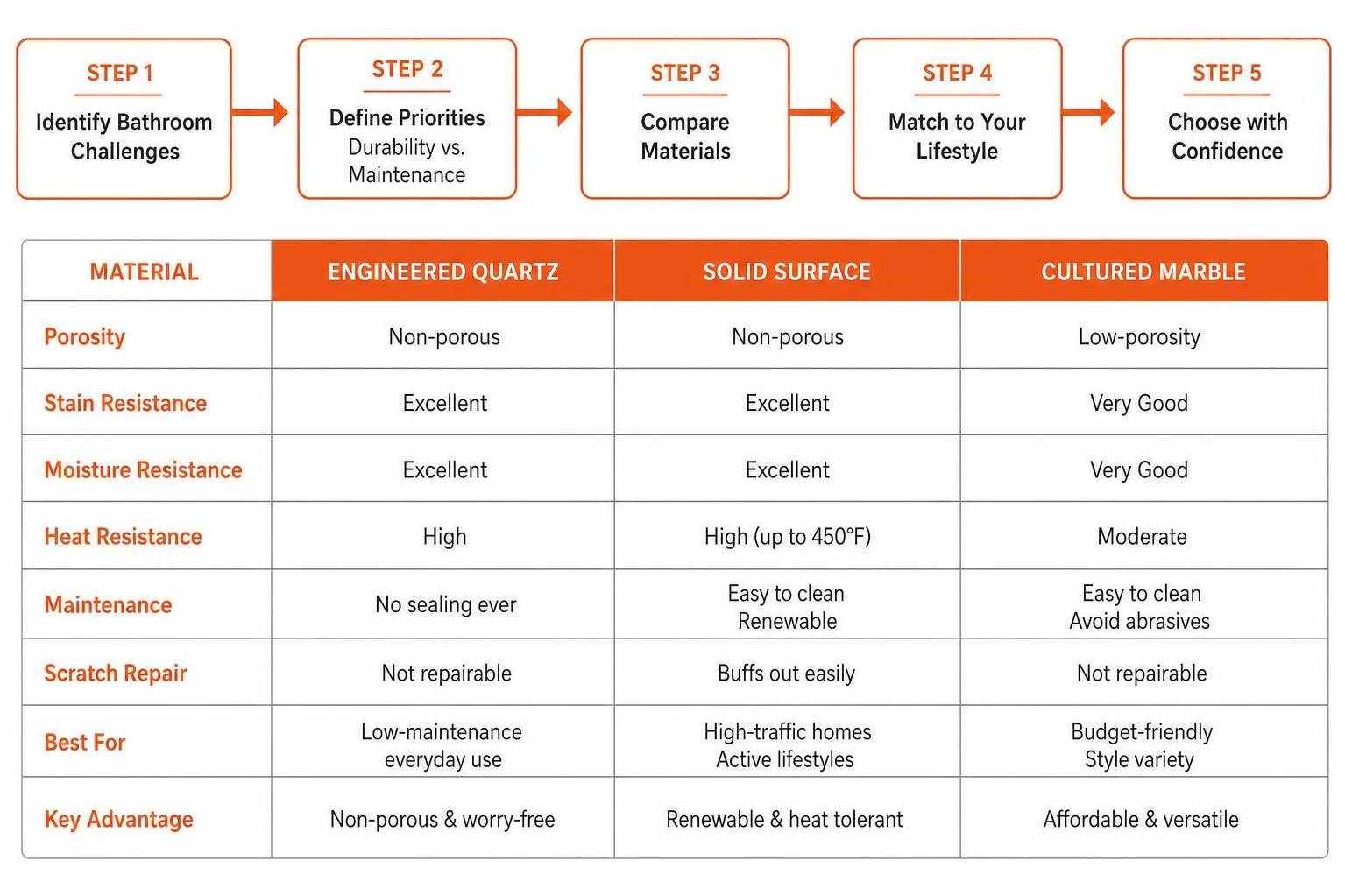
Here is a quick comparison table to help you visualize how these premium and engineered options stack up:
| Material | Porosity | Sealing Required? | Heat Resistance | Stain & Scratch Resistance |
|---|---|---|---|---|
| Engineered Quartz | Non-porous | No | Moderate (use trivet) | Excellent |
| Solid Surface | Non-porous | No | High (up to 450°F) | Excellent (renewable) |
| Cultured Marble | Non-porous | No | Moderate | Good (avoid abrasives) |
| Granite | Porous | Yes (periodically) | Outstanding | Outstanding |
| Marble | Porous | Yes (frequently) | High | Prone to etching/scratching |
| Sintered Stone | Non-porous | No | Outstanding | Outstanding |
Standard Sizes and Measuring Guide
Before you fall in love with a specific color or material, you must get your measurements exactly right. Standard prefabricated vanity tops are manufactured to match the most common cabinet dimensions on the market.
Standard widths for vanity tops include 24, 30, 36, 37, 48, 60, 61, and 72 inches.
- 24 to 30 inches: Perfect for small powder rooms or guest bathrooms where saving physical floor space is the priority.
- 36 to 37 inches: The sweet spot for a standard guest bath, offering a great balance of storage and usable counter space.
- 48 inches: A generous single-sink size that gives you plenty of room for cosmetics and daily grooming essentials.
- 60 to 72 inches: The standard range for double-sink master vanities, ensuring that partners don’t bump elbows during the morning rush.
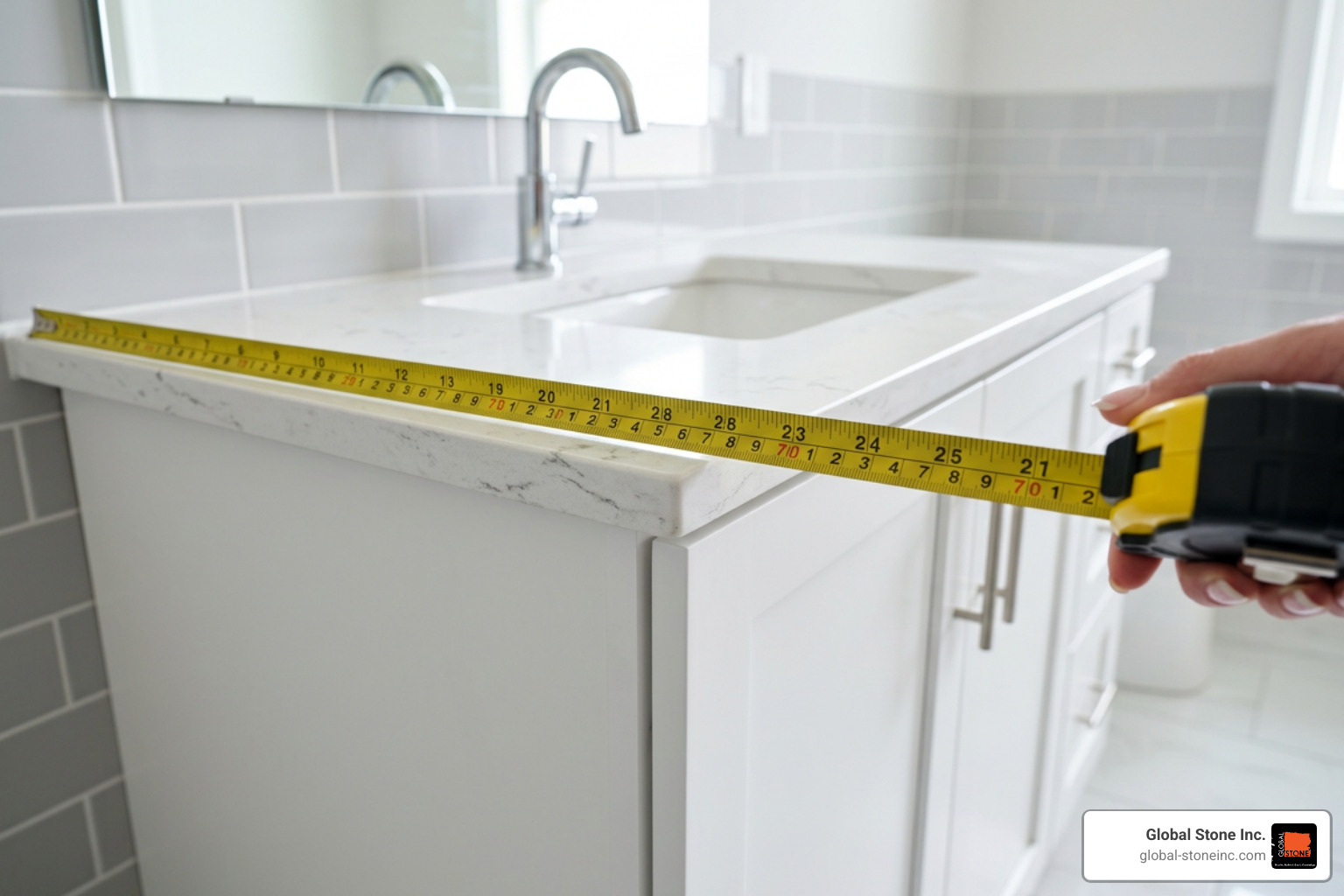
When buying a vanity top, it is designed to be slightly wider and deeper than the cabinet itself to create a small overhang. Typically, a standard vanity cabinet has a depth of 21 inches, which means you will want to look for a vanity top with a depth of 22 to 22.25 inches. This creates a standard 1/2-inch overhang on the front and sides, which prevents water from dripping directly down the face of your cabinetry.
If you are navigating standard mid-sized options, our 37 x 22 vanity top guide details how to ensure a flawless fit. If you have a slightly shallower cabinet, learning How to Choose the Right 22 Inch Vanity Top will help you find the perfect shallow-depth configuration.
How to Measure for a Replacement Bathroom Vanity Top
If your existing bathroom vanity cabinet is still in great structural shape, you don’t need to tear out the whole unit. Replacing just the bathroom vanity top is one of the most cost-effective, high-impact DIY weekend projects you can do.
To ensure your replacement top fits perfectly, follow this step-by-step measuring sequence:
If your vanity is tucked into a corner or an alcove between two walls, you must measure the distance wall-to-wall at the back, middle, and front of the opening. Walls are rarely perfectly square, and a top that is even 1/8 of an inch too wide will not slide into place.
Additionally, look inside your cabinet to check where your hot and cold water supply valves and drain line sit. You want to make sure the bowl of your new vanity top doesn’t collide with your existing plumbing layout. Once you have your new top ready to place, knowing how to secure your vanity top with the right silicone adhesive will prevent any future shifting or wobbling.
Sinks, Faucets, and Backsplashes
The sink and faucet are the focal points of your vanity top, and how they integrate into the surface impacts both your daily cleaning routine and the overall design style.
Integral vs. Undermount Sinks
When browsing vanity tops, you will generally choose between two primary sink styles:
- Integral Sinks: These are molded directly out of the same piece of material as the countertop itself (very common in solid surface, cultured marble, and ceramic tops). Because there are no seams, joints, or caulk lines whatsoever, they are incredibly easy to clean. You can wipe water and debris straight into the bowl without anything getting caught in a seam.
- Undermount Sinks: These separate basins (often made of durable vitreous China) are mounted securely beneath the countertop slab. This creates a clean, modern look and allows you to showcase the beautiful polished edge of natural stone or quartz.
Sink Shapes and Counter Space
- Oval Sinks: A classic choice. The curved lines soften the overall look of the vanity and are excellent for traditional, transitional, or cozy cottage-style bathrooms.
- Rectangular Sinks: Extremely popular in modern and contemporary designs. Because they have vertical sides, they maximize the usable water volume inside the basin and provide a deep, generous wash area.
- Square Sinks: Bold and geometric, square sinks are perfect for compact powder rooms or minimalist floating vanities where you want a sharp, architectural statement.
That rectangular basins take up slightly more physical space below the counter, which can slightly reduce your active countertop surface space compared to a compact oval bowl.
Faucet Hole Configurations
Faucets are not one-size-fits-all, and your vanity top must be pre-drilled to match the specific faucet style you plan to install. The three most common configurations include:
- Single Hole: Designed for modern, single-handle faucets that control both temperature and flow with one lever. This setup leaves the most open counter space and is incredibly easy to clean around.
- 3-Hole Centerset (4-inch): A traditional configuration where the hot/cold handles and the spout are combined on a single base plate, with the outer holes spaced 4 inches apart. This is highly common in standard, budget-friendly bathrooms.
- 8-Inch Widespread: A premium, highly elegant setup where the hot handle, cold handle, and spout are three entirely separate pieces, spaced 8 inches apart. This creates a wider, more luxurious look that is common in master suites.
Always purchase your faucet first or double-check the drilling specs of your vanity top before ordering to avoid a costly mismatch!
Frequently Asked Questions
What is the difference between a vanity top and a bathroom countertop?
While these terms are often used interchangeably in casual conversation, they do have distinct differences in the home improvement industry:
- Vanity Top: Typically refers to a prefabricated, all-in-one unit that comes pre-sized to fit standard cabinet widths. It often features a pre-drilled faucet pattern and can even include a pre-installed or integrated sink basin.
- Bathroom Countertop: Generally refers to a custom-fabricated slab of stone (like quartz, granite, or marble) that is custom-cut from a larger raw slab to fit a specific, non-standard cabinet layout, double-vanity run, or unique architectural space.
How do I clean and care for different vanity top materials?
Different materials require different levels of care to keep them looking brand new:
- Quartz Care: Clean daily with a soft cloth, warm water, and mild dish soap. Although highly stain-resistant, you should wipe up strongly pigmented spills (like hair dye or makeup) quickly. For detailed care tips, refer to our guide on how to clean quartz.
- Natural Stone (Granite & Marble): Avoid acidic cleaners, vinegar, and abrasive scrubbers. Use a dedicated, pH-neutral stone cleaner. To prevent water spotting and deep stains, ensure your stone is sealed at installation and periodically resealed. Check out our marble countertop maintenance tips to keep your natural stone looking pristine.
Do I need a backsplash with my vanity top?
While not strictly mandatory for structural stability, a backsplash is strongly recommended if your vanity sits flush against a wall. The bathroom is a high-moisture environment, and water will inevitably splash behind the faucet.
A matching 4-inch stone backsplash protects your drywall from water damage, mold growth, and peeling paint, while creating a cohesive, professional finish.
Conclusion
Your bathroom vanity top is more than just a place to set your toothbrush—it is a central design element that can elevate your entire bathroom into a relaxing, functional oasis. Whether you opt for the ultra-low maintenance of engineered quartz, the seamless utility of solid surface, or the breathtaking, one-of-a-kind luxury of natural granite or marble, matching the material to your lifestyle is the key to long-term satisfaction.
At Global Stone Inc., we have spent over 20 years serving the Chicago area from our state-of-the-art fabrication facility in Elk Grove Village, IL, alongside our convenient Naperville and Chicago locations. Because we employ our own in-house design, fabrication, and installation teams, we are proud to offer an industry-leading lifetime warranty on our craftsmanship.
If you are ready to upgrade your bathroom with a gorgeous custom stone vanity top, explore our detailed guide to bathroom countertops or contact us today to schedule your design consultation!