
What is a Banjo Bathroom Countertop and Do You Need One?
What is a Banjo Countertop and How Does It Work?
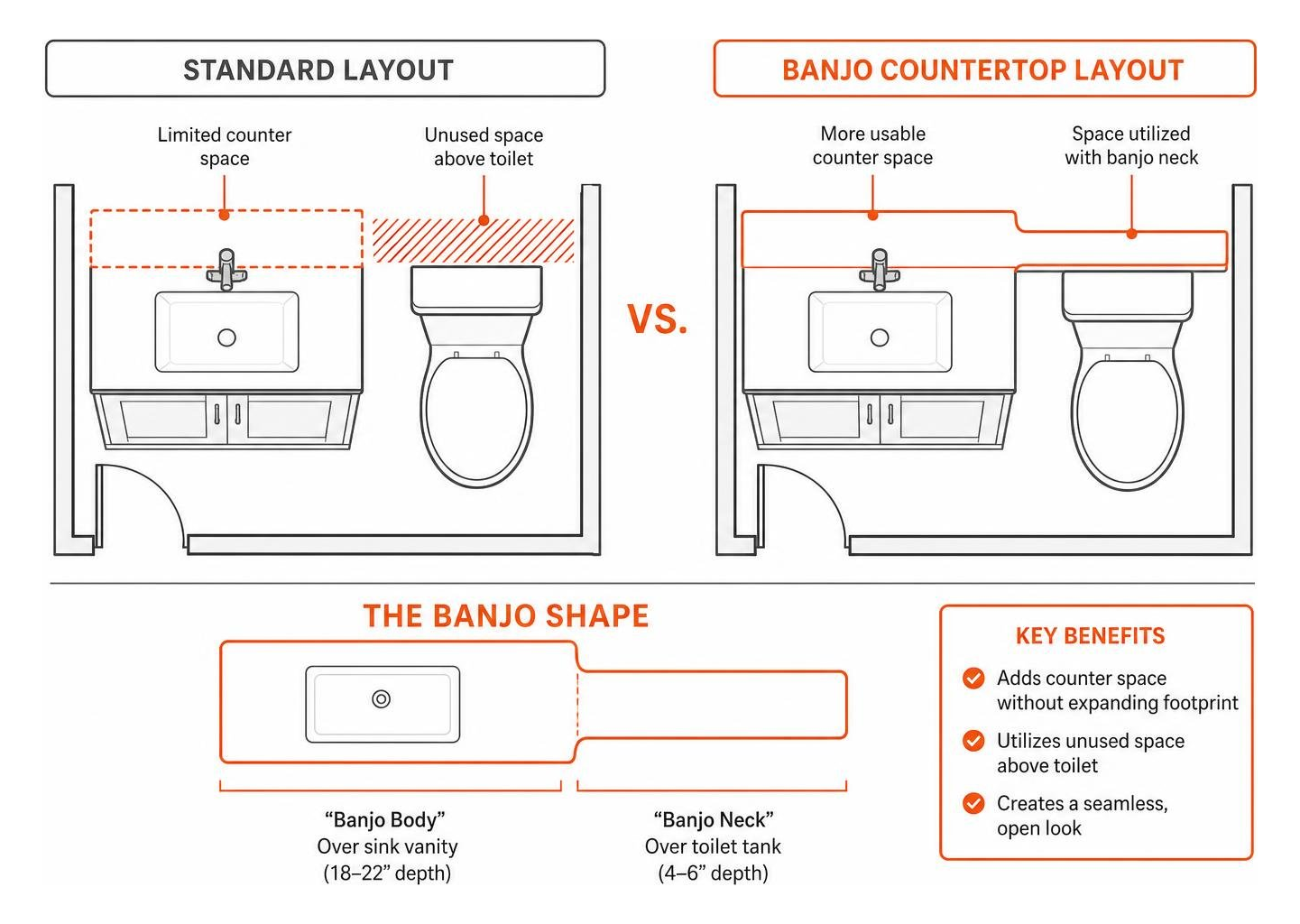
A banjo countertop works by taking advantage of unutilized airspace in your bathroom. In most standard powder room layouts, the space directly above the toilet tank sits completely empty while the adjacent sink vanity struggles for breathing room. A banjo bathroom countertop bridges this gap by extending a continuous slab of stone from the primary vanity base out over the toilet tank.
This design creates a seamless counter run without expanding the footprint of the vanity cabinet below. You get extra room for hand soap, guest towels, tissue boxes, and everyday essentials without sacrificing valuable floor space or creating traffic bottlenecks. By cantilevered extension over the plumbing fixture, the slab offers functional utility right where space is usually squandered. For an in-depth breakdown of standard vanity dimensions and material options, check out our A-Z Guide to Bathroom Vanity Top Materials Sizes.
Origin and Unique Shape
The term “banjo” comes directly from the silhouette of the slab when viewed from above. The deep main section over the sink cabinet represents the circular body of the instrument, while the slender shelf stretching over the toilet tank mimics the long, narrow neck.
This clever geometric transition creates a powerful spatial illusion in small powder rooms. By running a single, uninterrupted ledge along the wall, the eye perceives a wider, more fluid room layout rather than a choppy collection of disconnected fixtures. Custom edge profiles, such as rounded bullnose, sleek bevel, or elegant ogee edges, can be carved along the entire perimeter to unify the neck and body of the piece. If you are exploring options for compact sink setups, our guide on how to choose the best 26 inch vanity top with sink for your remodel offers helpful sizing insights.
Materials Used in Banjo Bathroom Countertops
Because the cantilevered “neck” of a banjo top suspends over the toilet without full cabinet support underneath, choosing a durable, rigid material is essential for structural stability.
- Quartz: Engineered quartz is our top recommendation for modern banjo tops. It is non-porous, highly stain-resistant, and possesses exceptional flexural strength, meaning it handles the structural overhang beautifully without cracking under load.
- Granite: Natural granite slabs offer unmatched tensile strength and unique, natural veining. When sealed properly during installation, granite withstands daily moisture, harsh cleaners, and adds significant long-term home value.
- White Marble: For a luxurious, classic aesthetic, white marble creates a bright, reflective surface that helps small powder rooms glow. Marble requires periodic sealing to guard against etching, but its timeless beauty remains unmatched.
- Engineered Stone & Solid Surfaces: Cost-effective and highly customizable, engineered materials allow seamless joints, integrated backsplashes, and custom edge shaping to fit tight alcoves effortlessly.
To explore all stone possibilities and slab thickness options, read our detailed guide to bathroom countertops.
Pros and Cons of Banjo Bathroom Countertops
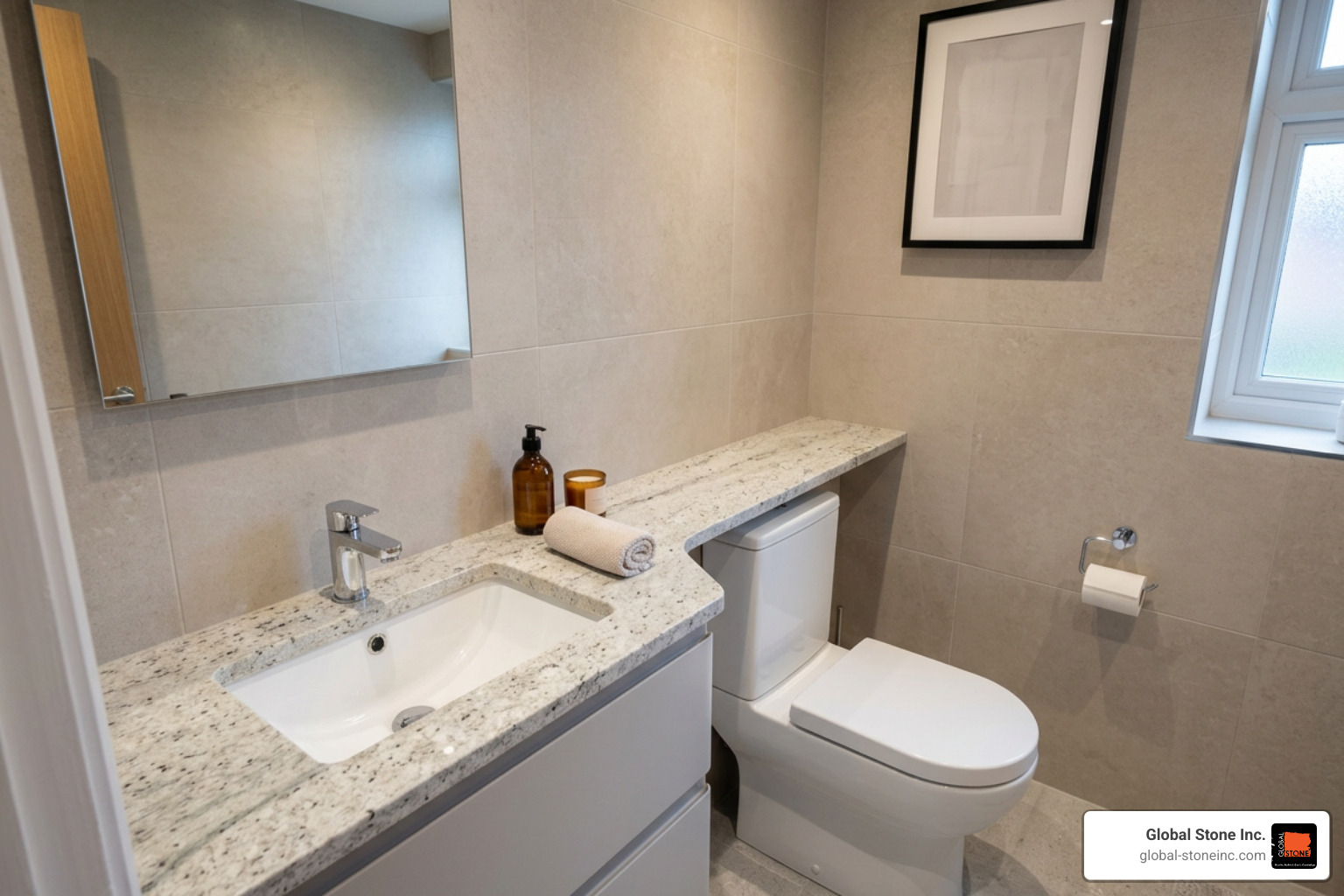
While banjo bathroom countertops solve many spatial headaches, they also introduce specific installation, clearance, and maintenance considerations. Evaluating these pros and cons will help you decide if this specialized layout matches your lifestyle, bathroom dimensions, and budget.
Key Benefits for Small Powder Rooms
- Expanded Surface Area: The primary perk is pure convenience. You gain an extra 18 to 36 inches of horizontal stone ledge without taking up an extra inch of floor space.
- Enhanced Visual Continuity: Extending stone continuously across two functional zones unifies the bathroom design. Pair it with a wide, framed wall mirror to double the visual depth of the room and bounce light naturally.
- Safer Overhead Storage: Unlike wobbly freestanding over-the-toilet wire racks or tension shelves that risk tipping over, a wall-anchored stone banjo shelf provides a rock-solid, safe surface for heavier bath decor and grooming items.
- Airy Atmosphere: Keeping the space below the extended arm open keeps floor sightlines clear, preventing compact 8×5 foot powder rooms from feeling cramped or cluttered.
For style ideas on maximizing compact layouts, see our 5 tips for choosing bathroom countertops that radiate style.
Potential Drawbacks and Clearance Challenges
The most prominent disadvantage of a banjo bathroom countertop involves toilet tank access and plumbing maintenance. Because the stone ledge sits directly over the cistern, servicing internal toilet components requires careful initial measurement.
- 29-Inch Clearance Rule: You must maintain a minimum of 29 inches of vertical space from the finished floor to the underside of the countertop extension. This leaves a crucial 2-inch to 3-inch gap above the toilet tank lid so you can slide the lid out horizontally during flapper or fill valve repairs.
- Custom Fabrication Costs: Unlike standard off-the-shelf vanity tops, banjo tops require custom laser templating, precision CNC cutting, and specialized wall support bracket installation. Custom stone cutouts and edge detailing add fabrication overhead compared to standard pre-cut tops.
| Feature / Detail | Banjo Countertop | Standard Freestanding Vanity |
|---|---|---|
| Counter Space | High (Extends over toilet) | Limited to cabinet width |
| Floor Footprint | Compact (Unchanged) | Varies (Requires wider cabinet for more surface) |
| Toilet Maintenance Access | Requires 2–3″ top gap or lift lid clearance | 100% Unobstructed |
| Visual Effect | Makes room appear wider | Breaks wall into separate fixture zones |
| Fabrication Requirement | Custom fabrication & wall bracket anchoring | Stock pre-cut options available |
| Typical Cost Range | $400 – $2,300+ depending on stone | $200 – $1,200 |
Replacing or Removing a Banjo Countertop: What You Need to Know
If you are updating an older 1980s or 1990s bathroom, you might consider removing an existing banjo top to install a sleek, freestanding vanity or modern floating unit. Homeowners often run into unexpected secondary updates when taking out a banjo top—as documented in real-world remodels like this banjo countertop before and after remodel.
Wall Mirror and Drywall Considerations
Banjo tops are almost always paired with full-width wall mirrors that span from the sink edge to the far side of the toilet wall. Removing the extended shelf creates ripple effects across your walls and fixtures:
- Exposed Unfinished Wall: The section of drywall previously hidden under the stone extension will likely lack paint, texture, or even finished drywall mud.
- Mirror Gaps: Removing the banjo shelf will leave a noticeable gap under a wall-to-wall mirror. You will either need to replace the mirror entirely with a framed vanity mirror or install custom decorative wood trim along the bottom edge to cover the raw gap.
- Lighting Relocation: Overhead light fixtures centered over a wide, full-width mirror may look off-center once you downsize to a narrow, standalone vanity cabinet.
When setting up your new vanity layout, review our instructions on how to stop the wobble: how to secure your bathroom vanity top and our complete bathroom countertop installation overview.
Design Alternatives to Banjo Bathroom Countertops
If you want extra storage without installing or keeping a banjo bathroom countertop, consider these popular modern design alternatives:
- Floating Wall Shelves: Mounting two sturdy hardwood or quartz floating shelves directly above the toilet provides vertical storage without blocking tank lid removal or interfering with plumbing.
- Recessed Medicine Cabinets: Recessing storage into the wall cavity between studs preserves physical elbow room over the sink while offering hidden organization.
- Compact High-Efficiency Vanities: Selecting a specialized narrow-depth cabinet paired with a quality stone top can yield surprising storage without crowding the room. Learn more about sizing options in our guide on how to choose the right 22 inch vanity top.
Frequently Asked Questions About Banjo Countertops
How much vertical clearance is needed above the toilet tank?
You need at least 29 inches of total vertical clearance measured from the finished floor to the underside of the banjo extension. This leaves a vital 2-inch to 3-inch gap above standard 26- to 27-inch tall toilet tanks, giving you ample room to slide the tank lid off horizontally whenever plumbing maintenance, fill valve replacements, or flapper adjustments are required.
Can you cut off a banjo countertop overhang to fit a new toilet?
Yes, you can trim off an existing banjo extension if you are installing a modern high-efficiency or comfort-height toilet that sits taller than the original fixture. Professional stone fabricators use a heavy-duty circular saw equipped with a continuous-rim diamond blade and wet-cutting dust attachment to carefully score and cut quartz, granite, or laminate surfaces. The raw edge is then shaped, ground with diamond polishing pads, and buffed to match the existing counter finish.
Are banjo countertops outdated in 2026?
While thin 1970s laminate banjo counters with plastic edging feel dated, modern banjo bathroom countertops crafted from 3cm quartz, natural granite, or porcelain are extremely popular in high-end urban remodels. Using concealed heavy-duty steel wall brackets instead of visible wood corbels creates a floating, minimalist profile that fits perfectly into sleek contemporary home aesthetics.
Conclusion
Banjo bathroom countertops remain one of the most effective and elegant structural solutions for maximizing usable surface area in compact powder rooms and cozy guest baths. By extending premium stone across the unused space above your toilet, you gain functional storage, clean visual continuity, and an open, expansive bathroom layout.
Whether you need a custom laser-templated quartz banjo top or expert guidance on replacing an outdated vanity setup, professional stone crafting ensures lasting beauty and perfect fit. At Global Stone Inc., our expert in-house team brings over 20 years of custom stone fabrication and installation experience to homeowners across the Chicago area, including Elk Grove Village and Naperville. Backed by our lifetime warranty and state-of-the-art Elk Grove Village facility, we make vanity upgrades seamless from start to finish. Explore custom stone countertops with us today to design the ideal surface for your home!