
A Quick Start Guide to Stone Kitchen Wall Tiles
Why Stone Kitchen Wall Tiles Are a Smart, Lasting Choice
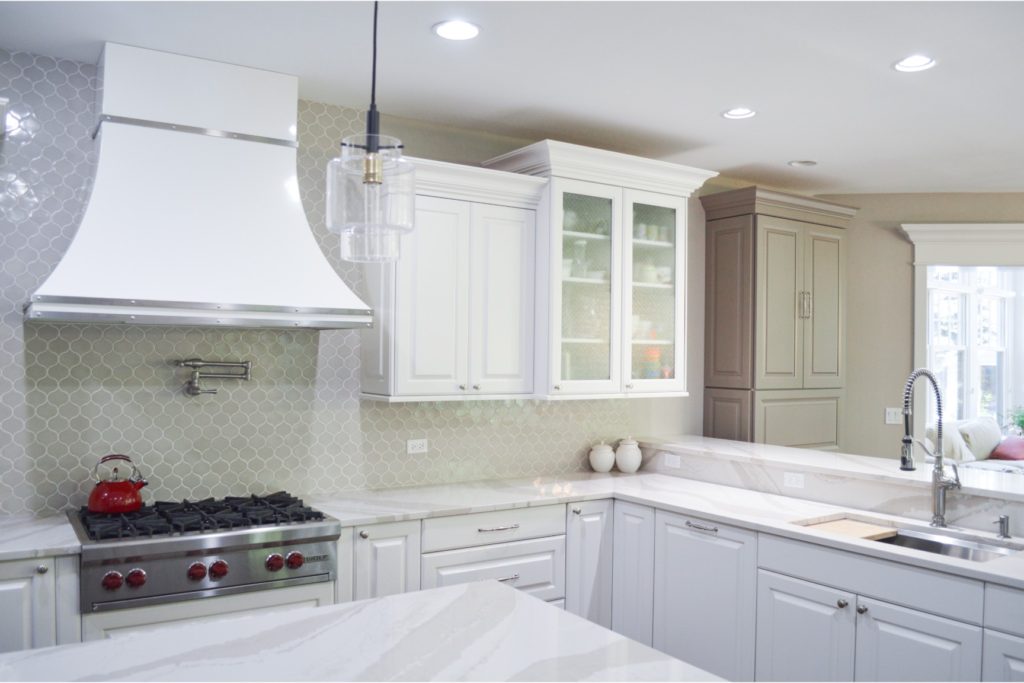
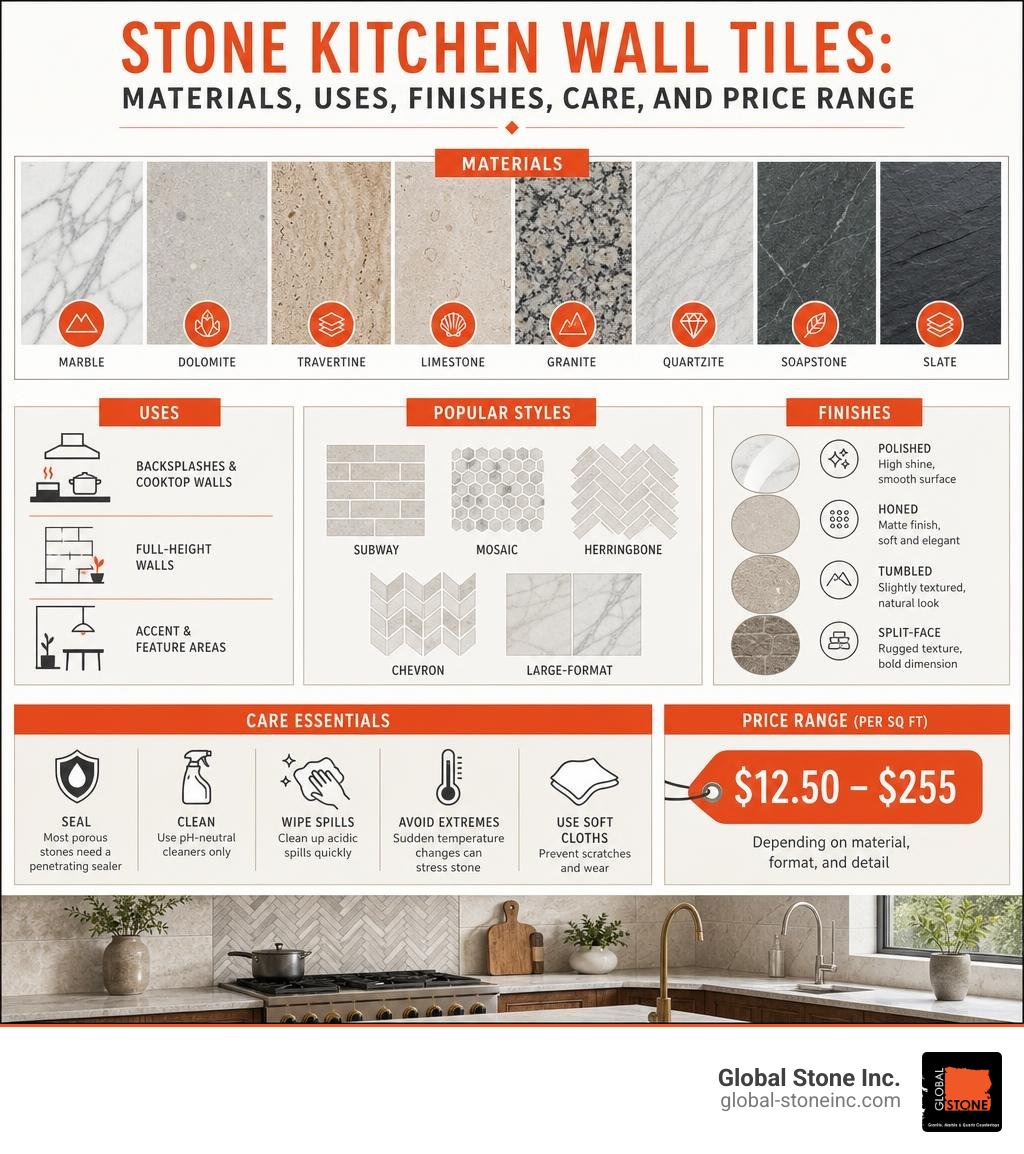
Stone kitchen wall tiles bring natural color, texture, and durable surface protection to backsplashes, full-height walls, and feature areas. Popular choices include marble, dolomite, travertine, limestone, granite, quartzite, soapstone, and slate – each with a distinct look and care needs.
| Quick answer | What to know |
|---|---|
| Best use | Backsplashes, cooktop walls, and accent walls |
| Best-known styles | Marble subway tile, mosaic, herringbone, chevron, and large-format stone |
| Main benefit | A timeless, heat-tolerant wall finish with natural variation |
| Important care step | Most porous stones need a penetrating sealer and pH-neutral cleaning |
| Typical tile cost | About $12.50 to $255 per square foot, depending on material, format, and detail |
Unlike manufactured tile, real stone has veining, mineral movement, and small variations that make every installation feel one of a kind. It can suit a clean modern kitchen, a warm farmhouse space, or a classic design – but choosing the right stone, finish, grout, and installation method matters in a room exposed to heat, water, grease, and food splashes.
I am Greg Zamarski of Global Stone Inc., with more than 20 years of experience in natural-stone fabrication and kitchen installation across the Chicago area. That hands-on work with marble, granite, quartz, travertine, and stone kitchen wall tiles helps homeowners connect a beautiful backsplash with a countertop and installation plan built to last.
Key Benefits and Popular Types of Stone Kitchen Wall Tiles
When remodeling a kitchen in Chicago, Naperville, or Elk Grove Village, homeowners frequently ask us whether natural stone wall tiles are worth the investment compared to standard ceramic or porcelain field tile. The answer lies in natural stone’s unique blend of longevity, visual character, and structural integrity.
Beyond its striking aesthetic appeal, stone kitchen wall tiles provide severe heat resistance behind cooktops and ranges, exceptional durability against daily wear, and a tangible increase in resale value. Unlike synthetic prints, real stone ages gracefully, acquiring a fine natural character over decades. To explore how wall tiles coordinate with overall kitchen architecture, take a look at The Complete Guide to Backsplashes.
Classic Marble and Dolomite Stone Kitchen Wall Tiles
Marble remains the premier choice for elegant kitchen backsplashes. Famous varieties like Bianco Carrara and Calacatta Gold deliver soft white-to-gray backgrounds accented by delicate feathered or bold gold veining. Statuary and Thassos marble offer luminous, brilliant white surfaces that amplify natural sunlight across kitchen walls.
Dolomite stone tile—often grouped alongside marble—is a magnesium-rich carbonate rock that provides enhanced density and slightly lower acid sensitivity. Varieties like Bianco Dolomiti offer bright white backdrops with subtle cloud-like mineral patterning.
When choosing marble or dolomite stone kitchen wall tiles, selecting the right surface finish dictates both style and upkeep:
- Honed Finish: Soft, velvety, and matte. Honed stone scatters ambient light, concealing micro-scratches, grease smudges, and minor etching far better than glossy surfaces.
- Polished Finish: Highly reflective and smooth. Polished tiles bring out maximum color depth and mineral veining, ideal for dramatic backsplashes, though they require routine wiping to maintain their pristine sheen.
For an in-depth look at selecting fine marble formats, see our detailed article, Rock-Solid Style: How to Choose the Perfect Marble Kitchen Wall Tile.
Rustic Travertine, Limestone, and Lavastone Options
For spaces seeking warm, organic, or Old-World charm, sedimentary and volcanic stones offer incredible tactile depth.
- Travertine: Formed in hot springs, travertine features subtle voids and earthy tones ranging from warm ecru and beige to walnut and terracotta. Available in tumbled, brushed, or filled-and-honed finishes, travertine brings architectural texture to Tuscan and rustic farmhouse kitchens.
- Limestone: Sedimentary limestone (such as Cloud, Foussana, or Belgian Bluestone) offers velvety, muted tones ranging from sandy cream to dark charcoal. Because limestone is porous, proper sealing is essential to protect it against kitchen oils and sauces.
- Lavastone and Basalt: Volcanic stones like lavastone and basalt offer intense structural integrity and dark, moody palettes like charcoal grey and graphite black. Specialized cladding products, such as Lynia™ Graphite Lavastone Wall Tiles and machine-cut linear formats showcased in Lynia™ Stone Cladding Wall Tiles, leverage pre-mounted staggered strips on a mesh backing. These interlocking tiles create linear wall features with minimal visible joint lines. Lavastone naturally contains trace iron oxides; when exposed to moisture prior to sealing, subtle mineral variations or rust-like tones can emerge, adding natural character.
Granite, Soapstone, and Quartzite for High-Heat Walls
When cooking surfaces generate intense thermal radiation, stone selection becomes a functional priority.
- Granite Wall Tiles: Granite is an igneous rock packed with quartz and feldspar, offering incredible scratch resistance and minimal porosity. Granite tiles handle boiling oil splashes and extreme heat behind high-BTU gas ranges without scorching or cracking.
- Soapstone Tiles: Composed primarily of talc and rich minerals, soapstone is completely nonporous and chemically inert. It won’t stain from tomato sauce, lemon juice, or vinegar. Soapstone naturally withstands high heat, making it a favorite for stove surrounds. Over time, soapstone develops a soft, dark patina that can be accelerated with mineral oil. Pair these wall tiles thoughtfully using our guide to The Best Backsplash Options for Soapstone Countertops.
- Quartzite Tiles: Frequently confused with marble due to its elegant veining, natural quartzite is a metamorphic rock formed from quartz sandstone under intense heat and pressure. It delivers hardness and scratch resistance comparable to granite while offering the luxurious look of marble.
Comparing Different Stone Kitchen Tiles
Understanding how stone tile species differ in performance, maintenance, and cost ensures you select a wall finish that aligns with your household’s routine.
Performance and Durability Comparison
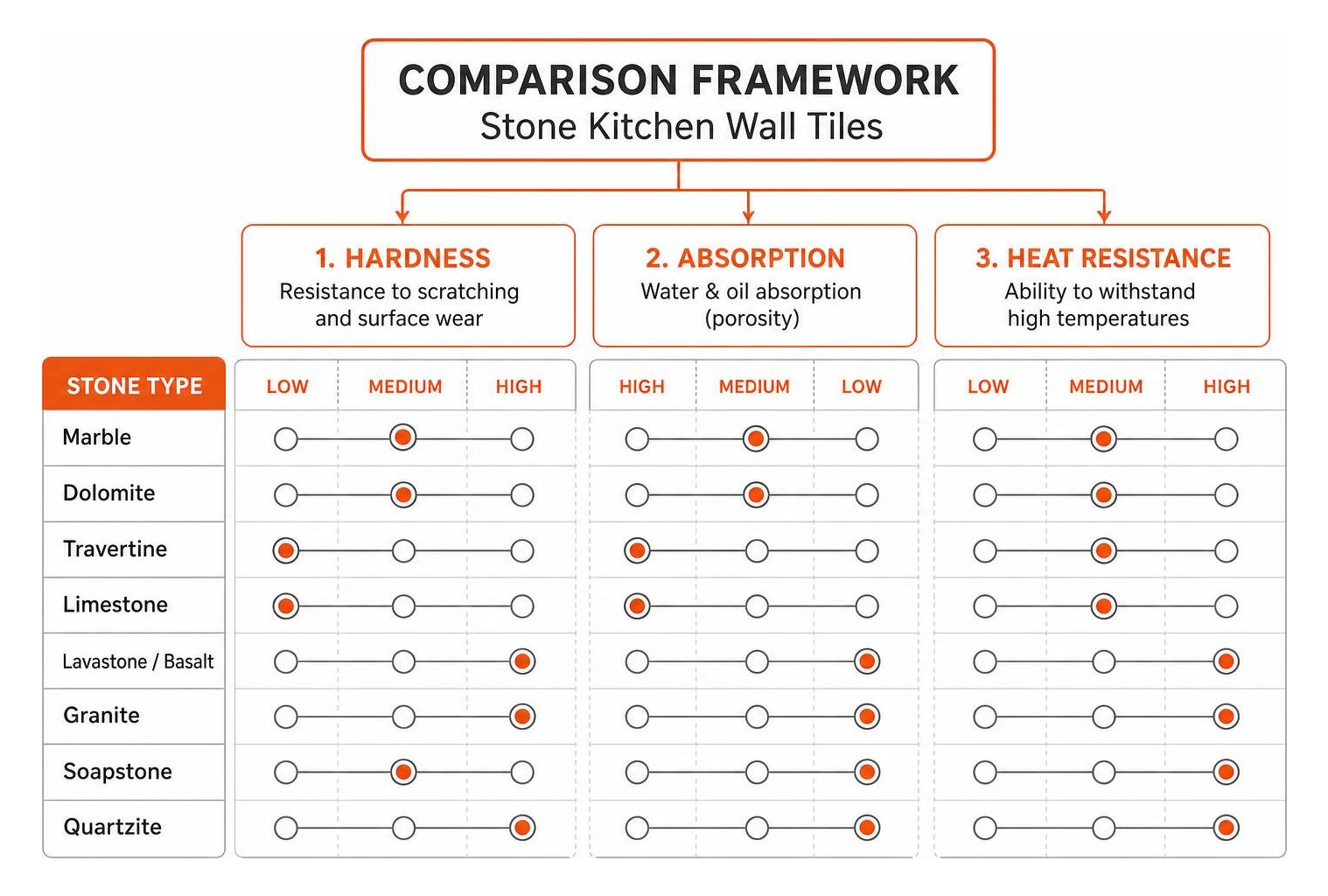
To help you compare key parameters, we have summarized performance metrics across popular natural stone wall tile categories:
| Stone Material | Hardness & Wear Resistance | Water & Oil Absorption | Acid & Stain Resistance | Ideal Maintenance Level |
|---|---|---|---|---|
| Marble | Moderate | Moderate (Needs Sealer) | Sensitive to Acid Etching | Moderate-High (Periodic Sealer) |
| Dolomite | Moderate-High | Low-Moderate | Moderately Sensitive | Moderate |
| Travertine | Moderate | High (Unfilled) / Moderate (Filled) | Sensitive to Acids | Moderate-High |
| Limestone | Moderate | High (Needs Pre-Sealing) | Sensitive to Acids | Moderate-High |
| Granite | High | Low | High Resistance | Low |
| Quartzite | Very High | Very Low to Low | High Resistance | Low-Moderate |
| Soapstone | Soft Surface / Dense | Zero (Nonporous) | Completely Impervious | Very Low |
| Lavastone / Basalt | High | Moderate (Porous Voids) | Moderate | Moderate (Requires Pre-Sealing) |
Natural stones vary considerably in density and water absorption. Dense materials like quartzite and granite absorb virtually no liquid, whereas limestone and travertine require penetrating sealers to close open pores. For an expansive material comparison, explore The Ultimate Guide to Comparing Stone Kitchen Tiles.
Cost Analysis and Budgeting Tips
The cost of stone kitchen wall tiles spans a wide range based on rarity, manufacturing detail, and sheet assembly:
- Entry-Level Field Tiles ($12.50 – $25.00 / sq. ft.): Standard 3″ x 6″, 4″ x 12″, or 12″ x 24″ field tiles in common Carrara marble, travertine, slate, or tumbled limestone.
- Mid-Range & Mosaic Sheet Tiles ($25.00 – $65.00 / sq. ft.): Mesh-backed geometric mosaics including basketweave, herringbone, chevron, and polished 300x300mm sheets, such as high-grade Backsplash Kitchen Wall Stone Marble Mosaic products.
- Luxury Waterjet Mosaics ($75.00 – $255.00+ / sq. ft.): Intricate, high-precision waterjet cut designs incorporating mixed marble tones, metallic stone accents, brass inlays, or multi-dimensional relief tiles (such as Orchid Dimensional Thassos mosaics).
- Trim Moldings & Decorative Edges ($17.00 – $77.00 / piece): Finishing pieces like bullnose, pencil moldings, crown caps, and base trim profiles used to complete exposed edges cleanly.
Budgeting should also account for professional installation labor, modified thinset mortars, unsanded tile grouts, and high-grade penetrating sealers. Alternatively, homeowners looking for temporary or ultra-lightweight alternatives sometimes turn to composite DIY options like Square Tile Backsplash Ecru Stone Self Adhesive Wall Tiles or linear stick-on sheets such as Ecru Peel and Stick Stone Backsplash Premium Linear Blend Tile. However, for permanent home value, real stone fixed with modified polymer mortar remains the gold standard. Homeowners seeking full wall panels without heavy tile grout maintenance can also investigate composite stone wall solutions such as those described on the Stone Wall Backsplash Rubble Stone DW8620 | Designerwand product page.
Designing Your Kitchen Backsplash with Stone Tiles
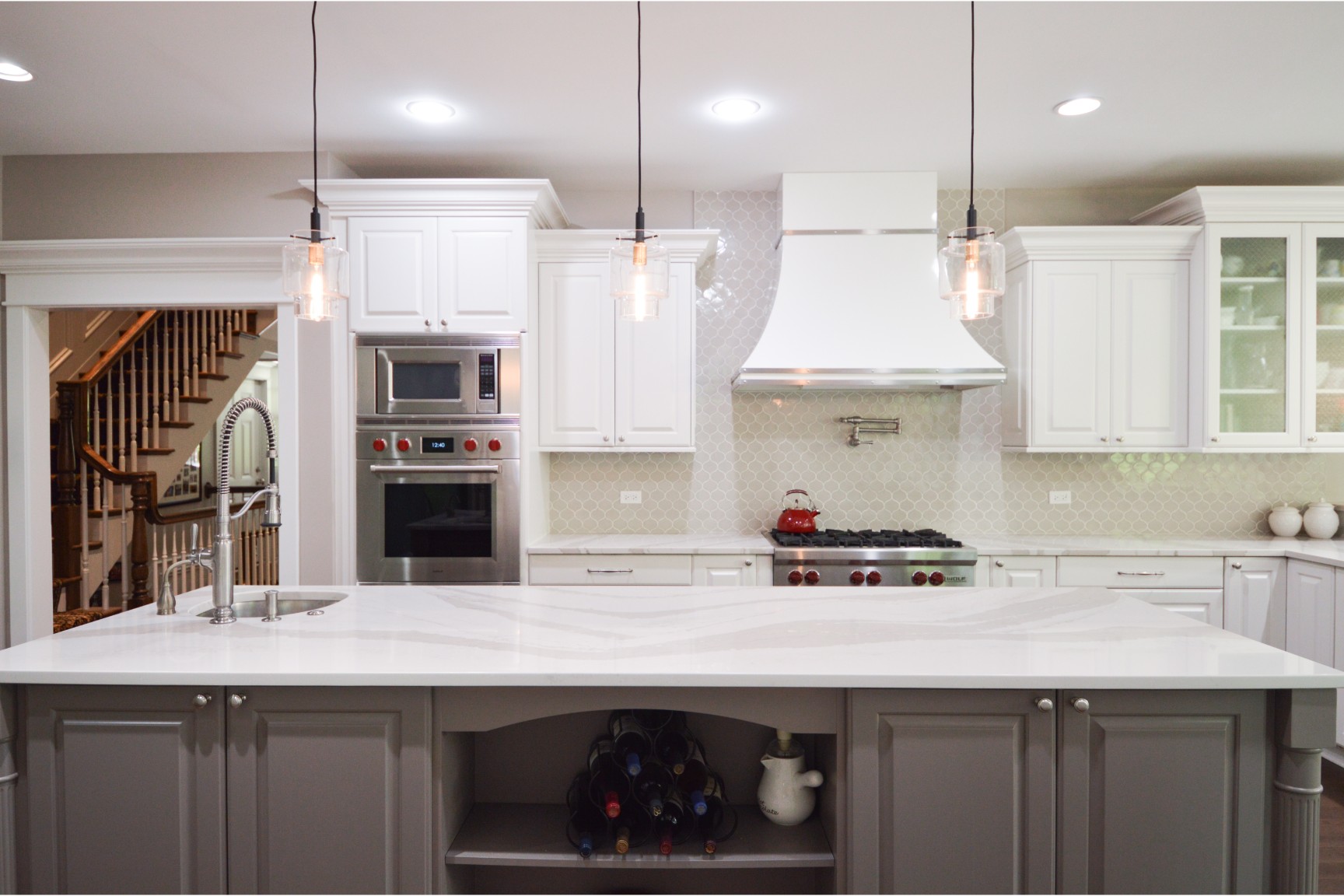
A stone backsplash is often the central visual element of a kitchen. Whether installed as a focal feature behind the stove or wrapped around the room as a full-height wall, stone kitchen wall tiles unify countertop surfaces, cabinetry, and lighting.
Choosing the Best Stone Kitchen Wall Tiles for Your Design Style
Matching your tile to your overall kitchen aesthetic ensures visual harmony across all architectural elements:
- Modern & Minimalist: Large-format 12″ x 24″ honed white dolomite or Carrara marble tiles reduce visible grout lines, creating clean, continuous stone planes that complement handleless cabinets and modern quartz counters.
- Transitional & Classic: Honed 3″ x 6″ marble subway tiles arranged in running bond, or classic 2″ hexagon mosaic sheets, bridging traditional wood cabinetry with contemporary sleek appliances. If you have engineered quartz worktops, coordinate your backsplash using our creative design guide, 7 Stunning Backsplash Ideas for Your Calacatta Quartz Countertops.
- Rustic & Farmhouse: Tumbled travertine, chiseled-edge limestone, or rugged stacked stone ledger panels add warm, inviting texture against painted shaker cabinets and wood floating shelves.
Layout Patterns, Mosaic Waterjets, and Surface Finishes
The layout pattern you select changes how light reflects off your kitchen walls and how spacious the room feels:
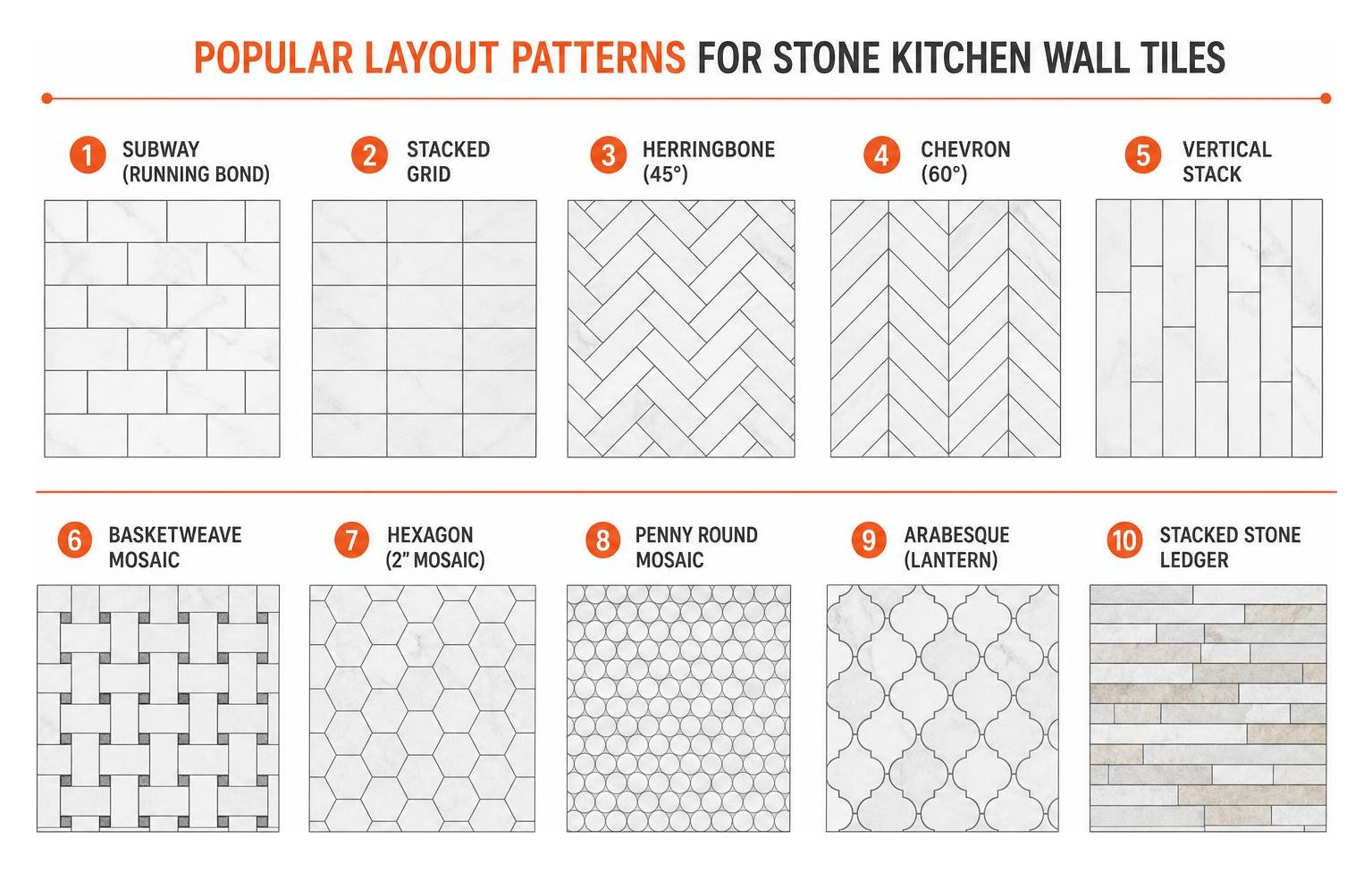
- Herringbone & Chevron: Setting rectangular stone tiles at 45 or 60-degree angles draws the eye upward, making standard 8-foot kitchen ceilings feel noticeably taller.
- Mesh-Backed Geometric Mosaics: Mosaics pre-assembled on 12″ x 12″ fiber mesh backing streamline installation for intricate patterns like basketweave, penny rounds, and arabesque shapes.
- Precision Waterjet Patterns: Advanced waterjet machinery cuts natural stone with micro-precision, allowing designers to interlock curving floral motifs, geometric stars, and mixed-stone accents with seamless 2mm grout joints.
Installation, Care, and Maintenance Guidelines
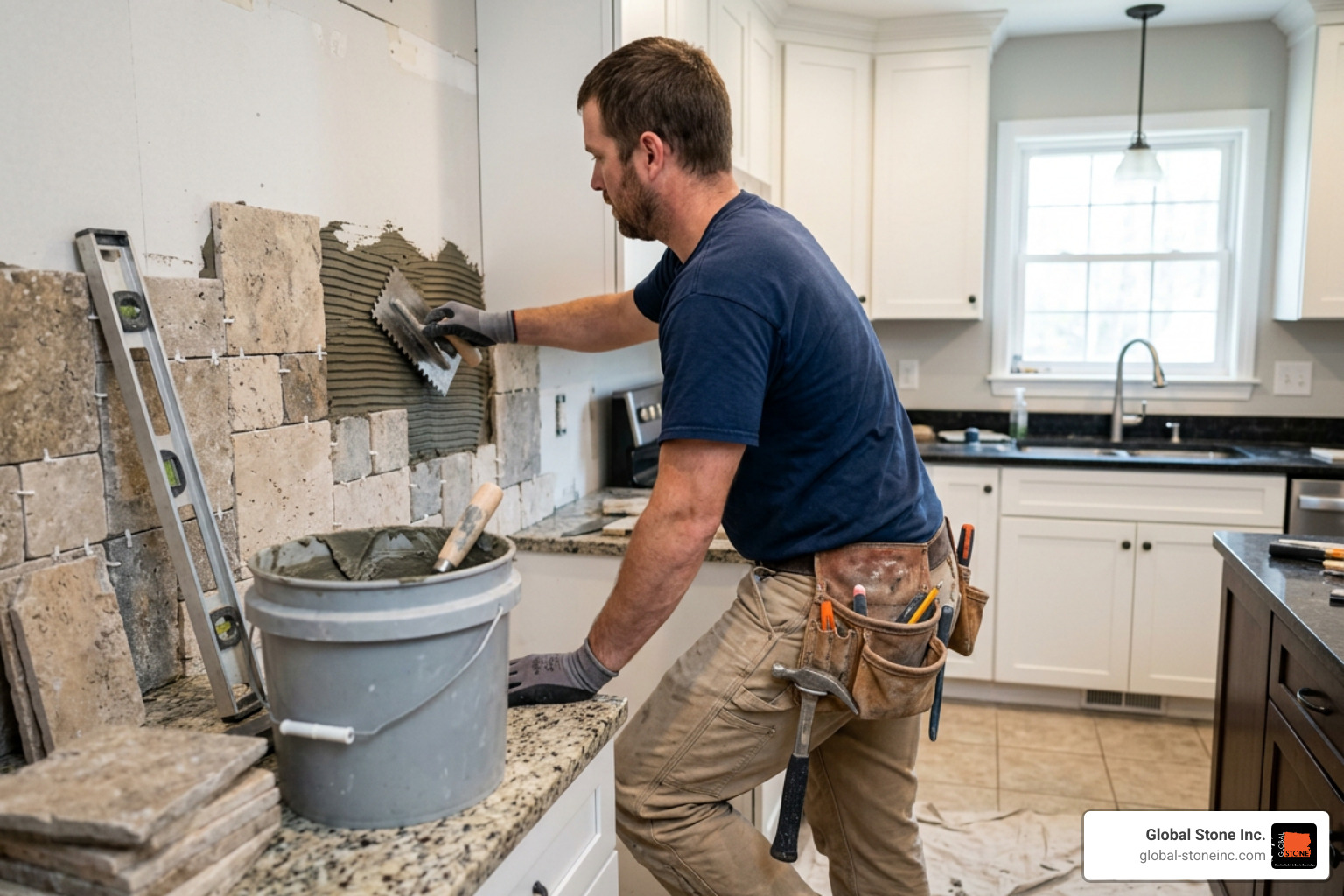
Installing stone kitchen wall tiles requires specialized techniques to ensure tiles adhere securely and resist water intrusion over time.
Pre-Sealing, Grout Selection, and Wall Preparation
Because natural stone is heavier than standard ceramic, wall preparation is essential:
- Substrate Preparation: Ensure the wall substrate is flat, clean, structurally sound, and capable of supporting stone weight. Cement backer board is strongly recommended over standard drywall in areas near sinks and cooktops.
- Pre-Sealing Porous Tiles: Texturized lava stone, porous basalt, tumbled travertine, and matte limestone must be pre-sealed with a high-quality penetrating sealer before grouting. Pre-sealing prevents grout pigment from locking into surface pits and microscopic voids, making final cleanup easy.
- Adhesive Mortar Selection: Use a white, polymer-modified thinset mortar (such as ANSI A118.4 compliant medium-bed mortar). White mortar prevents dark adhesive tones from shadowing through light marble or dolomite tiles.
- Grout Joint Selection: Use unsanded grout for delicate polished marble and stone mosaics with joint widths of 1/8″ (2mm) or narrower to avoid scratching polished surfaces. For wider rustic joints (over 1/8″), use high-grade sanded or non-sagging polymer grout.
Daily Cleaning and Long-Term Sealing Schedule
Proper ongoing care protects your stone wall tile investment against grease buildup and food stains:
- Daily Wiping: Wipe splatters promptly using a micro-fiber cloth dampened with warm water or a dedicated pH-neutral stone cleaner. Avoid harsh household cleaners containing bleach, ammonia, lemon juice, or vinegar, as acidic compounds chemically etch carbonate stones like marble, limestone, and travertine.
- Degreasing Cooktop Areas: Use a specialized pH-neutral degreaser formulated for natural stone to clean oil vapors above range hoods and cooktops.
- Re-Sealing Frequency: Apply a penetrating impregnating stone sealer every 12 to 24 months. Highly active cooktop splash areas may benefit from annual resealing. Perform the simple “water drop test”: splash a few drops of water onto the stone; if the water beads up, your seal is intact. If the water darkens the stone within a few minutes, it is time to reapply sealer.
For detailed maintenance instructions, read The Ultimate Guide to Cleaning Natural Stone Kitchen Wall Tiles.
Frequently Asked Questions About Stone Wall Tiles
How much do stone wall tiles cost per square foot?
Materials range from approximately $12.50 per square foot for standard field tiles up to $255.00 per square foot for luxury waterjet marble mosaics. Professional installation labor across the Chicago area typically adds $10 to $25 per square foot depending on pattern complexity, wall preparation, and trimming details.
Can natural stone tiles be installed directly behind a gas stove?
Yes. Solid natural stone tiles (such as granite, quartzite, marble, soapstone, and lavastone) are non-combustible and handle direct heat behind cooktops easily. Ensure tiles are set with heat-tolerant polymer thinset mortar and sealed thoroughly to prevent hot oil splatters from staining porous stone varieties.
How often should natural stone kitchen wall tiles be sealed?
Most indoor stone wall backsplashes should be sealed upon installation and resealed every 1 to 2 years. Nonporous stones like soapstone require no synthetic sealers, whereas porous limestones and travertine benefit from consistent annual sealant applications.
Conclusion
Choosing stone kitchen wall tiles elevates your home with natural beauty, rich tactile texture, and long-term structural durability. Whether you prefer the classic elegance of Carrara marble, the sleek warmth of honed dolomite, or the dramatic depth of dark lavastone, real stone provides a functional wall surface that withstands daily kitchen activity.
At Global Stone Inc., our in-house designers, fabricators, and installers bring over 20 years of hands-on stone experience to projects across Elk Grove Village, Naperville, and the greater Chicago area. Backed by our lifetime warranty, we help you pair the ideal wall tile pattern with your natural stone or quartz countertops seamlessly.
To protect your new backsplash for decades to come, review our complete care standards in The Ultimate Guide to Cleaning Natural Stone Kitchen Wall Tiles, or visit our Elk Grove Village showroom to start exploring stone tile samples today!