How to Choose the Perfect Artificial Stone Countertop for Your Kitchen
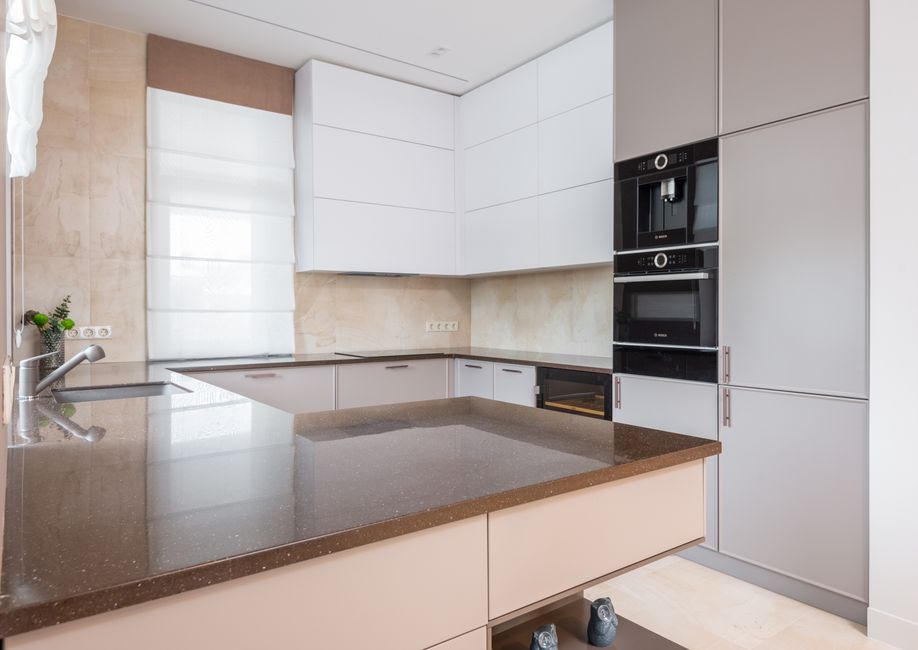
Is an Artificial Stone Countertop Right for Your Kitchen?
Choosing an artificial stone countertop is one of the most impactful decisions you can make during a kitchen or bathroom renovation. Here’s a quick comparison to help you decide at a glance:
| Feature | Engineered Stone | Granite | Marble |
|---|---|---|---|
| Porosity | Non-porous | Low porosity | Porous |
| Sealing required | No | Yes | Yes |
| Stain resistance | Excellent | Good | Poor |
| Heat resistance | Up to 300°F | High | Moderate |
| Scratch resistance | Mohs 6–7 | Mohs 6–7 | Mohs 3–4 |
| Outdoor use | No | Yes | Yes |
| Maintenance | Very low | Low | High |
| Pattern consistency | Uniform | Varies | Varies |
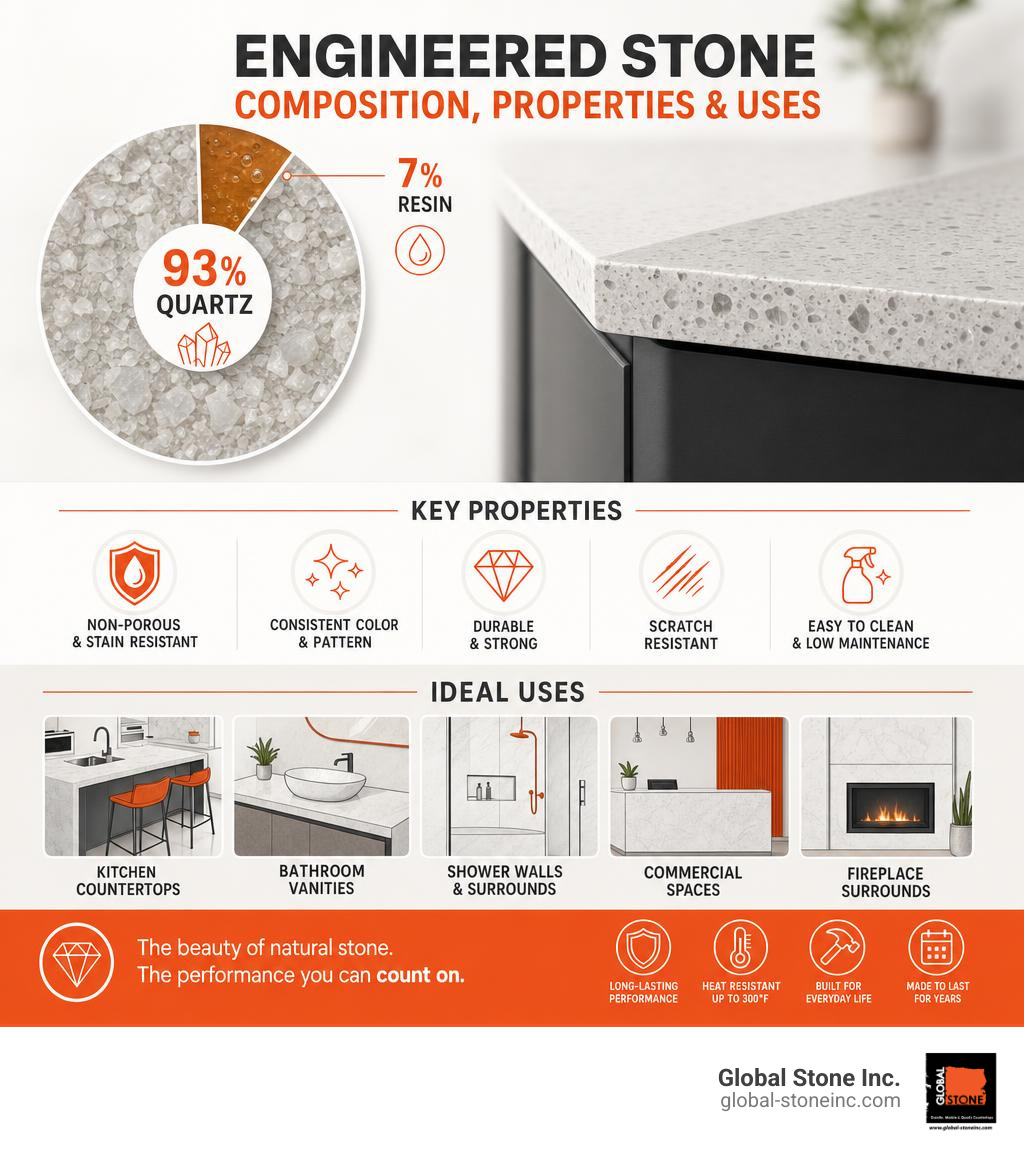
Engineered stone is a factory-made composite — typically 93% crushed quartz bound with 7% polymer resin. It looks like natural stone but performs more consistently, costs less to maintain, and never needs sealing.
The tradeoff? It can’t handle prolonged outdoor exposure, and placing very hot pots directly on it can cause damage.
If you want the beauty of marble or granite without the upkeep, engineered stone is worth a serious look.
I’m Greg Zamarski, and I’ve spent over 20 years fabricating and installing artificial stone countertops at Global Stone Inc. in Elk Grove Village — working on everything from modest bathroom remodels to large commercial projects. That hands-on experience shapes every recommendation in this guide.
Relevant articles related to artificial stone countertop:
What is an Artificial Stone Countertop?
An artificial stone countertop—most commonly referred to in the design world as engineered stone or quartz—is a manufactured composite surface. Unlike natural granite or marble slabs that are quarried directly from the earth in solid blocks, engineered stone is created in a factory setting.
The manufacturing process relies heavily on the Breton method, a highly advanced system developed by Breton S.P.A. in Italy during the 1960s. This process utilizes a specialized vibrocompression vacuum system. Raw quartz crystals are mixed with resins and pigments, poured into a mold, and then subjected to intense pressure, vibration, and vacuum conditions. The resulting slab is then cured in an oven, calibrated to an exact thickness, and polished to a brilliant, uniform shine.

Because of how it is constructed, many homeowners ask: is quartz actually a natural product? To dive deeper into this fascinating debate, explore our detailed guide on The Great Countertop Mystery: Is Quartz Actually Natural?.
Composition of an Artificial Stone Countertop
The exact recipe for an artificial stone countertop is engineered for maximum strength. By weight, these slabs typically consist of 90% to 93% stone aggregates (primarily crushed industrial-grade quartz, one of the hardest minerals on Earth) and 7% to 10% polymer or polyester resin binder. By volume, the ratio translates to roughly 66% quartz aggregate and 34% resin.
To achieve the stunning visual depth and coloration of these surfaces, manufacturers mix in mineral pigments and sometimes small reflective flecks of glass, mirror, or metallic ores. This high-pressure compaction results in a completely non-porous structure. There are no microscopic voids, cracks, or air pockets within the slab, making it highly sanitary and structurally uniform from edge to edge.
Artificial Stone Countertop vs. Natural Stone
When comparing engineered options to natural stones like granite, marble, or quartzite, the differences in performance and maintenance become clear. Granite and marble are highly prized for their unique, organic patterns, but they are naturally porous. They require regular sealing (usually once or twice a year) to prevent liquids from seeping deep into the stone and leaving permanent stains.
Quartzite, while incredibly hard (ranking 7 to 8 on the Mohs scale), is also a natural stone that requires sealing to protect its surface. Engineered quartz, on the other hand, never requires sealing.
| Performance Metric | Engineered Quartz | Natural Granite | Natural Marble |
|---|---|---|---|
| Porosity | Non-porous (Water absorption ≤ 0.05%) | Low porosity (Requires sealing) | High porosity (Highly prone to staining) |
| Maintenance | No sealing; wipe with soap and water | Periodic sealing; specialized stone cleaners | Regular sealing; highly sensitive to acids |
| Aesthetic Control | Perfectly consistent across multiple slabs | Highly variable; must view exact slab | Highly variable; prone to etching and scratching |
To see how these materials perform head-to-head in a real-world kitchen environment, check out our Quartz Countertops vs Marble Countertops Kitchen Showdown.
Key Advantages and Disadvantages of Engineered Stone
No countertop material is entirely perfect. Understanding both the strengths and limitations of engineered stone will help you determine if it fits your household’s lifestyle.
Advantages:
- Incredible Durability: The high quartz content makes it highly resistant to chips and impacts.
- Stain Resistance: Spilled coffee, red wine, lemon juice, or olive oil sit on top of the surface rather than soaking in, making cleanup simple.
- Low Maintenance: You will never have to buy specialized sealers, color-enhancers, or chemical polishes.
- Design Consistency: If you have a large kitchen requiring multiple slabs, the veins and colors will match seamlessly.
To learn more about why so many families choose this material, read about the 4 Advantages of Quartz Countertops.
Disadvantages:
- UV Sensitivity: The polymer resins used to bind the quartz particles are not UV-stable. Over time, direct exposure to sunlight causes the resins to discolor, turn yellow, or even degrade structurally. For this reason, engineered stone is strictly recommended for indoor use.
- Heat Vulnerability: While highly resilient, it cannot handle extreme, direct heat.
Performance, Heat, and Scratch Resistance
With a Mohs hardness rating of 6 to 7, an artificial stone countertop is incredibly difficult to scratch. You can occasionally slice a loaf of bread directly on the surface without leaving a mark (though we always recommend using a cutting board to protect your knife blades). Its water absorption rate is practically non-existent (typically ≤ 0.05%), meaning bacteria, mold, and mildew have nowhere to grow.
However, heat resistance is where homeowners must exercise caution. Engineered quartz can comfortably withstand temperatures up to 300°F (150°C). Above this threshold, the polyester resins can burn, melt, or discolor, leaving permanent yellow or brown rings. Always use trivets, hot pads, or silicone mats under hot pots, pans, slow cookers, and toaster ovens to protect your investment.
For a deeper dive into how quartz holds up over years of daily wear and tear, check out Why Quartz Usually Wins the Durability Battle Against Marble.
Health and Safety in Fabrication: The Silicosis Crisis
As premier fabricators serving the Chicago area, we believe in complete transparency regarding how our materials are crafted. There is a serious occupational health crisis associated with the fabrication of engineered stone: silicosis.
Silicosis is an irreversible, fatal, and entirely preventable lung disease caused by inhaling respirable crystalline silica (RCS) dust. Because engineered stone typically contains more than 90% crystalline silica—compared to natural granite which contains around 30%, and marble which contains less than 5%—cutting, grinding, and polishing these artificial slabs dry releases massive amounts of toxic silica dust into the air.
At Global Stone Inc., we take this issue incredibly seriously. We protect our workers by utilizing state-of-the-art wet-cutting machinery, advanced water-filtration dust-suppression systems, and strict personal protective equipment (PPE) protocols in our Elk Grove Village facility. This ensures that no harmful dust is ever dry-swept or inhaled. You can learn more about our commitment to ethical, safe fabrication on our main page for Global Stone Inc. Professional Fabrication.
Global Regulatory Bans and Safety Standards
The dangers of dry-processing engineered stone have led to massive regulatory shifts worldwide:
- Australia: Banned engineered stone entirely in 2024 following a severe silicosis outbreak that affected an estimated 1,000 stone workers.
- California: Implemented strict emergency safety standards after confirming 542 cases of silicosis and 29 deaths among countertop fabrication workers as of April 2024. Shockingly, 279 of those cases occurred in Los Angeles County alone.
- Safety Inspections: State OSHA inspections in California revealed that 51% of inspected stone fabrication shops had at least one worker exposed to silica dust levels well above the permissible exposure limit of 50 µg/m³.
These statistics highlight why it is vital to work with an established, professional company like us. We strictly adhere to all safety regulations, protecting the craftsmen who build your dream kitchen.
Design Options, Thicknesses, and Applications
Engineered stone offers a massive playground for interior design. Because it is manufactured, there are virtually no limits to the colors, patterns, and textures available.
Standard slab sizes typically measure around 3000mm x 1400mm (or 3040mm x 1440mm), while jumbo slabs reach up to 3200mm x 1600mm. These larger dimensions allow for expansive kitchen islands without visible seams.
Thickness Options:
- 12mm (approx. 1/2 inch): A sleek, minimalist profile popular in ultra-modern European designs.
- 20mm (approx. 3/4 inch): The versatile industry standard, offering a clean look with excellent structural strength.
- 30mm (approx. 1 1/4 inches): The traditional, luxurious profile preferred for classic kitchen island designs.
From striking Calacatta marble veins with dramatic gray and gold sweeps across a pure white background to industrial, matte concrete-look surfaces, there is a style for every home. If you are weighing your material options, take a look at our guide on The Best Materials for Residential Countertops.
Kitchens, Bathrooms, and Indoor Applications
Because of its non-porous nature, engineered stone is the gold standard for high-use indoor areas. In the kitchen, it shines on main countertops, massive waterfall islands, and seamless full-height backsplashes. In bathrooms, its resistance to moisture and humidity makes it perfect for vanity tops, tub surrounds, and custom shower wall cladding.
To explore our extensive collection of styles and find inspiration for your next project, view our dedicated page on Global Stone Inc. Quartz Countertops.
Frequently Asked Questions About Engineered Stone
Can you use artificial stone countertops outdoors?
No, we do not recommend using standard engineered stone countertops for outdoor applications in the Chicago area. The harsh Midwestern winters combined with intense summer UV rays will cause the binding resins to yellow, warp, fade, and eventually crack.
If you are planning an outdoor kitchen in Naperville or Chicago, we highly recommend choosing natural granite or specialized, weather-proof Ultra Compact Countertops which contain no resins and are completely UV-stable.
How do you clean and maintain engineered stone?
Maintaining your engineered stone is incredibly simple. For daily cleanup, all you need is a soft cloth, warm water, and a mild dish soap.
Avoid using harsh abrasive scrubbers, bleach, highly alkaline cleaners, or solvents like paint thinner and nail polish remover, as these can chemically dull the polished resin surface. If you run into a stubborn, dried-on spill, gently scrape it away using a plastic putty knife before wiping the area clean.
What is the typical cost and warranty of these surfaces?
The cost of an artificial stone countertop varies depending on the rarity of the design, slab thickness, and the complexity of your kitchen layout (such as the number of sink cutouts and edge profiles). Generally, prices range from $60 to $150+ per square foot installed.
At Global Stone Inc., we provide an industry-leading lifetime warranty because we employ our own in-house designers, fabricators, and installers. This allows us to maintain strict quality control from the moment the slab arrives at our facility to the final installation in your home. To get an accurate, personalized quote for your space, you can Contact Global Stone Inc. for an Estimate.
Conclusion
An artificial stone countertop represents the perfect marriage of modern technology and natural beauty. It gives you the luxurious aesthetics of marble and quartzite alongside unmatched durability and stain resistance—all without the headache of annual sealing and delicate maintenance routines.
If you are ready to transform your kitchen or bathroom, we invite you to visit our state-of-the-art showroom in Elk Grove Village, IL. With over 20 years of experience serving homeowners across Chicago, Naperville, and the surrounding suburbs, our team at Global Stone Inc. is here to help you select, fabricate, and professionally install the perfect surface for your lifestyle.
If you love the timeless appeal of quarried stone, we are also happy to guide you through our natural options. Explore our natural stone countertops today to find the perfect fit for your home!