
The Secret to Professional Quartz Edge Finishing
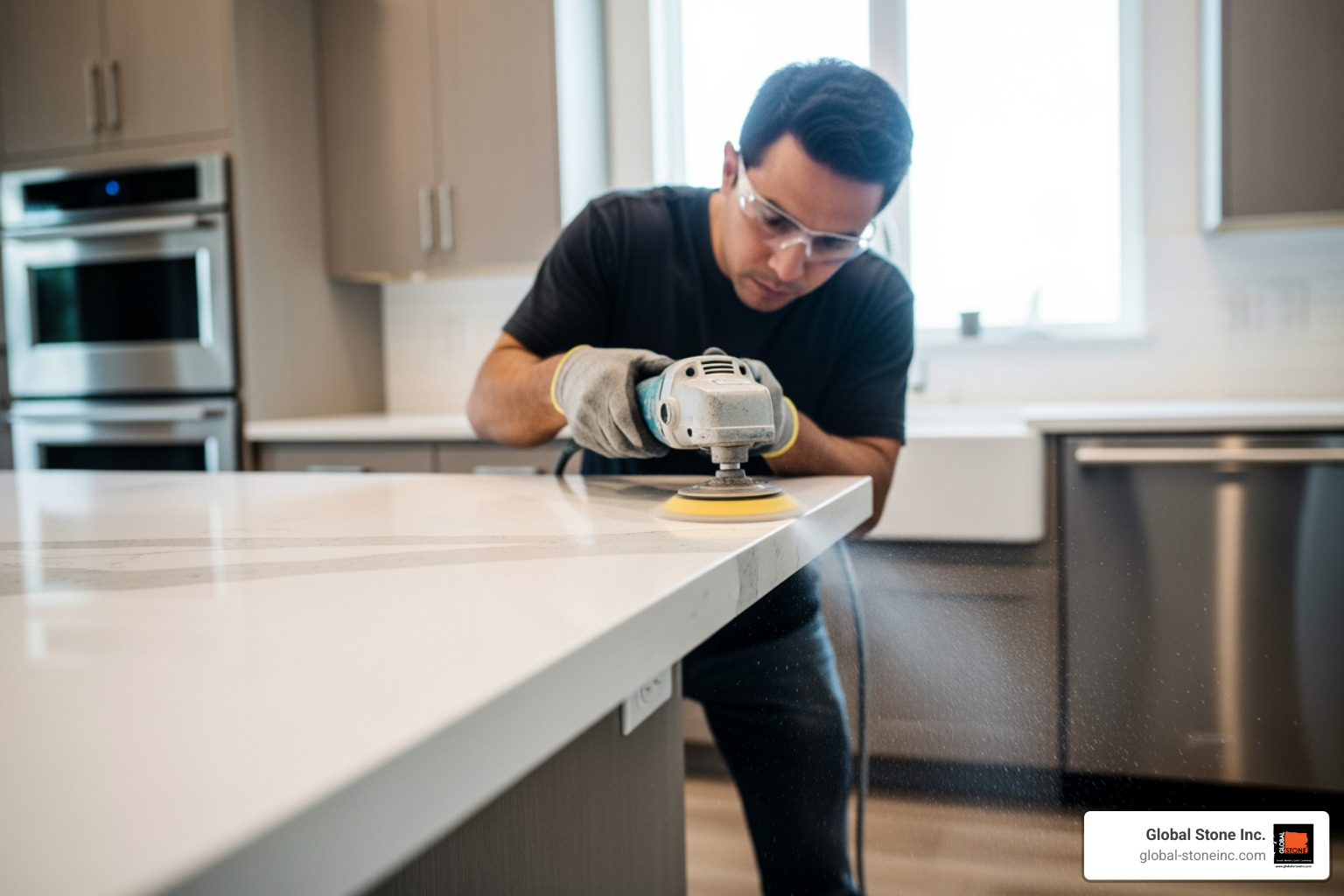
Why Professional Quartz Edge Finishing Makes or Breaks Your Countertop
Professional quartz edge finishing is the process of transforming a raw, machine-cut quartz edge into a smooth, polished surface that is safe to touch, visually consistent with the rest of the slab, and built to last.
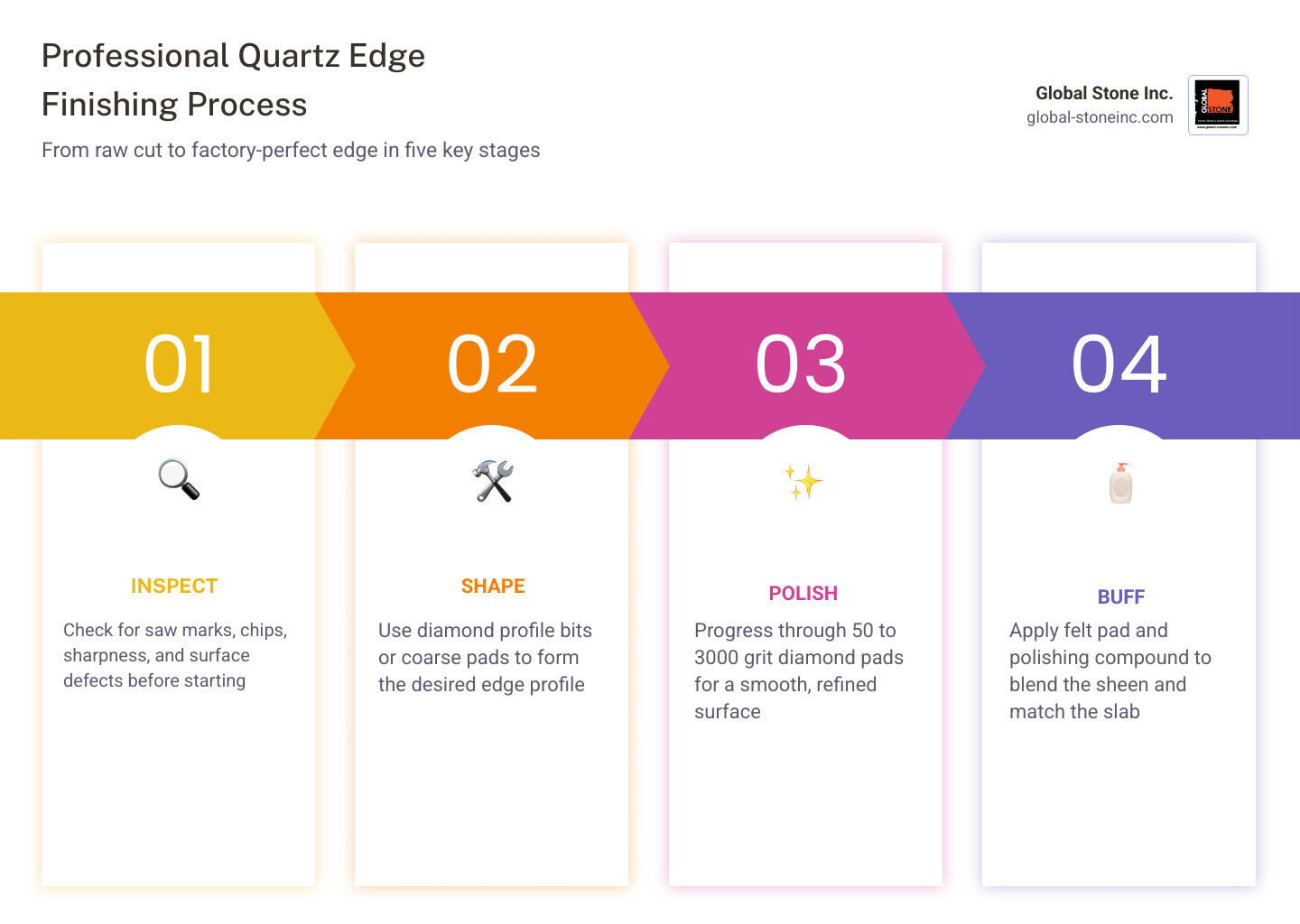
Here is a quick summary of what it involves:
| Step | What Happens |
|---|---|
| 1. Inspect | Check for saw marks, chips, or sharpness |
| 2. Shape | Use diamond profile bits or coarse pads to form the edge profile |
| 3. Polish | Progress through diamond pads from 50 grit up to 3000 grit |
| 4. Buff | Use a felt pad and polishing compound to blend the sheen |
| 5. Inspect | Check for consistency, smoothness, and finish match |
Most quartz slabs arrive from the factory with pre-finished edges. But once a fabricator makes on-site cuts — around a sink, along a wall, or at a seam — those raw edges need to be finished to match. Skip this step, and you end up with dull, sharp, or mismatched edges that stand out immediately.
Edge finishing also matters for safety. Unpolished quartz edges contain micro-serrations that can cut skin. A properly finished edge removes these risks while improving how the countertop looks and holds up over time.
This guide walks you through every part of the process — from choosing the right edge profile to polishing the final pass — so you get results that look and feel factory-perfect.
I’m Greg Zamarski, and with over 20 years of hands-on fabrication and installation experience at Global Stone Inc., I’ve refined our approach to professional quartz edge finishing across thousands of kitchen and bathroom projects in the Chicago area. Every technique in this guide comes from real jobsite experience, not theory.
Professional quartz edge finishing vocab explained:
What Professional Quartz Edge Finishing Really Involves
At a glance, edge finishing looks simple: smooth the edge and make it shiny. In real life, it is much more precise than that.
Quartz is an engineered stone made largely from crushed quartz plus polymer resins and pigments. That combination gives it excellent durability and a nonporous surface, but it also means the edge can react badly to excess heat, high RPM, or the wrong pad system. In other words, quartz is tough, but it is not a material you can bully.
A proper finish usually includes:
- Removing saw marks and chips
- Softening dangerous sharpness
- Reprofiling the shape when needed
- Matching the slab’s factory sheen
- Blending seams, corners, and sink cutout areas
For a broader overview of how quartz performs in kitchens and baths, see our quartz countertop guide.
Why professional quartz edge finishing matters after installation
This step becomes critical after installation because the jobsite is where real-world imperfections show up. Walls are rarely perfectly straight. Seams may need blending. Sink cutouts and exposed side returns often require final touch-ups. That is where professional quartz edge finishing earns its keep.
Done well, it improves:
- Safety by removing sharp edges
- Durability by reducing chip-prone corners
- Appearance by matching the factory face polish
- Client satisfaction because the edge looks intentional, not improvised
And yes, people notice edges. They run their hands across them constantly. A perfect slab with a rough edge is like wearing a tuxedo with untied shoes.
How quartz differs from granite and marble at the edge
Quartz is not polished exactly like granite or marble.
Key differences include:
- Quartz commonly contains 85% to 95% crystalline silica, so dust control is a major safety issue.
- The resin content is heat-sensitive, so aggressive polishing can burn or smear the edge.
- Quartz is hard, around 7 on the Mohs scale, so diamond tooling is essential.
- It can chip at corners if unsupported or overworked.
Because of that, we use lower RPMs, steady movement, proper cooling, and quartz-specific pads. White resin-bonded pads are often preferred to avoid color transfer, especially on white or very dark quartz.
Choosing the Right Quartz Edge Profile for Style, Safety, and Durability
The profile you choose affects more than looks. It also changes how the edge feels, how easily it chips, how safe it is around kids, and how much labor goes into finishing it.
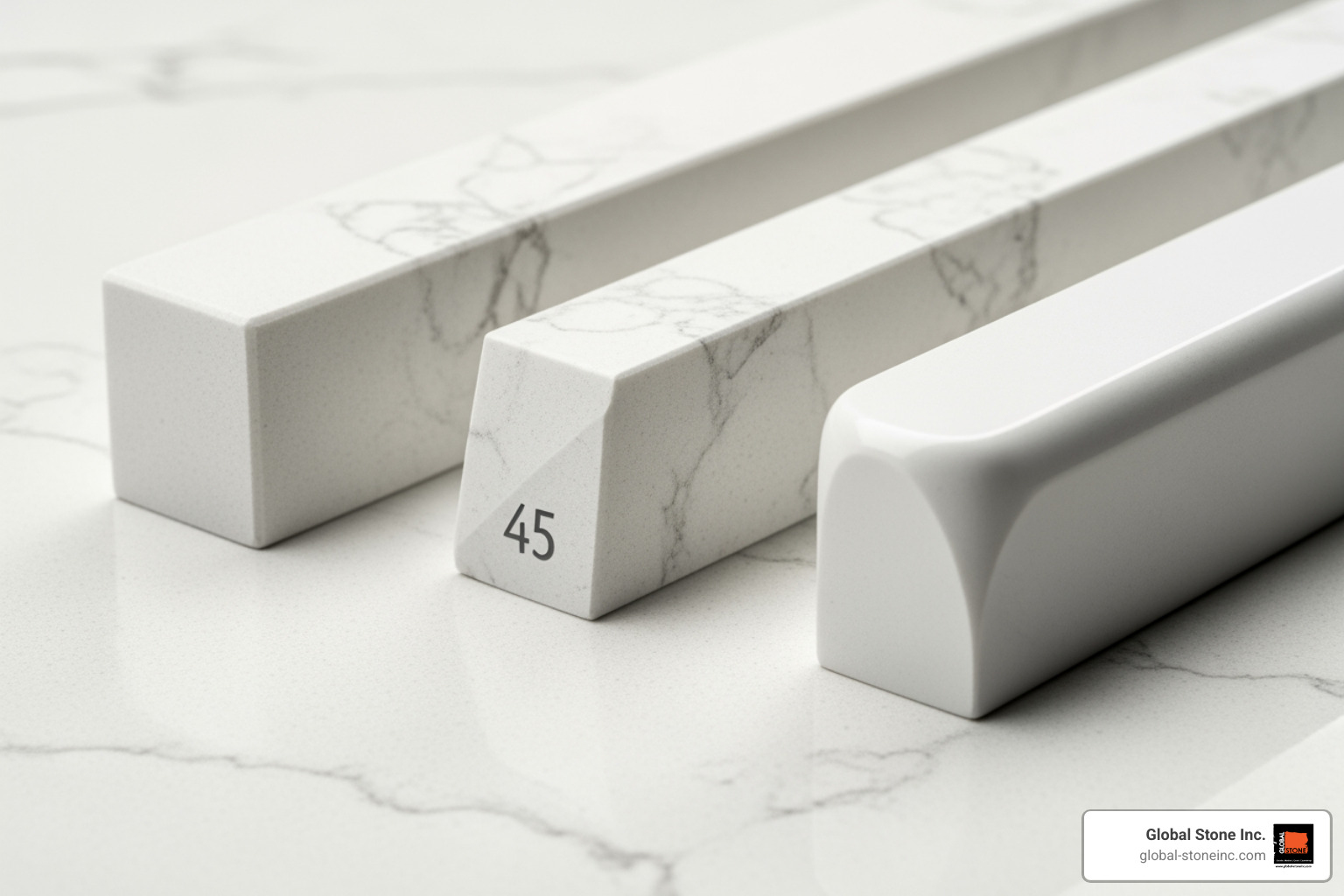
| Profile | Look | Safety | Durability | Budget |
|---|---|---|---|---|
| Eased | Clean, modern, slightly softened | Good | Very good | Lower |
| Beveled | Crisp with angled top edge | Good | Good | Lower to mid |
| Half bullnose | Rounded top, flatter bottom | Very good | Good | Mid |
| Full bullnose | Fully rounded | Excellent | Good | Mid |
| Ogee | Decorative S-curve | Good | Fair to good | Higher |
| Mitered | Thick, dramatic slab look | Depends on shape | Good if well made | Higher |
| Quarter round | Soft simple curve | Very good | Good | Lower to mid |
| Laminated/Miter-look | Thicker appearance | Depends on detail | Good if seam is sound | Higher |
The most common profiles and how they look in real spaces
The most common quartz edge profiles include:
- Eased edge: The most popular choice. It keeps the straight look of a square edge but softens the top corner slightly, often around 1/8 inch. Great for modern kitchens and easy to live with.
- Beveled edge: Usually cut at about 45 degrees. It adds a little more visual detail and can help direct drips away from cabinet faces.
- Bullnose: A half or full rounded edge. Softer to the touch and often chosen for family-friendly kitchens or bathroom vanities.
- Ogee: An S-shaped decorative profile that suits more traditional or formal spaces.
- Mitered edge: Creates the illusion of a thicker slab by joining pieces at an angle. Popular for statement islands and waterfall ends.
- Quarter round: A subtle rounded option that softens the edge without going full bullnose.
Which profiles are safest and most durable
If safety is a top concern, rounded profiles usually win:
- Full bullnose and quarter round feel the softest
- Eased edges are also very practical and child-friendlier than a sharp square edge
- Ogee looks beautiful but is more vulnerable at delicate detail points
- Mitered edges can be durable, but the seam quality matters a lot
For busy kitchens, breakfast bars, and high-traffic homes, we often recommend:
- Eased edge for the best all-around balance
- Quarter round or half bullnose where comfort matters
- Mitered only when the thicker visual effect is part of the design goal
When it makes sense to reprofile an installed quartz edge
Yes, an installed quartz edge can often be changed after installation, but there are limits.
Usually possible:
- Softening a sharp edge
- Turning a square edge into an eased or light round-over
- Cleaning up minor corner damage by adjusting the profile slightly
More limited:
- Creating a deep ogee after install
- Altering mitered edges without affecting the seam line
- Making major profile changes when slab thickness does not allow enough material
In short, post-install reprofiling is very doable for simple shapes, but not every edge can become every other edge. The simpler the change, the better the odds.
Tools and Setup for Professional On-Site Quartz Edge Work
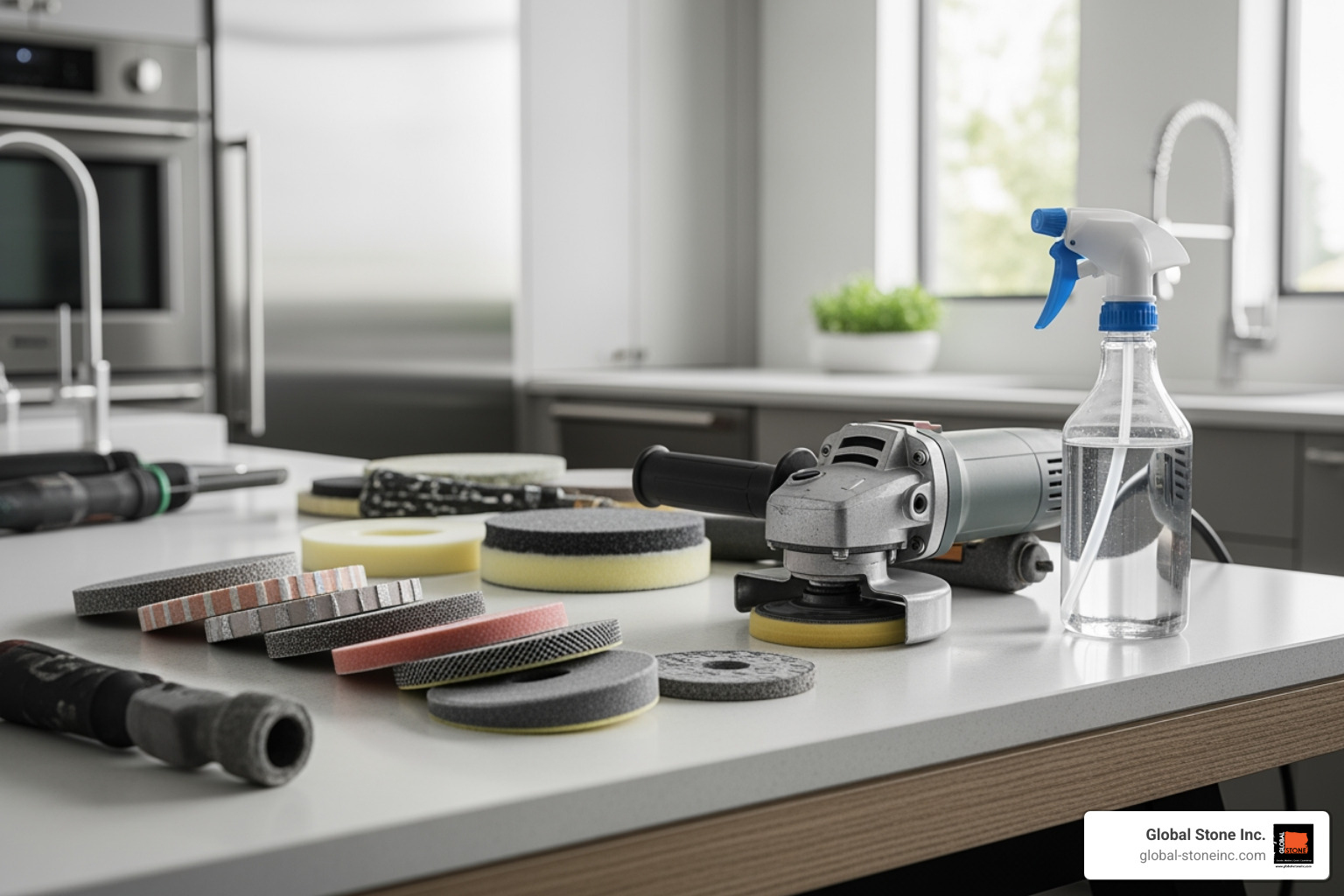
On-site edge work requires a compact but serious tool setup. This is not a sandpaper-and-hope situation.
For more on installation workflow, visit our countertop installation guide.
Essential tools for professional quartz edge finishing
Our standard toolkit for professional quartz edge finishing includes:
- Variable-speed polisher or angle grinder
- Diamond polishing pads from 50 to 3000 grit
- White resin pads formulated for quartz
- Rigid backing pad for straight profiles
- Flexible backing pad for concave or decorative profiles
- Diamond profile bits or profiling wheels
- Felt buffing pad
- Quartz polishing compound
- Dust shroud and HEPA vacuum
- Spray bottle or water-feed setup
- Masking tape and plastic protection
- Task lighting
- Seam clamps when blending transitions
The biggest rule: use variable speed. Fixed high-speed tools can overheat the resin fast and leave burn marks or haze.
Safety requirements for silica dust, noise, and lifting
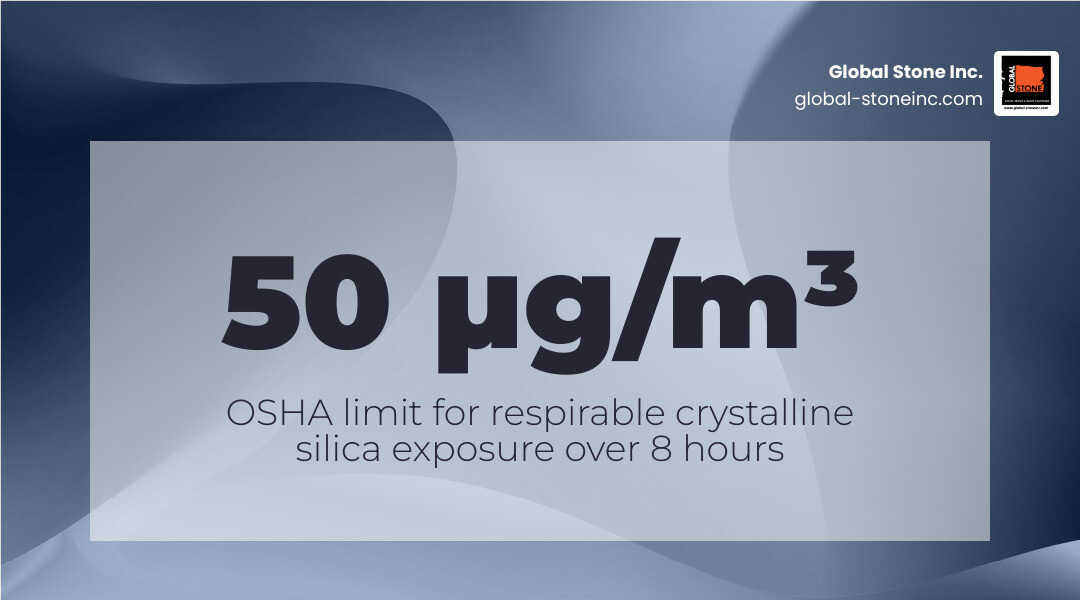
Quartz dust is not just messy. It is hazardous. Engineered quartz contains high crystalline silica content, and OSHA’s respirable crystalline silica limit is 50 micrograms per cubic meter as an 8-hour time-weighted average.
Best practices include:
- Wear a NIOSH-rated respirator such as a P100
- Use eye protection or a face shield
- Wear hearing protection
- Use wet methods whenever possible
- Connect grinders to HEPA vacuums rated to capture 99.97% of 0.3-micron particles
- Keep the work area ventilated and isolated
For official guidance on silica exposure and control methods, see OSHA’s Respirable Crystalline Silica Standard.
There is also the weight issue. Quartz countertops typically weigh about 20 to 25 pounds per square foot. Cabinets need proper support, and unsupported spans or overhangs should be reinforced, often every 18 to 24 inches. If the top is already under stress, aggressive edge work can increase the risk of cracks.
Jobsite preparation before polishing or reprofiling
Before touching the edge, we prepare the site:
- Mask finished walls, cabinets, floors, and appliances
- Protect adjacent surfaces with plastic sheeting
- Check support under overhangs and sink areas
- Clean the edge thoroughly
- Mark chips, saw marks, flat spots, and low areas with pencil or tape
- Confirm the target finish and profile before grinding starts
This prep saves cleanup time and prevents the classic problem of fixing one edge while damaging three nearby surfaces.
Step-by-Step Professional Quartz Edge Finishing Process
Here is the process we follow on-site for consistent, factory-quality results.
Step 1: Inspect the edge and decide whether to polish, repair, or reprofile
Start with a close inspection under strong side lighting.
Look for:
- Chips and corner damage
- Scratches
- Blade marks
- Uneven shape or flat spots
- Lippage at seams
- Sheen mismatch against the slab face
- Overly sharp corners
If the profile is basically correct and the issue is surface quality, polishing may be enough. If the edge is too sharp or damaged, reprofiling comes first. If there is a chip, we may need a color-matched adhesive repair before polishing.
Step 2: Shape the edge with the correct profile and support
If reshaping is needed, begin with coarse abrasives or a profile bit.
Typical shaping tools:
- 50 or 100 grit pads for minor rework
- Diamond router bits or profile wheels for consistent edge geometry
Best practices:
- Make shallow passes
- Support the slab well, especially at corners and overhangs
- Keep the tool moving
- Control heat with water or reduced RPM
- Ease corners slightly to improve chip resistance
This is the stage where geometry is established. If the shape is wrong here, no amount of polishing later will save it.
Step 3: Polish through the full grit sequence without skipping
This is where patience earns its paycheck. A mirror finish comes from removing the scratch pattern from the previous grit, not from magic at the end.
A common sequence is:
- 50 grit
- 100 grit
- 200 grit
- 400 grit
- 800 grit
- 1500 grit
- 3000 grit
Some jobs start at 100 or 200 grit if the edge is already fairly clean, but when saw marks or reprofiling are involved, coarser grits are necessary.
Rules we follow:
- Never skip grits
- Clean the edge between each stage
- Inspect under side lighting after every grit
- Use steady pressure, not brute force
- Reduce speed as grits get finer to protect the resin
If you skip from 100 to 400, the scratches from 100 will still be there. They just become shinier and more annoying.
Step 4: Buff and blend the edge to match polished, matte, satin, or luxe surfaces
After the diamond sequence, final blending depends on the slab finish.
For polished quartz:
- Use a felt pad and quartz polishing cream
- Run at low RPM
- Keep movement constant
- Check reflection against the face of the slab
For lower-sheen finishes:
- Stop at the grit level that matches the factory appearance
- Avoid over-buffing
- Blend carefully so the edge does not look glossier than the top
This is where professional quartz edge finishing becomes part science, part eye for detail.
Step 5: Final inspection for sharpness, sheen, and consistency
The final quality control check includes:
- Touch test for sharpness or micro-serrations
- Side-light inspection for scratches and swirl marks
- Glare check for sheen consistency
- Seam transition check
- Corner comfort check
- Full cleanup of slurry, compound, and tape residue
Afterward, homeowners should maintain the surface with quartz-safe cleaning methods, which we cover in our quartz cleaning guide.
How Finishes, Textures, and Common Problems Change the Technique
Not every quartz edge should end up glossy. Matching the factory finish is the goal, not chasing maximum shine.
How polished, matte, satin, and luxe finishes affect edge finishing
Quartz finishes change how we approach the final passes:
- Polished: High-gloss, reflective, and the most familiar. Usually requires the full sequence through 3000 grit plus buffing.
- Matte: Lower sheen with reduced reflection. Often needs a controlled stop point before high-gloss buffing.
- Satin: Soft sheen with subtle depth. Needs careful blending so the edge matches the face without looking flat or overworked.
- Luxe: Very high polish. Demands excellent scratch refinement because any defect shows quickly.
The key point is that these finishes generally keep the same core performance. The difference is appearance, not basic durability.
How textured quartz surfaces complicate edge profiling and blending
Textured surfaces such as Inverness, Satin Ridge, or Sculpted add visual depth, but they also make edge finishing trickier.
Challenges include:
- The top texture may not continue naturally over the edge
- Raised patterns can be lost during reprofiling
- Directional texture requires careful blending at transitions
- A standard smooth edge may be the only practical way to finish some textured designs cleanly
In many cases, the edge is finished as a complementary detail rather than an exact continuation of the surface texture.
Fixing chips, scratches, haze, uneven sheen, and sharp edges after installation
Most common post-install edge problems are repairable.
For chips:
- Clean the area thoroughly
- Fill with color-matched adhesive
- Let it cure fully
- Re-shape and polish the repair flush
For scratches:
- Identify the depth
- Start at the lowest grit needed to remove them
- Work back up through the full sequence
For haze or cloudy edges:
- Usually caused by incomplete scratch removal, pad contamination, or resin overheating
- Revisit the previous grit and repolish methodically
For uneven sheen:
- Compare the edge to the slab face under strong light
- Blend with the correct final grit or compound
- Avoid over-buffing one section
For sharp edges:
- A simple corner softening or small round-over is often enough
- This can prevent future chipping and make everyday use more comfortable
Quartz is highly durable, but edge details still matter. For more on overall performance, see why quartz often outperforms marble.
Frequently Asked Questions About Professional Quartz Edge Finishing
Is it possible to change quartz edge profiles after installation?
Yes, often. Simpler changes are the most realistic:
- Square to eased
- Eased to slightly rounder
- Sharp corners softened
- Minor chip damage blended into a revised edge
Complex changes are less practical:
- Deep ogee profiles
- Major miter modifications
- Large profile changes on thin material
The decision comes down to slab thickness, seam placement, existing damage, and whether the visual benefit justifies the labor.
What should homeowners consider before choosing or modifying an edge?
Think about four things first:
- Style: modern spaces often suit eased or mitered edges; traditional rooms may fit ogee or bevel details
- Safety: rounded or eased edges are better around children and seating areas
- Budget: eased and simple round profiles are usually more cost-effective than decorative custom work
- Usage: kitchen islands, breakfast bars, and bathroom vanities all experience edge contact differently
Also consider cleaning and maintenance. Simpler profiles are easier to wipe down and less likely to trap grime. For a broader look at quartz advantages, read 4 advantages of quartz countertops.
Should quartz edge polishing be a DIY job or left to a professional?
In most cases, this should be left to a professional.
Why:
- Silica dust exposure is serious
- Proper tooling is specialized and expensive
- Finish matching takes practice
- Quartz resin can burn if polished incorrectly
- Bad repairs often make chips and scratches more visible, not less
DIY touch-ups on engineered stone often start with confidence and end with a call for rescue. We say that with love.
Conclusion: Better Edge Details Start With Skilled Fabrication and Finishing
A beautiful quartz countertop is not just about the slab color. The edge is where safety, durability, and craftsmanship become obvious.
Done right, professional quartz edge finishing:
- Removes dangerous sharpness
- Reduces chip risk
- Matches the factory finish
- Improves the look of seams, sink cutouts, and exposed ends
- Makes the entire installation feel complete
At Global Stone Inc., we handle design, fabrication, and installation in-house, backed by more than 20 years of experience serving Chicago, Elk Grove Village, and Naperville. That control matters when edge details need to look seamless, not “close enough.”
If you are planning a quartz project or need help evaluating edge options, start with our page on quartz countertops in Elk Grove Village. If you are comparing materials for another look entirely, you can also explore our marble countertop options.
The slab gets the attention. The edge gets the handshake. We make sure both leave a good impression.