
Cheat Sheet to Stone Alternatives: Top Materials to Consider
Which Stone Alternative Fits Your Project?
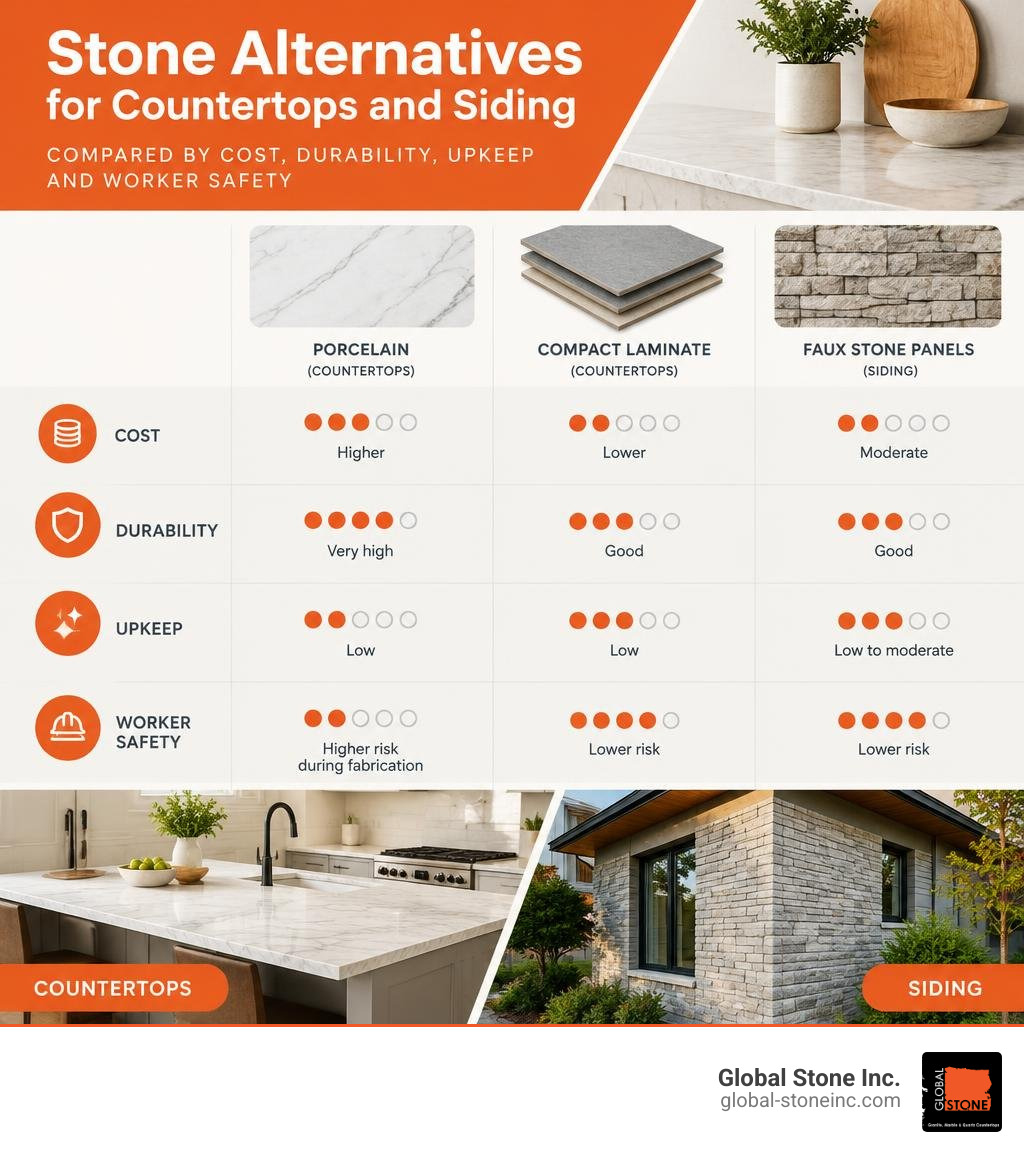
The best stone alternative depends on where you plan to use it. For kitchen and bathroom countertops, porcelain offers strong heat and stain resistance, while compact laminate is a lower-cost choice. For siding, lightweight faux stone panels can give you a stone look without the weight or masonry work of real stone.
Compare the installed cost, daily wear, upkeep, and how the material is cut. Silica dust is a serious risk for workers fabricating some stone surfaces, but an installed countertop does not release that dust during normal use.
I’m Greg Zamarski, and I’ve spent more than 20 years helping Chicago-area homeowners choose, fabricate, and install countertops at Global Stone Inc. That experience helps me explain when a stone alternative makes sense and when granite, marble, or quartz may be the better fit.
Why Homeowners Are Seeking a Stone Alternative for Modern Homes
Natural stone and traditional engineered quartz have dominated residential remodeling for decades. However, the building materials landscape has shifted significantly as of November 2026. Homeowners across the Chicago area, from historic bungalows in the city to newer builds in Naperville, are exploring surface options that deliver high-end visuals without the traditional drawbacks of quarrying, extreme weight, or high maintenance.
Several converging factors drive this transition:
- Occupational safety awareness: Buyers are increasingly mindful of how their building products are made and fabricated.
- Structural and weight constraints: Heavy stone slabs require reinforced subfloors and load-bearing framing that add hidden construction costs.
- Thermal and energy demands: Exterior building envelopes require high-performance cladding that insulates rather than merely decorates.
- Budget flexibility: Rising installation labor costs make single-step, DIY-friendly, or easily fabricated materials financially practical.
When comparing your options, reviewing a comprehensive countertop comparison guide provides clear context on how traditional natural slabs stack up against newer manufactured materials.
Occupational Health and Global Silica Regulations
The most critical regulatory and health shift involves respirable crystalline silica dust. Traditional engineered quartz can contain over 90% crystalline silica. In contrast, natural granite generally carries between 25% and 60%, concrete contains roughly 30%, and marble has less than 5% to 10%.
When dry-cut, ground, or polished without strict environmental controls, high-silica slabs release microscopic particles that penetrate deep into lung tissue. This has led to an international health crisis involving silicosis—a preventable, progressive lung disease. Studies show that roughly one in four workers cutting traditional high-silica engineered stone has developed silicosis. In regions with dense fabrication operations, such as California, over 200 worker cases, multiple lung transplants, and fatalities were documented by late 2024, largely impacting younger tradespeople with a median age of just 45.
These safety realities led to Australia’s world-first engineered stone ban on July 1, 2024, prohibiting slabs containing high crystalline silica concentrations. In the United States, the Occupational Safety and Health Administration (OSHA) enforces a strict Permissible Exposure Limit (PEL) of 50 micrograms per cubic meter of air, driving modern fabricators to wet-processing systems and pushing consumers toward a guide to safe and sustainable counters. Understanding the safety and composition of engineered quartz helps clarify how modern surface innovation is moving rapidly toward zero-silica mineral composites and recycled surfaces.
Structural Weight and Building Envelope Performance
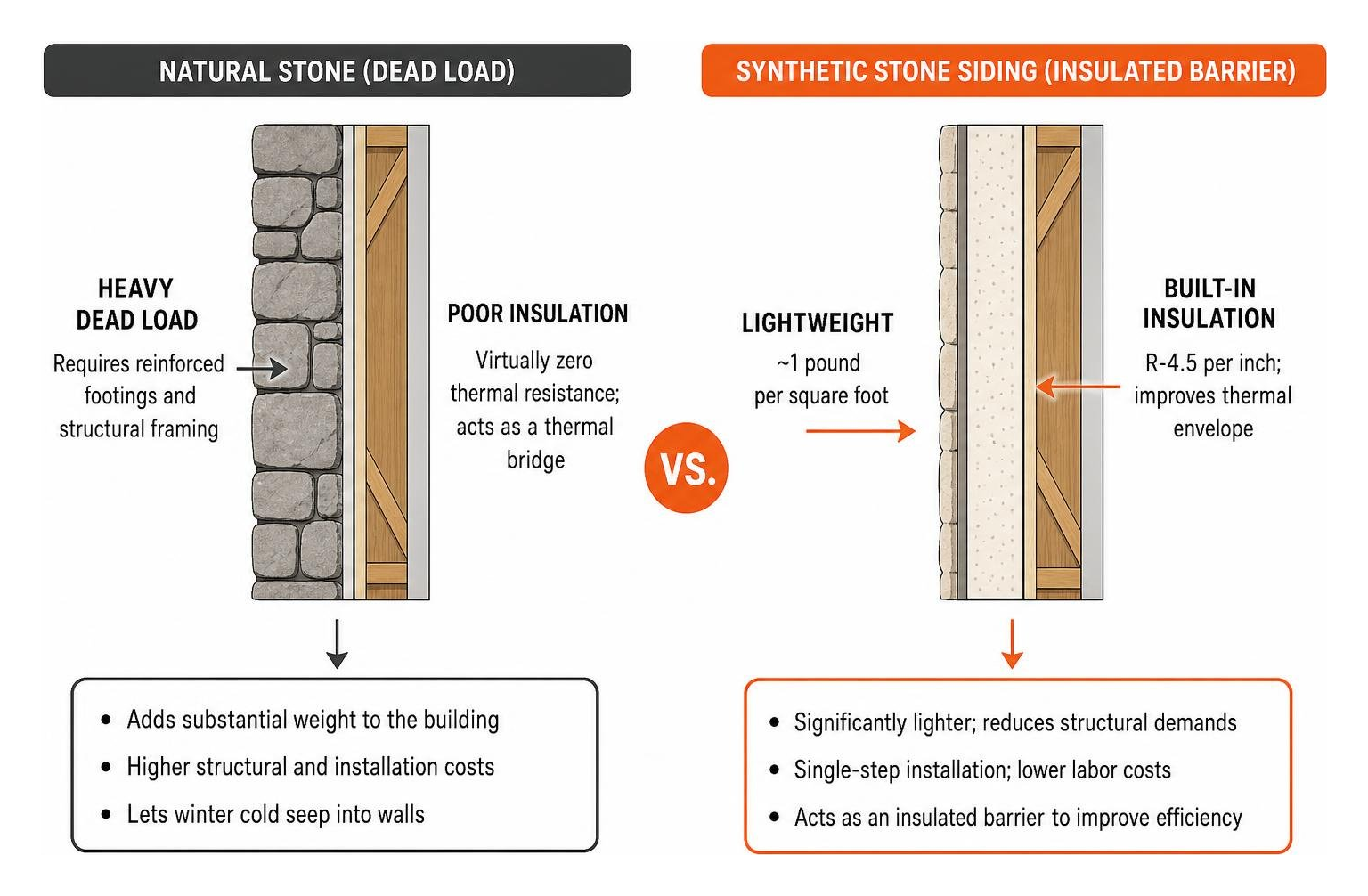
Weight is another major factor when designing home interiors and exteriors. Natural stone masonry adds substantial “dead load” to a building. Traditional quarried stone or full-depth masonry veneer often requires concrete foundation footings, reinforced wall framing, and multi-step mortar beds.
By comparison, modern synthetic stone alternatives weigh significantly less. Polyurethane-based faux stone siding panels weigh approximately 1 pound per square foot, compared to heavy natural stone. Because they are cast with dense insulating backings, these exterior panels also provide an insulation value of R-4.5 per inch. Traditional stone delivers virtually zero thermal resistance, acting as a thermal bridge that lets winter cold seep into walls. Using an insulated exterior stone alternative improves your home’s thermal envelope while eliminating the need for expensive structural retrofitting.
Best Surface Replacements for Kitchens and Bathrooms

Kitchens and bathrooms demand materials that resist moisture, impact, staining, and thermal shock. When evaluating engineered slabs against natural stone, several high-performing categories stand out for both residential prep zones and vanity spaces.
Porcelain and Sintered Slabs: A High-Heat Stone Alternative for Kitchens
Porcelain slabs and sintered compact surfaces (such as Dekton) represent the top tier of synthetic surface technology. These materials are manufactured by subjecting natural clay, feldspar, and mineral pigments to extreme pressures (often exceeding 25,000 tons) and kiln temperatures above 2,200°F.
The resulting slab is dense and vitrified, offering key advantages:
- Near-zero porosity: Slabs absorb virtually no liquids, making them completely immune to stains from red wine, lemon juice, oils, and coffee without needing sealers.
- High heat resistance: Unlike quartz slabs bound with polymer resins, porcelain and sintered stone will not scorch, discolor, or crack when exposed to hot cookware.
- UV stability: Sintered surfaces do not degrade in sunlight, making them suitable for indoor kitchens and outdoor patio cooking stations.
- Low silica profile: Porcelain contains approximately 15% crystalline silica, making it significantly safer for fabricators to process under standard wet-cutting protocols.
Because thin porcelain slabs can be prone to edge chipping if struck directly with heavy cast iron, fabricators recommend small arris or pencil-round edge profiles. Discover more about top residential countertop materials to see how sintered slabs compare in luxury kitchen builds.
Solid Core Compact Laminate and Bio-Composites
Compact laminate is an engineered, solid-core panel constructed from layers of kraft paper saturated with thermosetting resins, cured under high pressure. Unlike standard laminate—which features a thin decorative sheet glued over a moisture-sensitive particleboard core—compact laminate is completely homogeneous and waterproof throughout.
- Impact resistance: It withstands heavy kitchen impacts and will not delaminate or swell when exposed to sink moisture.
- Machinability: It can be cut and routed with standard woodworking tools, creating zero respirable crystalline silica during installation.
- Sustainable mineral blends: Newer bio-composites utilize crushed post-consumer recycled glass and plant-based resins, offering unique visual depth while keeping silica content near zero.
Cast Concrete and Character-Rich Hardwood
For homeowners seeking organic warmth, cast concrete and solid hardwood butcher block serve as distinct stone substitutes.
- Cast concrete: Concrete offers an architectural, industrial look that can be custom-poured into seamless shapes, integrated sinks, and drainage grooves. However, concrete contains roughly 30% silica, requires regular sealing to avoid food stains, and can develop micro-cracks over time as the home settles.
- Solid timber: Hardwood tops made from maple, walnut, or oak add natural warmth and comfort to prep areas. While wood requires regular mineral oil treatment and cannot tolerate direct heat, it can be sanded and refinished repeatedly over its service life. Pairing a hardwood prep island with an impervious porcelain sink surround offers an ideal balance of aesthetics and function.
Siding and Accent Wall Stone Substitutes

Updating an exterior facade or an interior fireplace surround with natural stone masonry can be time-consuming and labor-intensive. Homeowners increasingly rely on manufactured and composite wall systems to achieve classic stone texture without the structural complexity.
Polyurethane Faux Panels: An Insulated Stone Alternative for Siding
High-density polyurethane panels molded directly from natural rock patterns offer a fast, reliable way to achieve a stone look.
- Ultra-lightweight construction: At roughly 1 pound per square foot, these panels mount directly to exterior sheathing, framing, or interior drywall without requiring foundation footings or brick ledges.
- Single-step interlocking installation: Patented 45-degree tongue-and-groove interlocking designs allow panels to slide together seamlessly. Fasteners remain hidden, eliminating the 10-step masonry process of metal lath, scratch coats, mortar mixing, and grouting.
- Built-in insulation: With an R-value of 4.5 per inch, these panels provide thermal insulation that helps reduce heating and cooling costs during freezing Chicago winters and humid summers.
- Fire retardant and UV stable: Formulated with specialized UV inhibitors and fire retardants, quality polymer panels will not catch or sustain a flame, nor will they fade when exposed to direct sunlight.
Architectural Cast Stone and Pre-Cast Masonry
For projects requiring traditional masonry texture with greater dimensional consistency, architectural cast stone provides a refined option. Made from a combination of white portland cement, fine graded aggregates, and integrated through-body mineral pigments, cast stone replicates fine cut limestone.
Cast stone offers tight, uniform surfaces that resist mold and water penetration better than soft natural sedimentary rocks. It is widely used for window headers, sills, column wraps, and ventilated rainscreen facade assemblies on residential and light commercial developments.
Performance, Maintenance, and Pricing Cheat Sheet
Selecting the right material requires balancing upfront purchase cost, fabrication labor, daily upkeep, and long-term durability.
| Material Category | Primary Application | Installed Cost Range | Heat Resistance | Maintenance Needs | Silica Content |
|---|---|---|---|---|---|
| Porcelain Slabs | Kitchens & Baths | $70-$150 / sq ft | Outstanding (Direct Heat) | Very Low (No Sealing) | Low (~15%) |
| Sintered Stone | High-Traffic Counters | $90-$200+ / sq ft | Outstanding (Direct Heat) | Very Low (No Sealing) | Low to Zero (<11%) |
| Compact Laminate | Budget Countertops | $35-$60 / sq ft | Moderate (Use Trivets) | Low (Non-Porous) | Zero (0%) |
| Cast Concrete | Custom Counters | $70-$150 / sq ft | Moderate (Sealer Can Burn) | High (Requires Sealer) | Moderate (~30%) |
| Faux Polyurethane Panels | Siding & Accents | $7-$15 / sq ft | Non-Flammable / Insulated | Very Low (Wash with Water) | Zero (0%) |
| Architectural Cast Stone | Exterior Masonry | $15-$35 / sq ft | High (Fireplace Safe) | Low (Occasional Wash) | Low to Moderate |
Review our current countertop pricing overview for an in-depth look at fabrication and installation figures.
Daily Maintenance and Long-Term Sealing Needs
Daily care varies widely across synthetic and natural surface categories:
- Porcelain, sintered stone, and compact laminate: Wipe down daily using warm water, mild dish soap, and a soft microfiber cloth. Because these surfaces are non-porous, they never require chemical sealants, wax treatments, or special stone cleaners.
- Concrete and solid hardwood: Concrete requires food-safe penetrating sealers applied every 12 to 24 months to block oil and acidic etching. Hardwood surfaces need regular applications of mineral oil or beeswax to prevent moisture damage and drying.
- Polyurethane siding panels: Exterior faux panels require no repointing, tuckpointing, or waterproofing coatings. An annual rinse with a garden hose easily removes outdoor dust and pollen.
When comparing manufactured options, learning the best ways for choosing resilient artificial stone ensures you match surface porosity and chemical resistance to your cooking and cleaning habits.
Budget Breakdown: Best Options by Price Point
- Entry-level budgets (Under $40 / sq ft): Standard and compact laminates deliver reliable moisture resistance and clean, modern profiles for utility spaces, laundry rooms, and rental renovations. For siding, lightweight faux stone panels offer high curb appeal without the expense of hiring a professional mason.
- Mid-range budgets ($40 to $80 / sq ft): Low-silica engineered mineral surfaces, bio-composites, and pre-cast masonry trims deliver elevated performance while maintaining approachable material costs.
- Premium architectural tier ($80 to $150+ / sq ft): Sintered stone slabs and high-definition large-format porcelain deliver unmatched scratch and heat resistance. These surfaces allow for bookmatched waterfall legs and integrated splashbacks. Explore our selection of custom countertops to find the right slab style for your project.
Frequently Asked Questions about Stone Alternatives
What is the most cost-effective stone alternative for kitchen counters?
Compact laminate and high-pressure standard laminate are the most affordable alternatives to natural stone. Compact laminate provides a water-resistant, impact-tolerant solid core that requires minimal maintenance, providing a streamlined modern look at a fraction of the cost of quarried slabs.
Is engineered stone dangerous to keep in the home after installation?
No. Installed stone surfaces do not pose a health risk to homeowners. Crystalline silica is hazardous only when released as airborne, breathable dust during cutting, grinding, shaping, or dry fabrication. Once fabricated and installed in your home, the slab is inert, solid, and safe for daily food preparation and family use.
How does faux stone siding improve residential thermal insulation?
Unlike natural stone or traditional cement-based brick veneers—which allow heat to escape through thermal bridging—high-density polyurethane faux stone panels are manufactured with an insulating foam matrix. High-performance panels deliver an insulation rating of R-4.5 per inch, helping block exterior drafts, stabilizing indoor wall temperatures, and lowering seasonal heating and cooling bills.
Conclusion
Choosing the ideal surface for your remodel means balancing visual design, functional durability, maintenance needs, and budget. Whether you select ultra-durable sintered stone slabs for a busy family kitchen, high-efficiency polyurethane panels to boost your home’s exterior curb appeal, or traditional materials, understanding your options ensures a durable, lasting installation.
At Global Stone Inc., our in-house team handles design, fabrication, and precision installation from our Elk Grove Village facility, backing our work with over 20 years of local expertise and a lifetime warranty. Ready to plan your renovation? Contact us today to explore materials for your home, or explore limestone surfaces as a natural stone alternative to bring classic texture and elegance to your living space.