The Complete Guide to Caesarstone vs Quartz Countertops
Understanding Engineered Stone: Caesarstone vs Standard Quartz
When comparing Caesarstone to standard quartz countertops, the key distinction is brand heritage, design innovation, and material technology. Standard quartz refers generally to engineered surfaces manufactured with crushed mineral aggregate and polymer resins, whereas Caesarstone is the pioneering brand known for proprietary designs, lifetime warranties, and sustainable low-silica options like Caesarstone ICON. Both surfaces provide exceptional non-porous durability and stain resistance for residential spaces.
At its core, engineered stone is manufactured by blending pulverized natural minerals with high-performance polymer resins and pigments. For standard slabs across the market, our detailed breakdown in the ultimate guide to quartz countertops explains how this precision manufacturing creates a dense, non-porous slab that eliminates the fissures and weak spots found in quarried rock.
Standard quartz countertops rely on natural quartz crystals, cristobalite, and other rock-sourced minerals containing crystalline silica (SiO2) bound together with roughly 7% to 10% resin binders. This formulation gives engineered surfaces their signature strength, stain resistance, and uniform appearance. Many homeowners wonder if these slabs are completely synthetic or mined directly from the earth—a question we dive into when exploring The Great Countertop Mystery: Is Quartz Actually Natural?.
Caesarstone holds a unique place in this industry. Established in 1987, Caesarstone pioneered the modern engineered quartz industry. With nearly four decades of surface engineering experience, their manufacturing standards provide exceptionally uniform slab density, structural integrity, and artistic depth across a portfolio spanning over 100 sophisticated colors.

Traditional Quartz vs Caesarstone ICON Surface Technology
As materials science has advanced, surface technology has reached an exciting new turning point. In addition to their traditional high-mineral formulations, Caesarstone developed Caesarstone ICON.
Traditional quartz slabs rely heavily on crystalline silica sourced from natural rock. Caesarstone ICON is engineered with a patent-pending, crystalline silica-free formulation (containing less than 1% crystalline silica). Instead of raw crystalline silica, ICON uses an advanced blend of amorphous silica, premium polymer resins, specialized mineral additives like titanium dioxide, and high-performance pigments.
Key highlights of this advancement include:
- 80% Recycled Content: Caesarstone ICON integrates up to 80% recycled material, significantly reducing the environmental footprint of quarrying and manufacturing.
- Worker Safety: Reducing crystalline silica to negligible levels protects the craftsmen and fabricators who cut, shape, and polish these slabs every day.
- Uncompromised Durability: ICON maintains the scratch resistance, heat tolerance, and zero-porosity performance that homeowners expect from top-tier engineered quartz.
Key Performance Features of Caesarstone Countertops
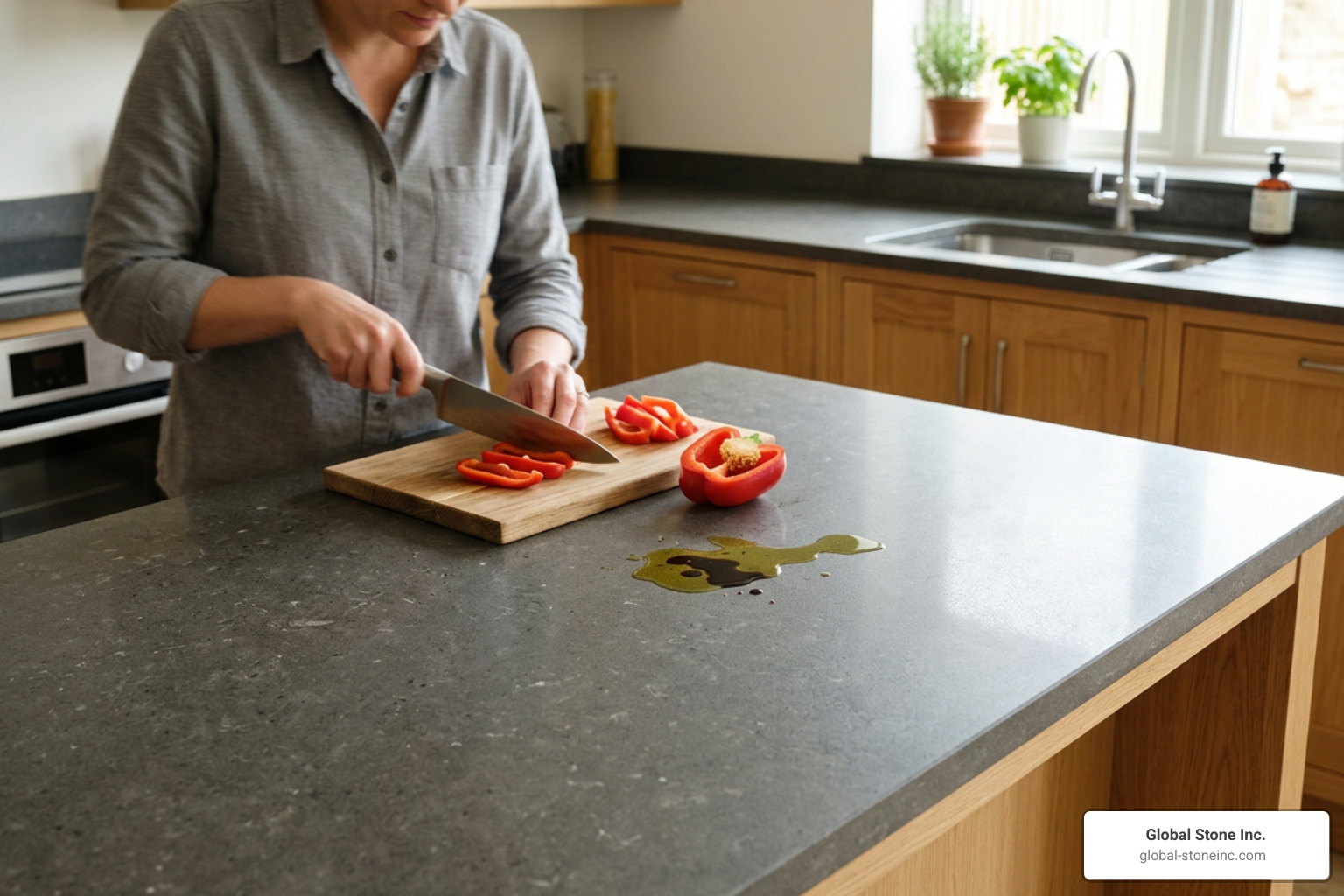
Whether you choose traditional quartz or modern ICON surfaces, engineered stone is built to withstand real-world kitchen use. Countertops need to survive dropped utensils, spilled wine, morning coffee splashes, and hurried meal prep without degrading.
Because engineered stone is compacted under extreme vibration and vacuum pressure during manufacturing, it features a completely sealed, non-porous structure. Spills sit right on the surface instead of absorbing into pores, preventing mold, mildew, and deep discoloration. This gives quartz a massive practical advantage when comparing materials; in fact, Why Quartz Usually Wins the Durability Battle Against Marble comes down to this non-porous composition that eliminates the need for regular chemical sealing.
| Feature / Metric | Standard Generic Quartz | Caesarstone Quartz Surfaces | Caesarstone ICON Line |
|---|---|---|---|
| Inorganic Mineral Content | Up to 85–90% | Up to 90% rock-sourced minerals | Silica-free mineral blend |
| Recycled Content | Varies (0–20%) | Varies by design series | Up to 80% recycled material |
| Porosity & Sealing | Non-porous; no sealing | Non-porous; zero sealing required | Non-porous; zero sealing required |
| Color & Design Range | Basic to moderate patterns | 100+ designer colors and textures | Curated sustainable palettes |
| Finish Selections | Typically polished or matte | Polished, Honed, Concrete, Rough, Natural | Polished and matte textures |
| Outdoor Suitability | Indoors only (yellows in UV) | Dedicated Outdoor Collection available | Indoors / climate-controlled |
| Warranty Backing | 10–15 years limited | Lifetime residential warranty | Lifetime residential warranty |
Designing with Caesarstone Countertops: Colors, Slabs, and Finishes
Caesarstone stands out for its realistic depth and sophisticated textures that replicate natural stone without the maintenance headache. For classic veining patterns, you can see A Deep Dive into Caesarstone Calacatta Nuvo for Your Kitchen to explore how subtle grey veining pairs with bright, light-reflective cabinetry. If you are comparing palettes, our guide on Don’t Take It for Granite: A Guide to Quartz Countertop Color Selection walks you through matching slab undertones with your backsplashes, floors, and walls.
When planning your project, consider both slab dimensions and surface textures:
- Slab Dimensions: Standard slabs measure approximately 125″ × 56.5″, while jumbo slabs measure roughly 130″ × 65″. Jumbo slabs allow for large kitchen islands and expansive perimeter counters with minimal seams.
- Thickness Choices: Available in 2 cm (approx. 3/4″) for modern, sleek designs or vertical wall cladding, and 3 cm (approx. 1 1/4″) for traditional, sturdy horizontal surfaces.
- Surface Textures:
- Polished: A mirror-like, high-gloss shine that enhances natural ambient light.
- Honed: A smooth, velvety matte finish with a soft, non-reflective feel.
- Concrete: A lightly textured, industrial matte finish that adds tactile depth.
- Rough: A distinct, rugged texture that captures the rustic look of coarse rock.
- Natural: A gentle, satin-smooth finish highlighting raw mineral beauty.
The final look of your counters is brought together by your edge profile. Exploring The Secret to Professional Quartz Edge Finishing will help you decide between eased, beveled, mitered, or bullnose edges for your space.
Indoor and Outdoor Applications for Engineered Stone
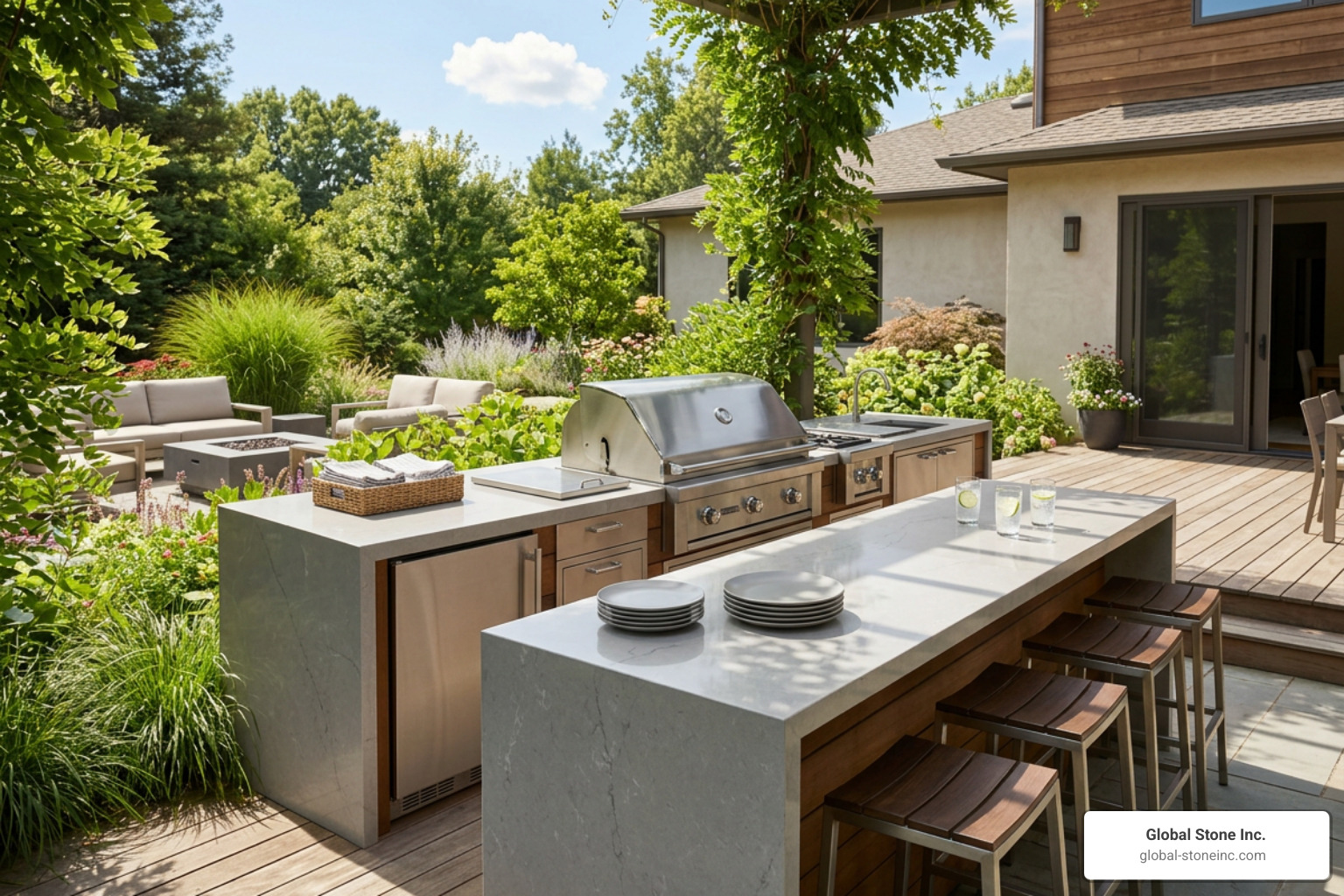
Engineered surfaces are versatile across a wide variety of indoor and outdoor home improvement applications:
- Kitchen Countertops and Waterfall Islands: Withstands heavy prep work, sauce spills, and frequent wipe-downs.
- Bathroom Vanities & Shower Panels: Because it resists moisture and mildew, exploring why Built to Last: Why Your Next Bathroom Counter Should Be Quartz makes clear why it excels in high-humidity spaces.
- Backsplashes and Wall Cladding: Large slab formats create smooth, grout-free vertical accents behind stoves and vanities.
- Commercial Hospitality Spaces: Popular for reception desks, restaurant tabletops, and bars needing high wear resistance.
For homeowners budgeting their renovation, reviewing Is 3K a Fair Price for Your New Quartz Countertops? can help you balance fabrication complexity, square footage, and slab grades.
The Caesarstone Outdoor Collection Difference
Standard interior quartz is not designed for direct sunlight. When exposed to outdoor weather, standard resins degrade, yellow, and crack under ultraviolet (UV) radiation.
Caesarstone solved this problem with a dedicated Outdoor Collection. Engineered with specialized UV-resistant polymer resins and mineral pigments, these exterior slabs are tested to withstand extreme temperature fluctuations, harsh sun exposure, rain, and snow.
Popular exterior color selections include:
- Palm Shade: A delicate white base accented with subtle charcoal veining that stays cool under the sun.
- Clearskies: A light, pale grey with tiny dark flecks mimicking smooth poured concrete.
- Midday, Fresh Concrete, and Concrita: Earthy, neutral tones tailored for natural outdoor landscapes and patio brickwork.
These exterior surfaces make it simple to design an outdoor kitchen or bar area that matches the design flow of your interior living spaces.
How to Clean and Maintain Caesarstone Countertops for Lasting Beauty
Maintaining engineered stone surfaces is straightforward:
- Daily Cleaning: Wipe down the surface using a soft microfiber cloth, warm water, and a mild, pH-balanced liquid dish soap. Rinse away soap residue and dry with a clean towel.
- Tough Spots: For dried food spills, gently scrape them away with a plastic putty knife, then clean the area with a non-abrasive sponge.
- Chemical Safety: Never use harsh cleaners containing bleach, abrasive scrubbing powders, oven cleaners, or acetone.
- Heat Management: While engineered quartz handles moderate warmth, extreme thermal shock from direct contact with hot pots, cast iron pans, and air fryers can cause discoloration or cracking. Always set hot cookware on a heat-safe trivet or hot pad.
- Warranty Coverage: Caesarstone backs their interior residential installations with a lifetime warranty, protecting against manufacturing defects when fabricated and installed by certified stone specialists.
Frequently Asked Questions About Caesarstone and Quartz
What is the primary difference between Caesarstone and generic quartz?
While all quartz countertops blend crushed mineral aggregate with polymer binders, Caesarstone offers nearly 40 years of engineering experience, rigorous quality control, unique proprietary color designs, and silica-free ICON technology. They also provide comprehensive lifetime warranty coverage supported by an established global manufacturer.
Can Caesarstone surfaces be installed outdoors safely?
Only slabs from the Caesarstone Outdoor Collection can be installed in direct exterior elements. Standard interior Caesarstone and generic quartz slabs use resins that will yellow, haze, or warp under continuous UV radiation. The Outdoor Collection utilizes a specialized resin formulation tested against sun exposure and seasonal temperature swings.
Is Caesarstone heat resistant compared to other natural stones?
Caesarstone handles short-term warmth, but natural stones like granite withstand higher direct heat. Because engineered stone contains polymer resins, placing high-heat cookware directly on the surface can scorch the binder. We always advise our clients to use heat trivets under hot pots, electric skillets, and slow cookers.
Conclusion
Choosing the right countertop comes down to finding a surface that fits your day-to-day lifestyle, design taste, and budget. Caesarstone pairs the low-maintenance, stain-resistant durability of engineered quartz with an expansive palette of colors, multiple surface textures, sustainable ICON technology, and dedicated outdoor options.
At Global Stone Inc., our in-house team handles every stage of your project—from design consultations and laser-guided digital templating to precision slab fabrication and expert installation. Backed by our lifetime installation warranty and more than 20 years of craftsmanship across the Chicago area, we are ready to help you bring your vision to life.
Ready to start your renovation? Visit our showroom facility in Elk Grove Village or contact our team to explore Caesarstone countertops for your home today.