
The Ultimate Breakdown of Different Types of Marble Countertops
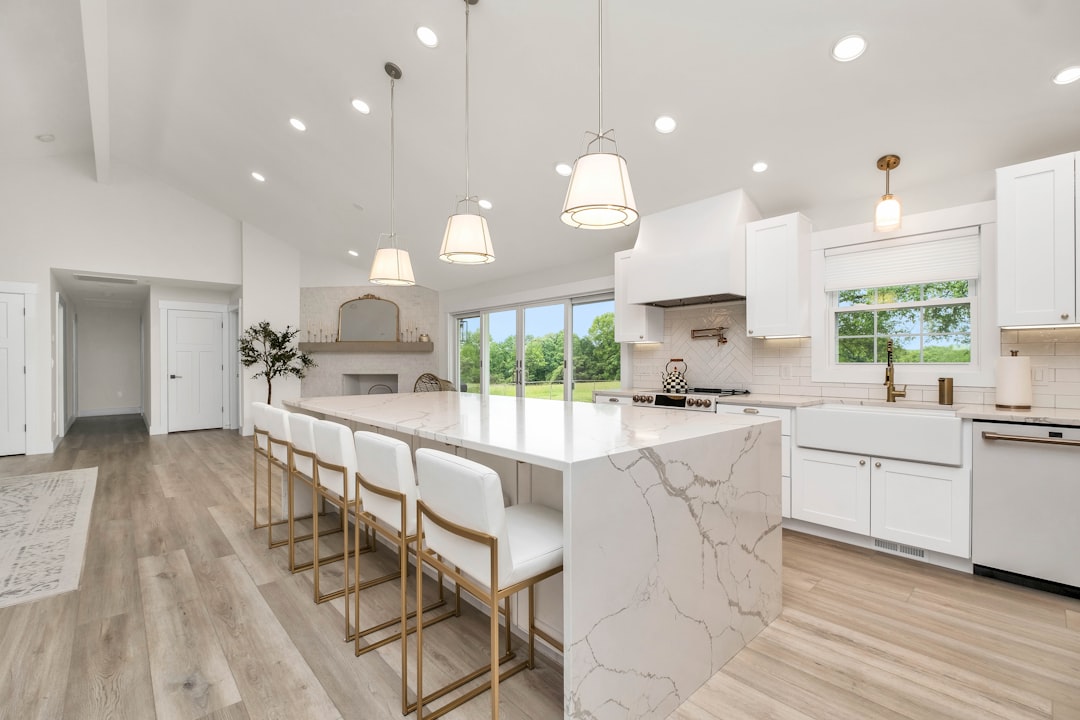
Why Understanding Different Types of Marble Countertops Matters Before You Buy
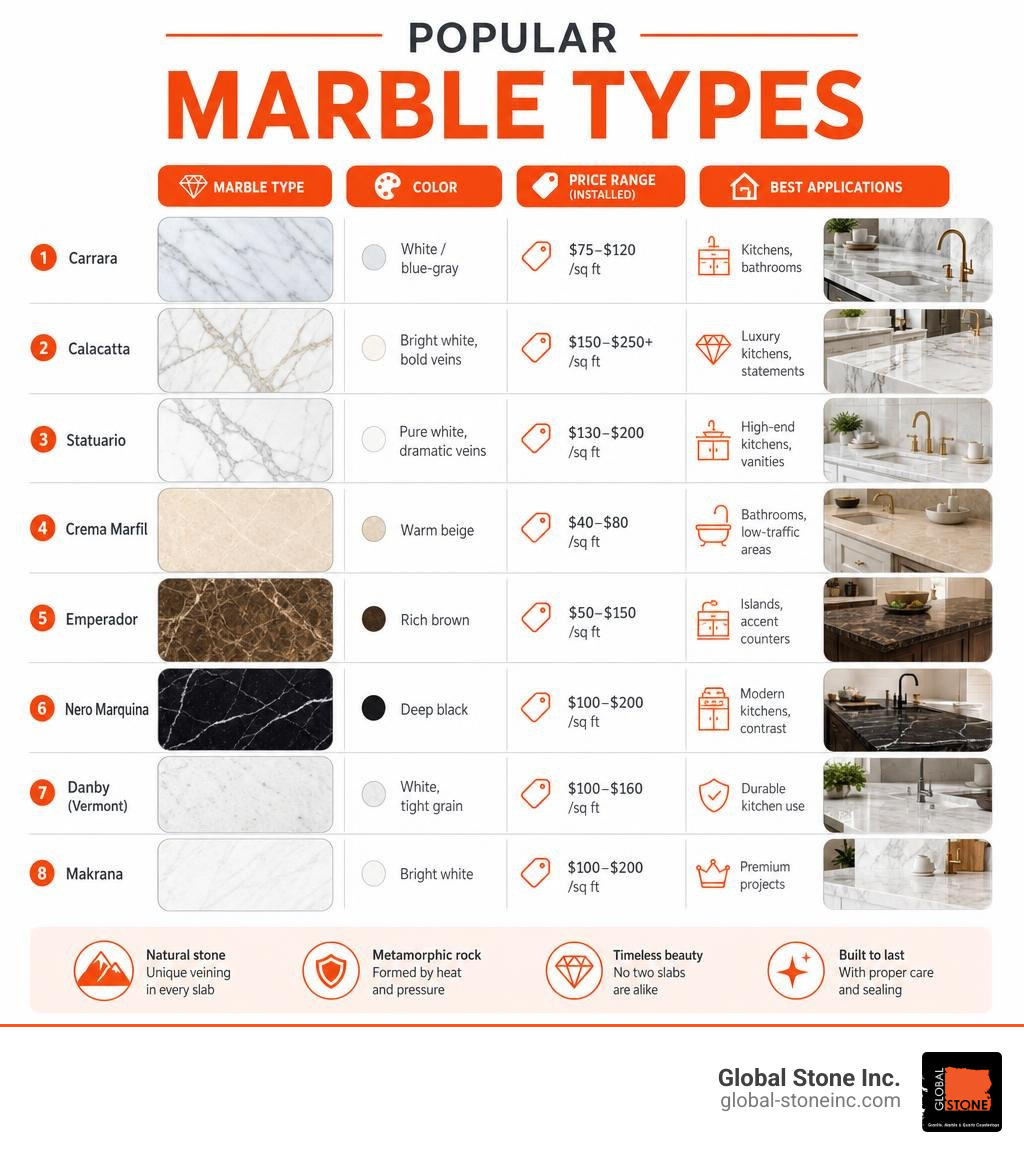
The different types of marble countertops available today range from affordable everyday options to rare, exotic slabs — and choosing the wrong one for your space can be a costly mistake. Here’s a quick breakdown of the most popular types:
| Marble Type | Color | Best For | Price Range (installed) |
|---|---|---|---|
| Carrara | White/blue-gray | Kitchens, bathrooms | $75–$120/sq ft |
| Calacatta | Bright white, bold veins | Luxury kitchens, statements | $150–$250+/sq ft |
| Statuario | Pure white, dramatic veins | High-end kitchens, vanities | $130–$200/sq ft |
| Crema Marfil | Warm beige | Bathrooms, low-traffic areas | $40–$80/sq ft |
| Emperador | Rich brown | Islands, accent counters | $50–$150/sq ft |
| Nero Marquina | Deep black | Modern kitchens, contrast | $100–$200/sq ft |
| Danby (Vermont) | White, tight grain | Durable kitchen use | $100–$160/sq ft |
| Makrana | Bright white | Premium projects | $100–$200/sq ft |
Marble is a metamorphic rock — formed when limestone is transformed by extreme heat and pressure deep underground. That process creates the stunning veining and unique patterns that no engineered material can truly replicate. Every slab is one of a kind.
But beauty isn’t the whole story. Different marble types vary significantly in porosity, hardness, price, and maintenance needs. What works beautifully in a low-traffic bathroom may frustrate you in a busy family kitchen.
I’m Greg Zamarski, founder of Global Stone Inc., with over 20 years of hands-on fabrication and installation experience helping Chicago-area homeowners navigate the full range of different types of marble countertops. In this guide, I’ll walk you through everything you need to know to choose the right marble for your project.
A Guide to Different Types of Marble Countertops

When exploring natural stone, you quickly realize that “marble” isn’t just one single material. It is a vast family of stones, each quarried from different corners of the globe, boasting its own mineral composition, color palette, and structural characteristics.
The geological journey of marble begins as sedimentary limestone. Over millions of years, intense heat and pressure recrystallize the calcium carbonate minerals within the stone, creating a denser, interlocking crystalline structure. The gorgeous swirls and lines we call “veining” are actually mineral impurities—such as iron, clay, sand, or silt—that were trapped in the limestone during its transformation.
Because nature never repeats itself, no two slabs are ever identical, even when cut from the consecutive blocks of the exact same quarry. To help you navigate these natural wonders, you can Learn more about marble varieties to understand how regional origins shape each stone’s personality.
Popular White and Grey Marble Options
White and grey marbles are the undisputed classics of home design. They bring a bright, airy, and undeniably luxurious feel to any space. However, the visual differences between the top three Italian varieties are distinct:
- Carrara Marble: Named after the historic Carrara region of Tuscany, Italy, Carrara is the true workhorse of the marble world. It is characterized by a soft, light-grey or blueish-grey background covered in a delicate web of feathery, dispersed grey veins. Because it is highly abundant, it is one of the most accessible and budget-friendly marbles on the market. In fact, its subtle patterning is excellent at concealing minor daily wear, making it a highly practical choice for active homes.
- Calacatta Marble: Also originating from the Carrara region, Calacatta is far rarer and widely considered the most prestigious marble available. Unlike Carrara, Calacatta features a crisp, purer white background. Its veining is thick, bold, and dramatic, often showcasing a stunning mix of dark grey, beige, and even warm gold tones (as seen in the highly coveted Calacatta Gold). It is designed to be a showstopper.
- Statuario Marble: The rarest of the trio, Statuario is the ultimate statement stone. It features a brilliant, ice-white background that offers a stark, breathtaking contrast to its dark, heavy, and highly defined grey veining patterns. Because of its scarcity and dramatic contrast, it is prized for high-end, exclusive designs.
If you are weighing your options for an upcoming renovation, reading about the 3 Reasons to Consider Marble for Your Kitchen Remodel can help clarify why these white and grey classics remain so popular.
Unique Colored and Dark Marble Varieties
If your design aesthetic leans toward the dramatic, colorful and dark marbles offer an incredible palette of deep, moody tones and vibrant earth colors:
- Nero Marquina: A stunning deep-black marble from Spain, Nero Marquina features sharp, lightning-like white veins running across its dark surface. It is naturally denser and slightly less porous than many lighter marbles, making it a durable and visually arresting choice for modern, high-contrast kitchens.
- Emperador Dark: This rich Spanish marble boasts a deep, warm chocolate-brown background woven with fine, spiderweb-like veins of light beige and gold. It brings a cozy, organic warmth to spaces and pairs beautifully with natural wood cabinetry.
- Crema Marfil: For those who find white too cold, Crema Marfil offers a soothing, warm beige field with subtle, pale yellow or light brown veins. It is highly consistent in color, making it a favorite for large-scale bathroom installations where a serene, spa-like environment is the goal.
- Portoro Marble: Recognized as the most expensive black marble in the world, Portoro features an intense, deep-black background with striking, golden-yellow veins that look like liquid gold poured across the stone. It is highly exclusive and typically reserved for luxury accent pieces.
- Makrana Marble: Hailing from India, Makrana marble is historically famous as the stone used to build the iconic Taj Mahal. It is renowned for its incredibly high resistance to water absorption and exceptional durability, making it a legendary choice for long-lasting installations.
- Danby Marble: Quarried right here in Vermont, Danby marble is a fantastic domestic option. It features a tight crystal structure that makes it significantly denser and less porous than most Italian imports, offering superior resistance to moisture and staining.
To see how these diverse palettes can transform a room, you can Explore marble colors and styles to find the perfect match for your home’s decor.
Performance, Durability, and Maintenance Across Marble Varieties

Before falling in love with a specific slab, it is essential to understand how marble behaves under the pressures of daily life. On the Mohs hardness scale, marble rates between a 3 and a 5. To put that in perspective, granite rates at a 6 to 7, and engineered quartz lands around a 7. This means marble is a relatively soft, porous stone that requires a bit of love and mindfulness.
The two main challenges with marble are staining and etching. Staining occurs when pigmented liquids (like red wine, coffee, or cooking oil) seep into the stone’s microscopic pores. Etching, on the other hand, is a chemical reaction. Because marble is composed of calcium carbonate, acidic substances—like lemon juice, vinegar, tomato sauce, or soda—will dissolve a tiny layer of the surface on contact, leaving behind a dull, light-colored spot.
Fortunately, with the right approach, keeping your stone beautiful is entirely manageable. Be sure to review these 4 Essential Marble Countertop Maintenance Tips to establish an easy, effective care routine.
How Different Types of Marble Countertops Handle Wear
Because of their chemical makeup, all marble countertops will react to acids. A slice of lemon left on a polished marble counter can create a visible etch mark in as little as 30 seconds, while vinegar will react within a minute or two.
It is a common misconception that stone sealers prevent etching. Sealers do not prevent etching. A high-quality penetrating sealer acts like a temporary shield inside the pores of the stone, slowing down the absorption of liquids to give you a 10-to-15-minute window to wipe up spills before they turn into permanent stains.
For a complete breakdown of what to expect, check out this practical Guide to marble costs and care to align your lifestyle with the right stone.
Best Finishes for Kitchens vs. Bathrooms
The finish you choose for your marble countertops plays a massive role in how well they hide daily wear and tear:
- Honed Finish (Matte): A honed finish is created by stopping the polishing process early, leaving the stone with a smooth, satin-like, non-reflective surface. We recommend a honed finish nine times out of ten for kitchen countertops. Because the surface is already matte, dull etch marks from acidic foods are far less visible than they would be on a shiny surface.
- Polished Finish (Glossy): This classic high-gloss finish highlights the full depth of the marble’s colors and makes veining pop with incredible clarity. However, because it reflects light like a mirror, any dull etch mark or minor scratch will stand out immediately. Polished marble is absolutely stunning, but it is best suited for low-traffic areas like powder rooms, master bathroom vanities, or fireplace surrounds.
If your polished surfaces do experience wear over time, don’t panic. You can always utilize Professional Marble Polishing Services to Save Your Surfaces to restore that original, mirror-like luster.
Marble vs. Quartz and Granite: Pros and Cons
Choosing a countertop material is all about balancing aesthetics, performance, and maintenance. To help you see how natural marble stacks up against its closest competitors, here is a direct comparison:
| Performance Dimension | Natural Marble | Natural Granite | Engineered Quartz |
|---|---|---|---|
| Aesthetic Appeal | Unmatched natural depth, unique veining | Speckled, organic patterns | Consistent, manufactured patterns |
| Heat Resistance | High (handles up to 400°F easily) | Excellent (virtually heat-proof) | Moderate (resins can burn/discolor) |
| Scratch Resistance | Moderate (can scratch with metal knives) | High (highly scratch-resistant) | Excellent (highly scratch-resistant) |
| Stain Resistance | Low to Moderate (requires regular sealing) | High (when sealed annually) | Maximum (completely non-porous) |
| Care Effort | Moderate to High (requires gentle cleaning) | Low (annual sealing, easy cleanup) | Minimum (no sealing, soap and water) |
To explore these tradeoffs in even greater detail, you can Compare countertop materials side-by-side to determine which material fits your daily habits best.
Why Homeowners Choose Natural Marble
Despite the maintenance requirements, marble remains the gold standard of luxury for several compelling reasons. First, its aesthetic is irreplaceable. There is a luminous, three-dimensional depth to natural marble that engineered quartz simply cannot mimic.
Second, marble develops a gorgeous “patina” over time. In Europe, homeowners do not view minor scratches and etch marks as damage; they view them as a beautiful, lived-in record of family meals and memories.
Finally, marble is a baker’s dream. Because the dense stone naturally stays cooler than room temperature, it is the absolute best surface for rolling out pastry dough and tempering chocolate without it sticking or melting. Plus, high-quality stone surfaces consistently boost a home’s long-term resale value.
For design inspiration on integrating this classic stone into your home, take a look at how you can Upgrade Your Kitchen with Marble Countertops: 10 Simple Tips.
When to Consider Quartz or Granite Alternatives
If the thought of a lemon slice leaving a permanent mark on your countertop makes you break out in a sweat, marble might not be the right choice for your primary kitchen.
Engineered quartz offers a fantastic alternative if you want the look of marble without the maintenance. Made from roughly 90% to 94% ground natural quartz crystals bound together with polymer resins, quartz is completely non-porous, highly stain-resistant, and never requires sealing.
Granite, on the other hand, is the way to go if you want a 100% natural stone that can handle hot pans directly off the stove and resist scratches from stray knives. To weigh these options further, you can Read the countertop advisor guide for expert insights into alternative surfaces.
Sourcing and Selecting Your Perfect Marble Slab
Selecting your marble slab is the most exciting part of the entire renovation process, but it is not something you should ever do online or from a tiny 2-inch sample. Because natural stone varies wildly from slab to slab, you must visit a stone yard to select your exact pieces in person.
When you go to select your slab, keep these key factors in mind:
- Inspect for Fissures: Natural marble often contains tiny, naturally occurring hairline cracks called fissures. While these are a normal part of the stone’s character, your fabricator should inspect them to ensure they won’t compromise the structural integrity of your countertops during cutting or installation.
- Understand Vein Flow: Pay close attention to the direction of the veins. If your kitchen requires multiple slabs, your fabricator will need to map out where the seams will go to ensure the veining flows naturally from one piece to the next.
- Consider Book-Matching: If you are planning a large kitchen island or a full-height backsplash, ask if consecutive slabs from the same block are available. These can be “book-matched,” meaning they are polished on opposite sides so that when placed side-by-side, the veining patterns mirror each other like an open book.
To see how local homeowners have successfully navigated this process, check out the gorgeous results of Marble Countertops Chicago Homeowners Swear By.
Cost Factors for Different Types of Marble Countertops
The final price tag of your marble countertops is influenced by several key variables:
- Rarity of the Stone: Basic, readily available marbles like Carrara start at around $40 to $50 per square foot for the material alone. Rare, exclusive varieties like Calacatta or Statuario can easily soar to $150, $200, or even $400+ per square foot.
- Fabrication Yield: Unlike granite, which typically offers a 60% to 80% usable yield from a single slab, marble yield often runs lower (around 50% to 70%). This is because fabricators must work carefully around natural fissures and spend extra material to perfectly match complex veining across seams.
- Installation Complexity: Custom edge profiles (like mitered or waterfall edges), undermount sink cutouts, and full-height backsplashes require highly skilled, specialized labor.
At Global Stone Inc., we handle every step of this process in-house at our state-of-the-art Elk Grove Village fabrication facility. By eliminating middleman markups and utilizing our own highly trained designers, fabricators, and installers, we are able to deliver premium quality while keeping costs highly competitive for our neighbors across the Chicago area.
Frequently Asked Questions About Marble Countertops
How often do marble countertops need to be sealed?
Generally, marble countertops in high-use kitchens should be sealed every 3 to 4 months, while bathroom vanities or low-traffic areas can typically go 6 to 12 months between applications.
To find out if it’s time to reseal, perform the simple water droplet test: pour a few drops of water onto your countertop and let them sit for 10 to 15 minutes. If the water beads up on the surface, your sealer is still doing its job. If the stone absorbs the water and leaves a dark spot, it’s time to apply a fresh coat of high-quality penetrating sealer.
What is the difference between Carrara and Calacatta marble?
Though both of these famous marbles are quarried in the Carrara region of Italy, they look and perform slightly differently. Carrara marble features a softer, grey-white background with muted, feathery grey veining spread evenly across the surface. It is highly abundant and budget-friendly.
Calacatta marble features a much brighter, purer white background with bold, dramatic, and thick veins that range in color from dark grey to warm gold. Calacatta is much rarer, highly prestigious, and commands a significantly higher price point.
Can you remove etch marks from marble countertops?
Yes! Because etching is a surface-level chemical reaction rather than a deep stain, light etch marks on a polished marble countertop can often be buffed out at home using a specialized marble polishing powder (typically tin oxide or aluminum oxide based) and a damp microfiber cloth.
For honed marble, a very light buffing with a fine-grit abrasive pad can help blend the dull spot back into the surrounding matte finish. For deep, extensive etching or scratching across a large area, a professional stone restoration specialist can hone and repolish your countertops using progressive diamond pads to make them look brand new.
Conclusion
Choosing the right marble countertop is a journey of balancing timeless natural beauty with a practical understanding of how you live in your home. Whether you fall in love with the classic, soft textures of Carrara, the dramatic luxury of Calacatta, or the durable, tight-grained performance of domestic Danby, there is a perfect slab waiting to elevate your space.
At Global Stone Inc., we have spent over 20 years serving homeowners in Elk Grove Village, Naperville, Chicago, and the surrounding suburbs. We take pride in our craft, which is why we offer a lifetime warranty on our installations and handle everything—from initial design to final installation—with our own dedicated, in-house team.
If you’re ready to find the perfect natural stone for your home, work with a trusted Marble Contractor Chicago to bring your vision to life. Feel free to Schedule a consultation for custom marble countertops or stop by our showroom today to browse our stunning inventory of slabs in person!