The Essential Guide to Soapstone Kitchen Countertops
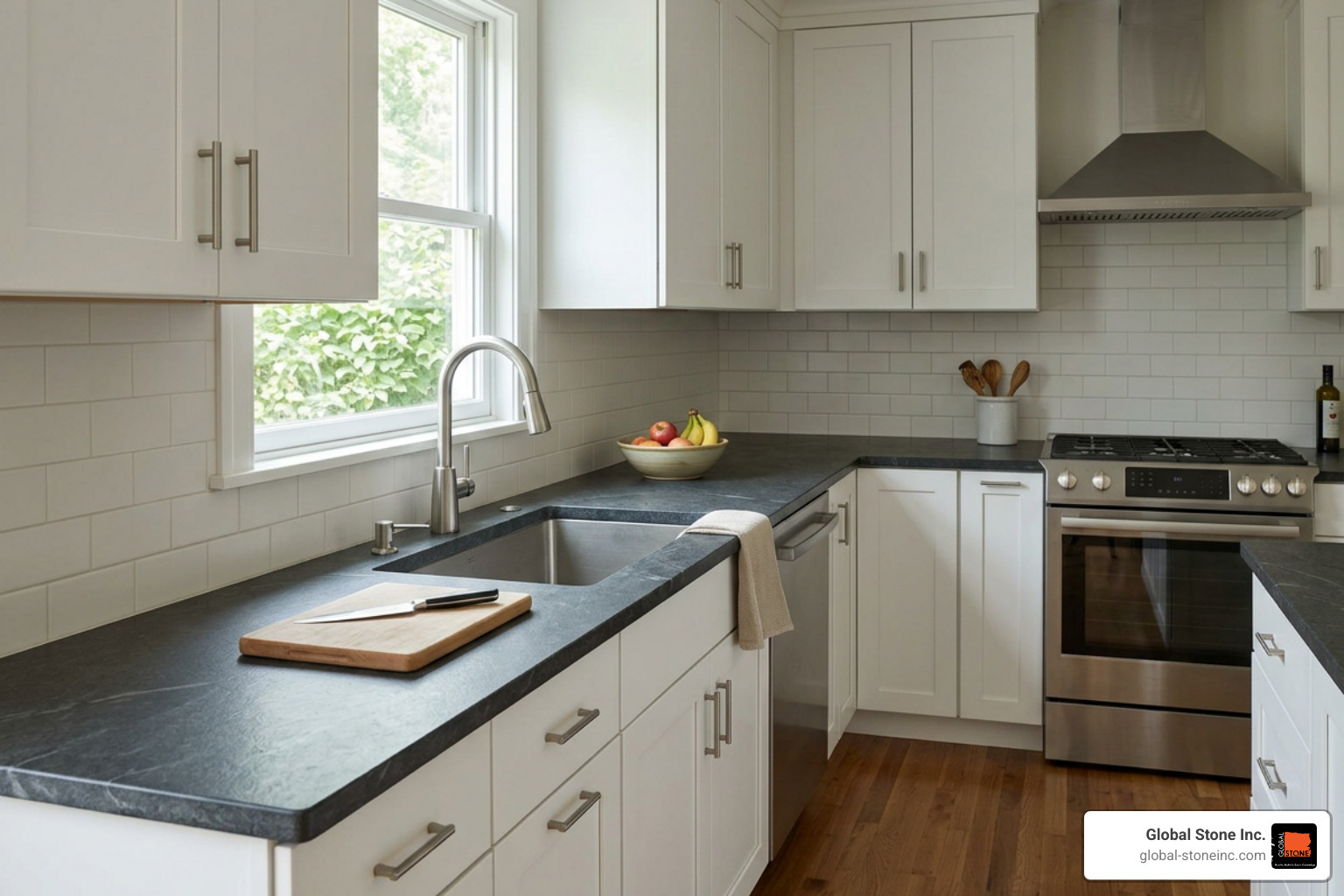
Why a Soapstone Kitchen Countertop Belongs on Your Shortlist
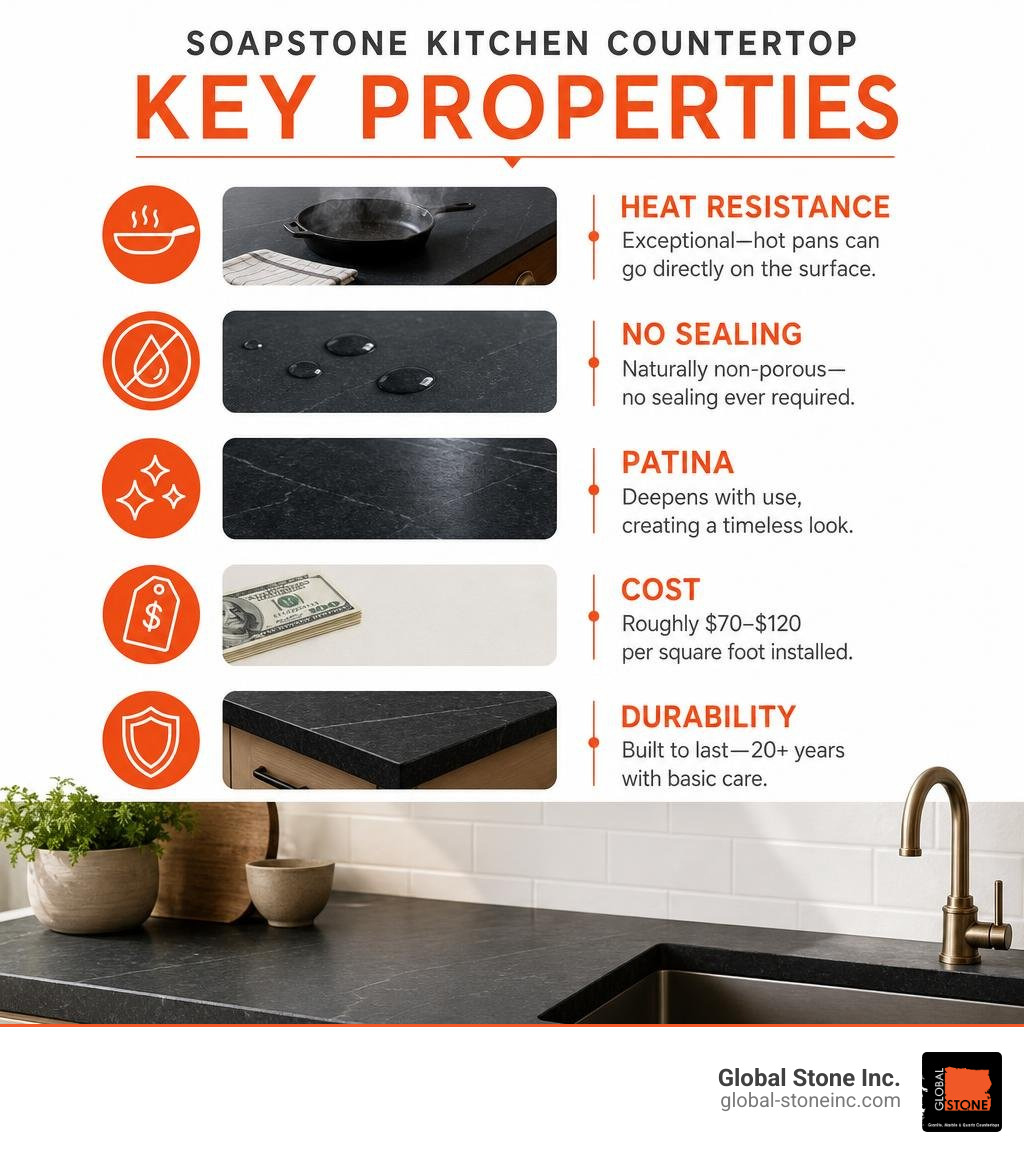
A soapstone kitchen countertop is a natural stone surface made primarily of talc, prized for its heat resistance, non-porous nature, and rich patina that deepens with age. Here’s what you need to know at a glance:
- Material: Metamorphic rock (mostly talc), naturally non-porous
- Heat resistance: Exceptional — hot pans can go directly on the surface
- Stain resistance: High — no sealing ever required
- Scratch resistance: Low — softer than granite, but scratches are easy to fix at home
- Cost: Roughly $70–$120 per square foot installed
- Colors: Light grey, charcoal, deep black, soft green, blue-grey
- Maintenance: Optional mineral oiling; daily cleaning with mild soap and water
- Lifespan: 20+ years with basic care; original 1800s installations still in use today
Soapstone has been a trusted kitchen material for over 200 years in American homes. It handles the heat of a busy kitchen better than almost any other countertop material, and it never needs sealing — unlike granite or marble. It does scratch more easily than harder stones, but those scratches sand out in minutes. It’s a surface that gets better with use, not worse.
I’m Greg Zamarski, founder of Global Stone Inc., and with over 20 years of fabricating and installing natural stone countertops in the Chicago area, I’ve helped hundreds of homeowners choose the right soapstone kitchen countertop for their needs. Let me walk you through everything — from material properties and costs to design pairings and daily care — so you can decide if soapstone is the right fit for your kitchen.
What is a Soapstone Kitchen Countertop?
To truly appreciate a soapstone kitchen countertop, it helps to understand what this material actually is. Unlike granite or marble, which are crystalline and heavily patterned natural stones, soapstone is a metamorphic rock composed primarily of talc, chlorite, and other minerals like magnesite. Also scientifically known as steatite, its high talc content gives the stone its signature “soapy” or velvety feel when touched.
However, not all soapstone is created equal. The stone is generally categorized into two distinct grades:
- Artistic Grade: This variety contains a very high concentration of talc (often up to 80%). Because it is incredibly soft and easy to carve, it is utilized for sculptures, ornaments, and traditional carvings. You definitely do not want this grade on your kitchen island!
- Architectural Grade: This is the variety used for structural and high-traffic applications, including kitchen countertops, sinks, and fireplace surrounds. It typically features a lower talc content (around 30% to 50%), which makes it significantly harder and more durable while still retaining that unique, velvety texture.
Historically, soapstone has a rich heritage in North America. Generations of homeowners in New England have relied on local quarries in Vermont and Virginia to supply stone for farmhouse sinks and wood stoves. Today, while domestic quarries still produce beautiful slabs, the vast majority of architectural-grade soapstone imported to the United States comes from Brazil (where it is known as Pedra-Sabão), as well as India and Finland.
If you are looking to source high-quality slabs in the Midwest, you can explore the extensive selection of Soapstone Slabs – Chicago IL – Marble and Granite Supply of Illinois. Working with the right material suppliers ensures that you get a slab with the exact mineral composition and density required for a busy kitchen.
Comparing the Soapstone Kitchen Countertop to Granite, Quartz, and Marble
When planning a kitchen remodel in the Chicago area, homeowners frequently ask us how soapstone stacks up against more mainstream materials like granite, engineered quartz, and marble. Each of these options has its own set of strengths and weaknesses, which we explore in-depth in our Soapstone Countertops 101: Material Comparison guide.
To give you a quick, digestible overview of how these popular surfaces compare, we have put together this simple performance scorecard:
| Feature | Soapstone | Granite | Engineered Quartz | Marble |
|---|---|---|---|---|
| Porosity | Non-Porous (0% absorption) | Porous (Requires sealing) | Non-Porous | Highly Porous (Stains easily) |
| Heat Resistance | Exceptional (Up to 600°F+) | High (Can thermal shock) | Low (Resins can scorch) | Moderate |
| Scratch Resistance | Low (Mohs 2.5–3.5) | High (Mohs 6–7) | High | Moderate (Mohs 3–4) |
| Chemical Resistance | Chemically Inert (Acid-proof) | Susceptible to acids | Chemical resistant | Acid-sensitive (Etches easily) |
| Sealing Required? | Never | Every 1–3 years | Never | Every 3–6 months |
| Repairability | High (DIY sand and oil) | Moderate (Requires pro resin) | Low (Chit repairs are visible) | Low |
Let’s break down these differences a bit further. Granite is incredibly hard and scratch-resistant, but because it is porous, it requires regular applications of chemical sealants to prevent red wine, oils, and juices from seeping in and leaving permanent stains.
Engineered quartz is highly popular for its uniform look and low maintenance, but because it is held together by synthetic resins, it is vulnerable to heat damage. Place a hot cast-iron skillet directly onto a quartz countertop, and you run a major risk of permanently scorching or cracking the surface.
Marble is undeniably gorgeous, but it is highly porous and chemically reactive. Acidic liquids like lemon juice or tomato sauce will quickly “etch” the surface, leaving dull, white spots behind.
Soapstone, on the other hand, stands alone as a completely natural, chemically inert, and non-porous option. It does not react to acids, it cannot be stained by wine or coffee, and it handles extreme heat like an absolute champ. The tradeoff is its physical hardness; because it ranks lower on the Mohs scale, it will show scratches over time. However, unlike any of the other materials, those scratches can be easily buffed out by hand in a matter of minutes.
Pros and Cons of Soapstone Countertops
Choosing the perfect countertop material is all about balancing aesthetics with lifestyle. To help you decide if this stone fits your daily routine, let’s take an honest look at the benefits and drawbacks of choosing a soapstone kitchen countertop. For an even more detailed breakdown, check out our Soapstone Countertops Pros and Cons: Honest Buyer Guide – D and G Flooring.
The Benefits of a Soapstone Kitchen Countertop
There is a reason why soapstone has maintained a fiercely loyal following for centuries. It offers a combination of physical properties that make it incredibly practical for serious home cooks. Here are the standout benefits that we highlight in our article on Soapstone Countertops: Why They Are the GOAT of Kitchen Design:
- Absolute Heat Proofing: Soapstone is a stellar conductor of heat and has an incredibly high thermal mass. It is so heat-tolerant that it is routinely used to line the inside of wood-burning stoves and fireplace hearths. You can take a baking sheet straight out of a 500-degree oven and place it directly onto your soapstone counter without a trivet. There is zero risk of cracking, thermal shock, or discoloration.
- Naturally Non-Porous: Because the stone is extremely dense, it has a absorption rate of virtually zero. This means liquids cannot penetrate the surface. Red wine, coffee, balsamic vinegar, and olive oil can sit on the counter overnight, and they will wipe away clean the next morning.
- Naturally Antibacterial and Hygienic: Because it is non-porous, there are no microscopic pores or crevices where bacteria, mold, or food particles can hide. This is why soapstone has been the material of choice for scientific laboratories and apothecary benches for over a century. You can prep raw meat or fish directly on the surface with complete peace of mind.
- Chemical Inertness: Soapstone is completely unaffected by acids and alkalis. If you spill lemon juice, vinegar, or harsh household cleaners on it, the stone will not etch or lose its finish.
- Easy DIY Repairability: While other stones require expensive professional intervention if they chip or scratch, soapstone can be repaired by the homeowner. A quick rubdown with some fine-grit sandpaper and a dab of mineral oil will make scratches disappear.
The Drawbacks to Consider
Despite its incredible performance, soapstone is not the perfect choice for every homeowner. There are a few key characteristics that some might view as disadvantages:
- Susceptibility to Scratches and Dings: There is no getting around it: soapstone is soft. With a Mohs hardness rating of 2.5 to 3.5, it can be scratched by keys, dropped cans, or sliding ceramic dishes. If you want a surface that remains pristine and mirror-smooth forever, soapstone will likely frustrate you.
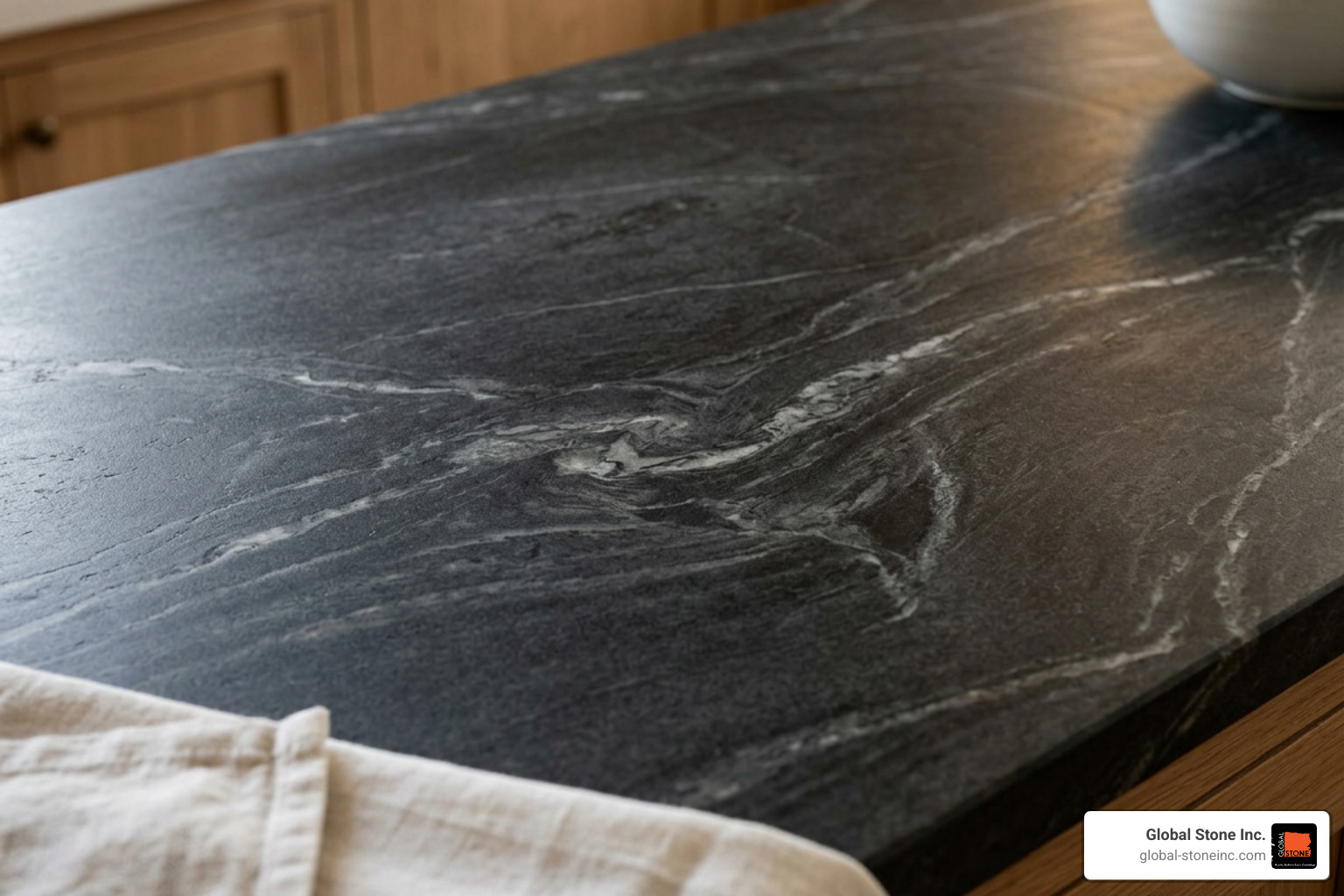
- Patina Development and Color Changes: Soapstone is a living, breathing material. It darkens naturally over time as it is exposed to skin oils, cooking splatters, and oxygen. This means the slab you install on day one will look quite different by year five. While many homeowners fall in love with this rich, historic patina, those who prefer static, uniform colors may find it unpredictable.
- Limited Color Palette: If you are looking for bright whites, vibrant blues, or highly consistent engineered patterns, you won’t find them here. Soapstone is limited to a narrow spectrum of greys, blacks, and greens.
- Higher Upfront Cost: Because it is a specialty stone that requires experienced fabricators to handle its unique properties, soapstone tends to be more expensive than standard granite or entry-level quartz.
Colors, Finishes, and Design Pairings
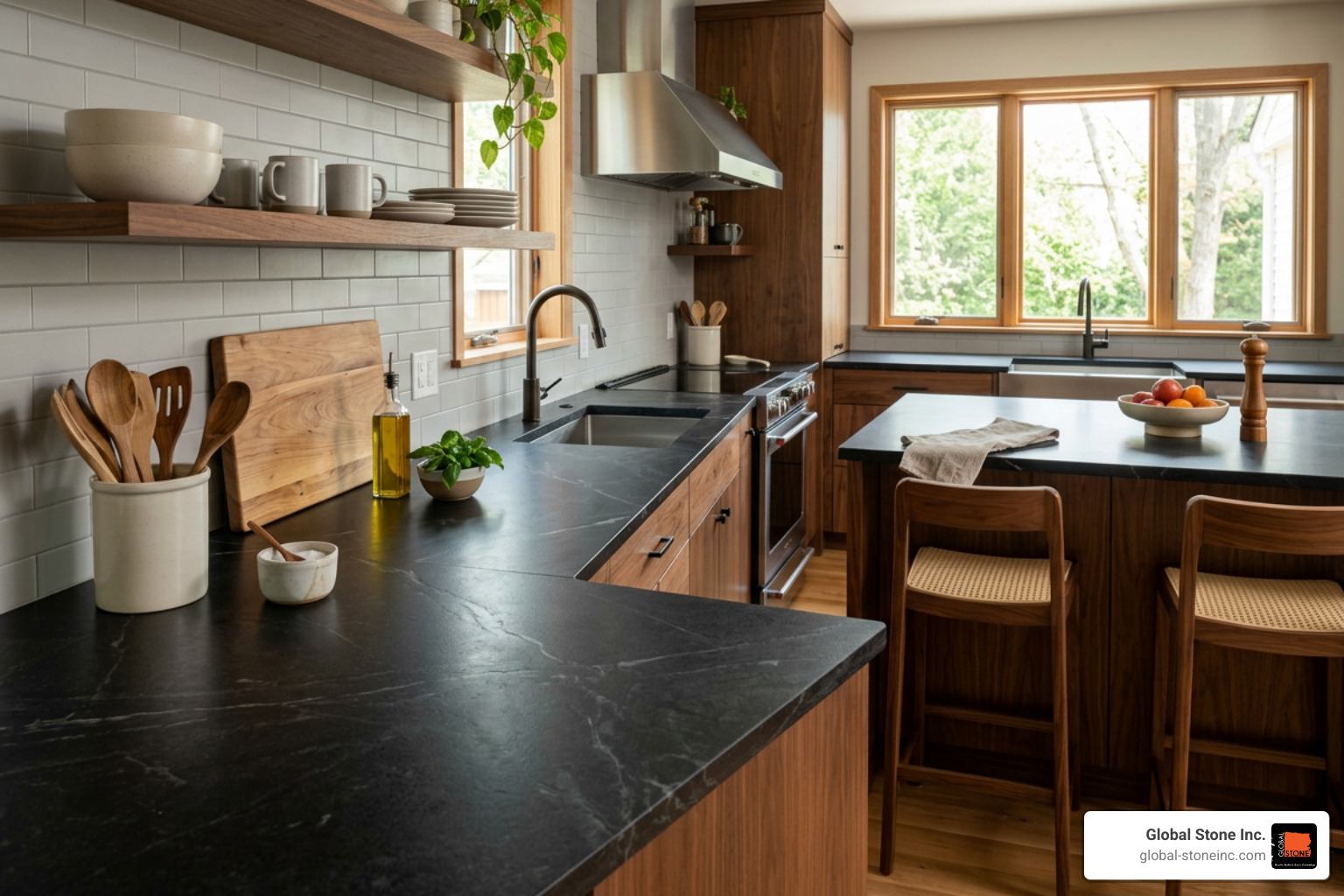
While the color range of soapstone is relatively narrow, the natural variations in veining, mineral deposits, and shading ensure that no two installations are ever identical. If you are curious about how these variations translate to real-world design, our guide From Slabs to Veining: Why Black Soapstone is a Timeless Choice dives deep into the aesthetic possibilities.
The most common soapstone varieties include:
- Light Grey: When left entirely untreated, natural soapstone has a cool, chalky, light-grey appearance. This look is perfect for bright, airy kitchens and pairs beautifully with Scandinavian or minimalist designs.
- Charcoal and Deep Black: When oiled, waxed, or naturally aged, the grey stone deepens into a dramatic, velvety black. Slabs like Black Honed Soapstone often feature striking white quartz veining that creates an elegant, high-contrast look.
- Soft Green: Some quarries produce slabs with high concentrations of chlorite, giving the stone a gorgeous sage, olive, or forest-green undertone. This option brings an organic, earthy warmth to traditional and rustic homes.
- Blue-Grey: Certain Brazilian varieties offer a cool, blue-grey cast that looks incredibly sophisticated when paired with modern stainless steel appliances.
Regardless of the color, soapstone is almost always finished with a honed (matte) finish. Because of its talc content, it cannot take a high-gloss polish like granite or marble. This matte finish is actually one of its greatest design assets, offering a soft, glare-free surface that feels incredibly luxurious to the touch.
Best Backsplash and Cabinet Pairings
Because of its organic, understated look, soapstone is incredibly versatile. It acts as a grounding element in a kitchen, allowing other design features to shine. To help you plan your space, here are some of our favorite design pairings, which we discuss in detail in The Best Backsplash Options for Soapstone Countertops:
- White Shaker Cabinets: This is a classic, high-contrast pairing that never goes out of style. The dark, velvety soapstone anchors the bright white cabinetry, creating a clean, timeless look that feels at home in both historic farmhouses and modern suburban homes.
- Natural Wood Tones: Pairing dark charcoal or green soapstone with warm wood cabinets (like white oak, walnut, or rustic cherry) creates an incredibly cozy, organic aesthetic. This look is perfect for mountain-style homes or craftsman kitchens.
- Integrated Farmhouse Sinks: Because soapstone is soft enough to be easily carved and shaped with woodworking tools, we can fabricate custom, integrated apron-front sinks from the exact same slab as your countertops. This creates a seamless, high-end look that is highly functional and historically authentic.
- Textured Backsplashes: To complement the smooth, matte texture of the stone, we recommend pairing it with a textured backsplash. Handcrafted zellige tiles, classic white subway tiles with dark grout, or even a matching full-height soapstone backsplash slab all look spectacular.
Cost, Installation, and Maintenance
Understanding the financial and logistical aspects of a countertop project is essential for a smooth remodel. Generally, soapstone countertops cost between $70 and $120 per square foot installed for the slab material itself. However, because soapstone is a specialty stone, the total project cost is influenced by several fabrication and installation variables.
To help you budget, here is a breakdown of the primary factors that influence the final price:
- Slab Selection and Rarity: Slabs with highly dramatic, active white veining or rare green undertones often command a premium compared to more uniform grey slabs.
- Thickness: The industry standard for kitchen countertops is 3cm (about 1.25 inches). Opting for thicker custom slabs will increase the material cost.
- Cutouts and Customization: Custom fabrications—such as undermount sink cutouts ($150–$300), cooktop cutouts ($200–$400), or integrated drainboards carved directly into the stone—will add to the labor cost.
- Edge Profiles: Simple edges like eased, beveled, or half-bullnose are typically included in the base fabrication price. More complex profiles like ogee or triple-pencil will incur an extra charge ($15–$30 per linear foot).
- Remnants for Small Projects: If you are doing a smaller project like a bathroom vanity, a home bar, or a fireplace surround, we can often source a high-quality soapstone remnant from our Elk Grove Village facility, saving you a significant amount on material costs.
To give you a clear picture of what to expect from start to finish, here is the typical journey of a soapstone project:

At Global Stone Inc., our experienced in-house team handles every step of this process. Because we do not outsource our fabrication or installation, we are able to maintain strict quality control and offer a lifetime warranty on our craftsmanship.
Oiling, Cleaning, and Scratch Repair
One of the most appealing aspects of soapstone is that its maintenance is entirely up to you. Unlike other stones where maintenance is mandatory to prevent damage, soapstone care is purely aesthetic.
If you want to learn more about keeping your counters looking pristine, read our guide on Squeaky Clean: Removing Tough Stains from Soapstone Kitchen Counters.
Here are the three core components of soapstone care:
1. The Oiling and Waxing Decision
Left untreated, soapstone will slowly and unevenly darken on its own as it absorbs oils from your hands and cooking. To accelerate this process and achieve a uniform, deep charcoal or black look, you have two options:
- Mineral Oil: Apply a thin layer of food-grade mineral oil (never use cooking oils like olive or canola oil, as they will go rancid!) to the surface. Let it sit for 15–30 minutes, then buff off the excess with a clean rag. For the first month, do this weekly. For the next six months, apply it monthly. After that, a quick touch-up a few times a year will keep the color rich and even.
- Soapstone Wax: A blend of natural beeswax and carnauba oil provides a longer-lasting finish than mineral oil. It requires less frequent application and gives the stone a beautiful, soft sheen.
Note: If you prefer the light, natural grey look, simply do not oil or wax the stone at all! Just clean up greasy spills quickly to prevent temporary dark spots.
2. Daily Cleaning
Because soapstone is chemically inert, you don’t need any specialty stone cleaners. Daily cleanup is as simple as wiping the surface with warm water and mild dish soap. Avoid using abrasive scouring pads, which can scratch the finish, and stay away from harsh chemical solvents if you have oiled your countertops, as they will strip the oil away (requiring you to re-apply it).
3. Scratch Repair
If you get a scratch on your soapstone kitchen countertop, don’t panic! You can easily repair it yourself using this simple process:
- For very light scratches, simply rub a small dab of mineral oil or wax over the mark. This will darken the scratch to match the surrounding stone, making it virtually invisible.
- For deeper scratches or small nicks, grab a piece of 120-grit or 220-grit sandpaper. Lightly sand the scratched area in a circular motion until the scratch disappears.
- Wipe away the stone dust with a damp cloth.
- Apply a fresh coat of mineral oil or wax to the sanded area to restore the dark, rich color and blend it seamlessly with the rest of the countertop.
Frequently Asked Questions about Soapstone Countertops
Is soapstone a good choice for a busy family kitchen?
Yes, absolutely! Soapstone is an excellent choice for active, busy family kitchens, but it requires a slight shift in mindset. If you are the type of homeowner who will stress over every minor scratch or ding, a softer stone might not be the best fit for your sanity.
However, if you appreciate natural materials that age gracefully and develop character over time—much like a high-quality leather jacket or a well-loved wooden cutting board—you will absolutely love soapstone. Its complete immunity to stains, acids, and heat makes it incredibly kid-friendly. You don’t have to worry about spilled juice, dropped lemon wedges, or hot pizza boxes ruining the surface. Plus, the fact that you can easily sand out any major scratches yourself makes it highly resilient.
To see how soapstone can even boost your home’s long-term appeal, take a look at our article on Soapstone Countertops in Real Estate Staging: The Secret to High Value Offers.
Do soapstone countertops need to be sealed?
No, soapstone countertops never need to be sealed. Unlike granite, marble, or quartzite, soapstone is naturally non-porous. Because there are no pores for liquids to penetrate, chemical sealants cannot sink into the stone and are completely useless.
Any treatment you apply to soapstone—whether it is mineral oil or specialized soapstone wax—is purely for aesthetic purposes to darken the stone and highlight its veining. If your fabricator uses epoxy or seam fillers during installation, it is important to ensure they use high-quality materials, as discussed in Best Epoxy for Soapstone: Don’t Let Your Kitchen Fall Apart, but the stone itself remains completely sealer-free.
Can you put hot pans directly on soapstone?
Yes! Soapstone has exceptional heat tolerance. Because it was formed under intense geological heat and pressure, and because of its high density and thermal mass, it can handle direct contact with hot cookware without any damage.
You can take a cast-iron skillet directly off a red-hot burner or a roasting pan straight out of a 500-degree oven and set it directly onto your soapstone counter. It will not scorch, discolor, or crack. In fact, soapstone is so good at absorbing and radiating heat that it is historically used to build Scandinavian masonry heaters and wood stove fireboxes.
Conclusion
A soapstone kitchen countertop is a unique, practical, and incredibly beautiful choice for homeowners who love the warmth and character of natural stone. With its unmatched heat resistance, natural stain immunity, and easy DIY repairability, it is a surface that is truly built to be lived on and loved for generations.
At Global Stone Inc., we have been serving the Chicago area—including Chicago, Elk Grove Village, and Naperville—for over 20 years. Our team of in-house designers, fabricators, and installers is dedicated to helping you find the perfect stone for your home. We stand behind our work with a lifetime warranty, ensuring that your investment is protected for years to come.
If you are ready to see the velvety texture and stunning veining of soapstone in person, we invite you to visit our state-of-the-art fabrication facility in Elk Grove Village, IL. Our experts can help you compare slabs, explore design pairings, and plan your dream kitchen.
Ready to take the next step? Get a Quote on Soapstone Countertops from us today, and let’s bring your vision to life!