
Is 3k a Fair Price for Your New Quartz Countertops
What Does It Actually Cost to Get Quartz Countertops in 2026?
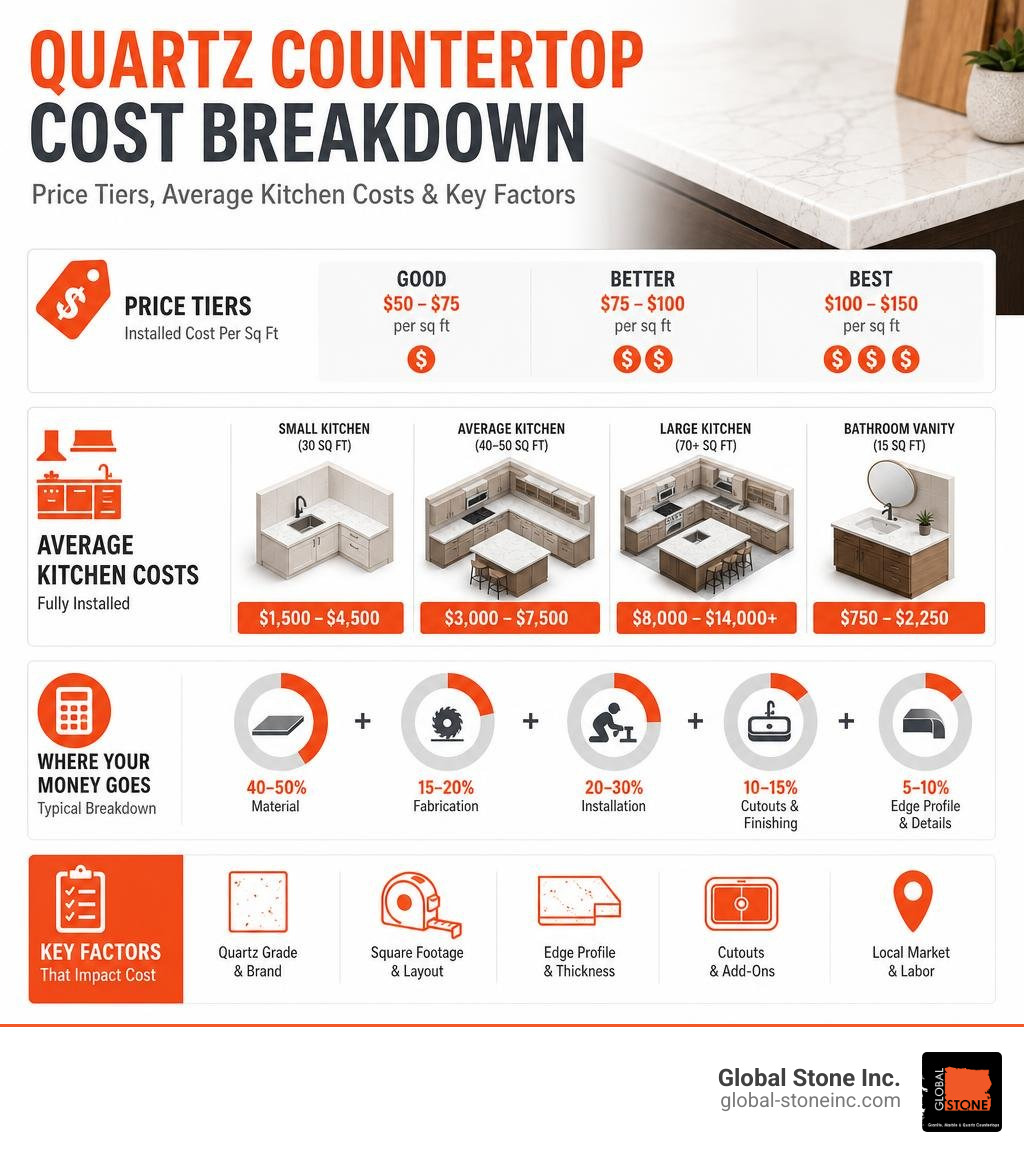
The cost of quartz countertops installed in 2026 typically falls between $50 and $150 per square foot, depending on the grade, brand, edge profile, and your local market. Here’s a quick breakdown to orient your budget before we go deeper:
| Project Type | Typical Total Cost |
|---|---|
| Small kitchen (30 sq ft) | $1,500 – $4,500 |
| Average kitchen (40–50 sq ft) | $3,000 – $7,500 |
| Large kitchen (70+ sq ft) | $8,000 – $14,000+ |
| Bathroom vanity (15 sq ft) | $750 – $2,250 |
Key numbers to remember:
- Material only: $30 – $100 per sq ft
- Fully installed: $50 – $150 per sq ft
- Most homeowners spend: $4,000 – $6,500 for a standard kitchen
- Project minimums: Most fabricators charge at least $1,500 – $2,500 regardless of job size
So is $3,000 a fair price for quartz countertops? It can be — for a smaller kitchen or a simple layout. But for most full kitchen remodels, the real number lands higher once fabrication, installation, cutouts, and edge profiles are added in. That’s exactly what this guide breaks down.
The pricing landscape can be genuinely confusing. Advertised rates rarely include everything you’ll actually pay for. And quotes from different fabricators often don’t line up — because they’re not quoting the same scope.
I’m Greg Zamarski, owner of Global Stone Inc. in Elk Grove Village, and with over 20 years of fabricating and installing quartz countertops across the Chicago area, I’ve helped thousands of homeowners understand the true cost of quartz countertops before they commit to a project. Keep reading and I’ll walk you through every factor that shapes your final price.
Is $3,000 a Realistic Budget for Quartz Countertops?
When you start planning a kitchen refresh, $3,000 feels like a solid chunk of money. And in many home improvement scenarios, it is. But when it comes to the cost quartz countertops require, whether $3,000 will cover your project depends entirely on the size of your kitchen and the complexity of your layout.
If you are working with a smaller galley kitchen, a townhome kitchen, or a condominium space that requires 30 square feet or less of material, $3,000 is a highly realistic and fair budget. For this price, you can easily secure a beautiful, entry-level to mid-range quartz slab, standard edge profiles, and professional installation.
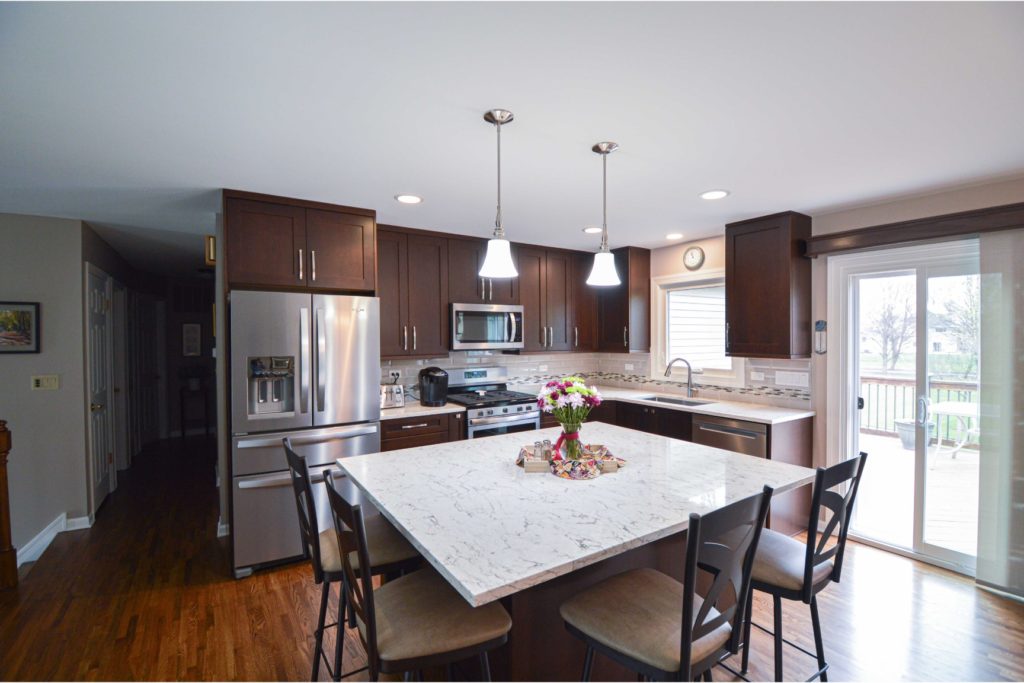
However, if you have a larger suburban kitchen with an island, a U-shaped layout, or a space requiring 50 to 70 square feet of stone, a $3,000 budget will fall short. For those larger spaces, you should realistically budget between $5,000 and $12,000.
Another critical factor to keep in mind is the “project minimum.” Because transporting heavy stone slabs, sending out templating crews, and running state-of-the-art fabrication machinery involves significant overhead, most reputable fabricators maintain a project minimum of $1,500 to $2,500. This means even a tiny bathroom vanity that only uses 8 square feet of stone will often be priced at the contractor’s project minimum rather than a simple per-square-foot rate.
To get a complete sense of how layout and planning affect your project scope, we recommend reading through The Ultimate Guide to Quartz Countertops and exploring our detailed breakdown of Countertops Natural Stone Countertops Quartz Countertop options.
Understanding the Average Cost Quartz Countertops Project
To understand why countertop quotes vary so much, we have to look at how the total cost is calculated. The final invoice you receive from a fabricator isn’t just a markup on raw stone; it is a combination of raw material costs, specialized fabrication labor, and precision installation.
On a national level, the average fully installed project ranges from $70 to $100 per square foot, with premium projects climbing to $150 or more. Here is how those costs break down behind the scenes:
- Raw Materials: The quartz slabs themselves typically cost between $15 and $50 per square foot. This price is determined by the brand, the rarity of the design, and the quality of the engineering.
- Fabrication and Labor: Transforming a raw slab into a finished countertop requires advanced CNC machinery, water jets, and hand-polishing. This fabrication and installation labor generally runs between $40 and $150 per square foot, depending on the complexity of the cuts, the number of sink openings, and the edge profiles selected.
- The “All-In” Reality: When you see an advertised price of “$45 per square foot” on a showroom wall, it almost always refers to the raw material alone or a highly restricted entry-level package. A true, all-inclusive quote that covers templating, fabrication, sink cutouts, edge polishing, delivery, and installation usually lands between $80 and $120 per square foot for a mid-grade slab in the Chicagoland area.
Breaking Down the Cost Quartz Countertops by Grade and Brand
Not all quartz is created equal. Because quartz is an engineered stone—made by combining ground natural quartz crystals with polyester resins and pigments—the manufacturing process directly influences both the price and the performance of the slab.
One of the most critical indicators of quartz quality is the resin-to-quartz ratio. Premium quartz brands typically use a mix of 90% to 93% natural quartz minerals and only 7% to 10% resin binder. This low-resin formulation yields an incredibly hard, scratch-resistant surface that looks virtually identical to natural stone. Cheap, builder-grade quartz often contains 12% or more resin. While cheaper to produce, high-resin slabs are softer, more prone to scratching, and can suffer from “resin pooling,” where ugly, concentrated splotches of resin ruin the visual consistency of the pattern.
To dive deeper into how this engineered marvel is constructed, check out our guide, The Great Countertop Mystery: Is Quartz Actually Natural?.
| Quartz Grade | Resin Content % | Material Cost (per sq ft) | Installed Cost (per sq ft) | Best Used For |
|---|---|---|---|---|
| Standard / Builder | 11% – 13%+ | $15 – $30 | $50 – $70 | Rental properties, laundry rooms, basic basements |
| Mid-Range | 9% – 11% | $30 – $50 | $70 – $100 | Standard residential kitchens, family bathrooms |
| Premium | 7% – 8% | $50 – $80 | $100 – $130 | High-traffic kitchens, master baths, custom designs |
| Luxury / Designer | 7% | $80 – $100+ | $130 – $180+ | Statement islands, waterfall edges, luxury homes |
Standard and Mid-Range Quartz Options
For homeowners looking to maximize their budget, standard and mid-range quartz options offer exceptional value. Entry-level or “builder-grade” quartz typically features simple, uniform patterns with solid background colors like soft creams, neutral grays, and basic whites. Because these patterns are easy to manufacture and don’t require complex color blending, they represent the most affordable entry point into engineered stone.
Mid-range quartz is the absolute “sweet spot” for the majority of residential kitchen renovations in the Chicago area. In this tier, you will find beautiful, subtle patterns that mimic light granite or fine sand. These slabs offer excellent durability and a massive step up in visual depth without the premium price tag. If you want to explore how Chicago homeowners utilize these cost-effective options, take a look at our article on Affordable Quartz Countertops Chicago Residents Love.
Premium and Luxury Quartz Brands
When you step into premium and luxury quartz tiers, you are paying for advanced manufacturing technology that can replicate the world’s most exotic natural stones. Luxury quartz is famous for its breathtaking, wide-vein patterns, particularly Calacatta and Carrara marble looks. Creating these organic-looking veins requires highly sophisticated, computer-controlled distribution of minerals and pigments during the casting process.
In this category, domestic manufacturers like Cambria command a 30% to 50% premium because they are manufactured entirely in the United States using pure quartz minerals and state-of-the-art quality control. These luxury slabs are highly coveted for massive statement islands and full-height backsplashes. If you are dreaming of a dramatic, high-end kitchen, read our design guide on 7 Stunning Backsplash Ideas for Your Calacatta Quartz Countertops.
Key Factors That Influence Your Final Quote
If you hand the exact same kitchen layout to three different fabricators, you might receive three wildly different quotes. This happens because the cost quartz countertops incur isn’t just about the square footage of the stone. Every custom cut, edge profile, and cutout adds labor time and complexity to the fabrication process.
Slab Thickness and Edge Profiles
Quartz slabs are primarily manufactured in two standard thicknesses: 2cm (approximately 3/4 inch) and 3cm (approximately 1 1/4 inch).
- 2cm Slabs: Choosing a 2cm slab can save you 15% to 20% on raw material costs. However, because 2cm stone is thinner, it requires a plywood subtop support system installed over your cabinets. To make a 2cm slab look thicker, fabricators can perform an “edge build-up” or a mitered edge, which glues a strip of stone along the front edge. While this saves material weight, the extra fabrication labor can sometimes offset the material savings.
- 3cm Slabs: This is the industry standard for kitchen countertops. It is incredibly strong, can be installed directly onto your cabinets without subtop support, and exudes a heavy, luxurious feel.
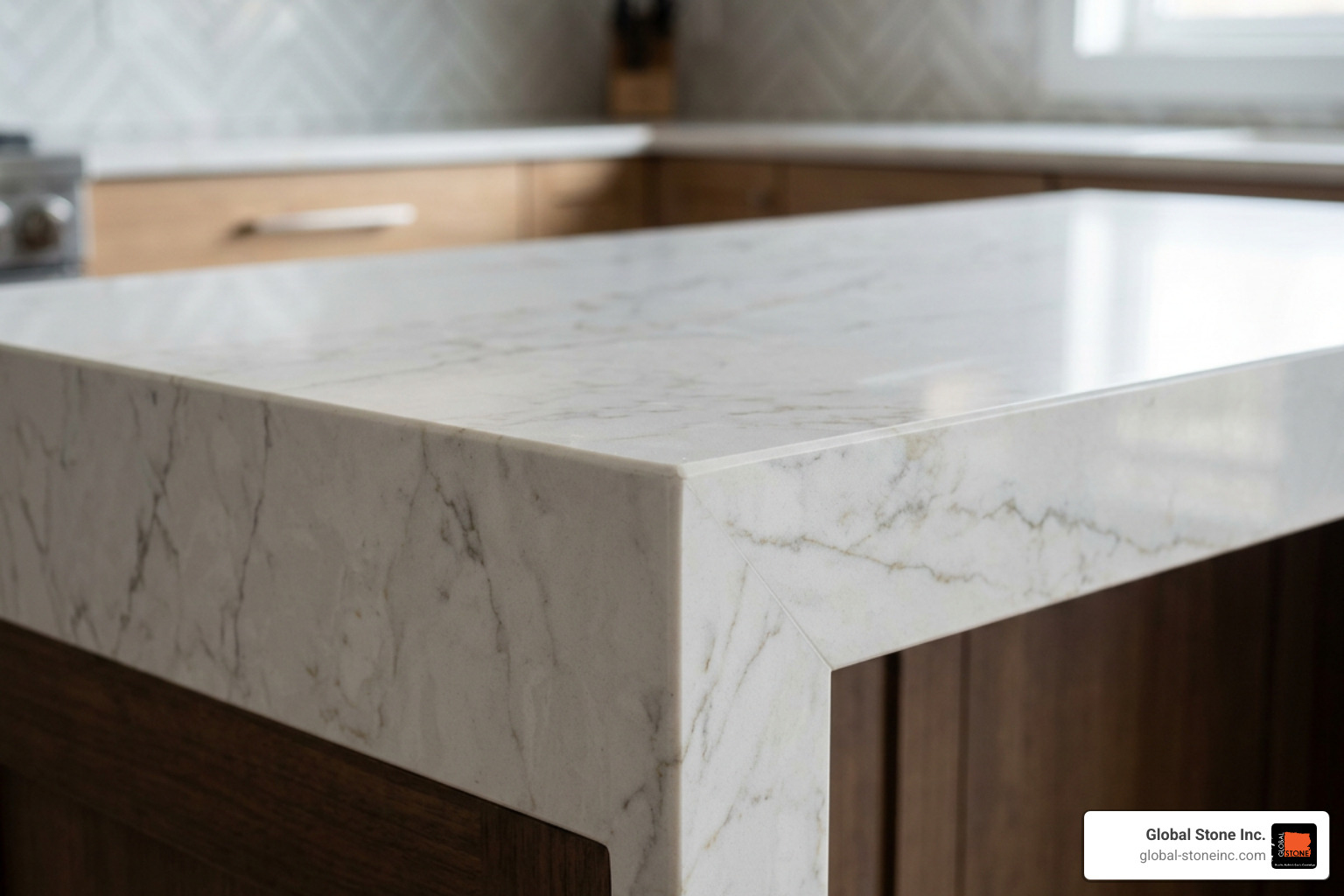
- Edge Profiles: The shape of the front edge of your countertop plays a major role in pricing. Standard edges, such as an “eased” (slightly softened square) or a 1/4-inch bevel, are almost always included in the base price of your fabrication. However, decorative edge profiles require specialized tooling and hand-polishing. Upgrading to a Bullnose, Ogee, or a dramatic Waterfall edge (where the stone wraps down the side of the cabinetry to the floor) can add significant cost:
- Eased / Flat Edge: Included in base price
- Beveled / Bullnose Edge: +$5 to $15 per linear foot
- Ogee Edge: +$10 to $30 per linear foot
- Waterfall Edge: +$30 to $80 per linear foot
To learn more about how master craftsmen achieve these flawless edges, read The Secret to Professional Quartz Edge Finishing.
Cutouts, Seams, and Fabrication Complexity
Every time a fabricator has to cut into a quartz slab, it introduces risk and requires precision machinery. This is why “cutouts” are billed as separate line items on your quote.
- Sink Cutouts: A standard drop-in sink is relatively inexpensive to fabricate because the raw, cut edge of the stone is hidden beneath the sink’s rim. An undermount sink, however, requires the fabricator to perfectly cut, polish, and bevel the inside edge of the stone, as it will be completely visible. Expect to pay $150 to $300 for an undermount sink cutout.
- Cooktop and Outlet Cutouts: Standard cooktop cutouts run between $150 and $300. Outlets cut directly into a quartz backsplash can add $50 to $100 each.
- Seam Placement: Standard quartz slabs measure roughly 120 inches by 55 inches. If your countertop run is longer than 10 feet, or if you have an L-shaped or U-shaped kitchen, your project will require seams. Strategically planning these seams to match the veining pattern of the stone requires skilled drafting and nesting software, and fabricators often charge a seam placement fee of $100 to $200 per seam to ensure a flawless, tight fit.
For a professional look at how custom fabrication is handled in the field, explore our services as a premier Countertop Contractor Chicago Quartz Countertop specialist.
Quartz vs. Other Materials: A Cost and Value Comparison
When deciding on a countertop material, it helps to see how the cost quartz countertops demand stacks up against other popular choices. While laminate is undeniably the cheapest upfront option, and marble sits at the pinnacle of luxury pricing, quartz occupies a highly desirable middle-to-high ground, offering an unmatched balance of durability and lifetime value.
To see a direct head-to-head comparison of engineered stone versus classic luxury natural stone, check out our popular comparison guide, Quartz Countertops vs Marble Countertops Kitchen Showdown.
Quartz vs. Granite and Natural Stone
Granite and quartz are the two most popular countertop materials on the market, and their installed costs overlap significantly. In 2026, installed granite ranges from $40 to $100 per square foot, while quartz ranges from $50 to $120 per square foot.
At the entry-level tier, granite is often $10 to $20 per square foot cheaper than quartz. However, granite is a naturally porous volcanic rock. To prevent stains, bacteria growth, and water damage, granite must be professionally sealed at installation and resealed every 1 to 3 years. This annual maintenance costs about $15 to $30 per year in DIY sealer, or upwards of $100+ if you hire a professional.
Quartz, being non-porous, never requires sealing, saving you hundreds of dollars in maintenance costs and hours of labor over its lifetime. For help choosing between these two giants, read Don’t Take It for Granite: A Guide to Quartz Countertop Color Selection.
Quartz vs. Premium Natural Stone Value
Premium natural stones like marble and quartzite are undeniably beautiful, but they come with heavy price tags and significant maintenance challenges. Marble ($100 to $250+ per square foot installed) is highly susceptible to “etching”—a chemical reaction that occurs when acidic liquids like lemon juice or wine come into contact with the calcium carbonate in the stone, leaving permanent dull spots. Quartzite ($100 to $200+ per square foot installed) is incredibly hard and heat-resistant, but it is highly porous and exceptionally difficult to fabricate, which drives installation labor costs through the roof.
Quartz offers the perfect alternative. It delivers the stunning, high-contrast veining of Carrara marble and the crystalline depth of quartzite, but with zero porosity, high stain resistance, and a more predictable installation cost. To understand why so many homeowners view quartz as the ultimate high-value investment, read about the 4 Advantages of Quartz Countertops.
Hidden Fees and Regional Pricing Variations
When you receive a quote for new countertops, the “sticker shock” usually comes from the line items that showrooms forget to mention in their initial advertisements. To build an accurate budget, you must account for the entire scope of the project, from demolition to final plumbing reconnections.
Additional Project Costs to Budget For
A complete kitchen countertop replacement involves several steps beyond simply dropping a piece of stone onto your cabinets. Here are the typical add-on costs you should budget for:
- Demolition and Haul-Away: Removing your old laminate, tile, or stone countertops and disposing of them safely typically costs between $200 and $500 ($5 to $15 per square foot).
- Plumbing Disconnect and Reconnect: Your fabricator is a stone expert, not a licensed plumber. You will need to budget $150 to $300 for a plumber to disconnect your sink and faucet before the install, and return afterward to hook up the drain and water lines.
- Template Fees: Precision laser templating is required before any stone is cut. Some fabricators charge a standalone template fee of $150 to $300, while others roll it into the installation package.
- Backsplash Installation: If you want a matching 4-inch quartz backsplash or a full-height quartz backsplash, expect to pay $15 to $40 per linear foot for material and labor.
If you are considering a bathroom upgrade alongside your kitchen, we explain these budgeting steps in our guide, Built to Last: Why Your Next Bathroom Counter Should Be Quartz.
How Local Markets Impact the Cost Quartz Countertops
Where you live plays a massive role in the final price of your stone. In the Chicago metropolitan area, labor rates, overhead, and delivery logistics are vastly different from the national average.
While the national average for a mid-grade quartz installation sits around $75 to $95 per square foot, Chicago-area projects typically average $85 to $120 per square foot. This variation is driven by several local factors:
- Urban Delivery Logistics: Delivering a 500-pound quartz slab to a high-rise condo in downtown Chicago, Lincoln Park, or Gold Coast involves significant logistical challenges, including parking permits, elevator bookings, and tight stairwells. These urban delivery complexities can add 10% to 15% to your installation labor costs compared to a suburban installation in Elk Grove Village or Naperville.
- The Advantage of Local Fabrication: Working with a local, direct fabricator who owns their own slab yard and fabrication facility—rather than a middleman showroom—can save you 15% to 25% on your total quote.
To see how we serve our local communities, check out our location-specific guide, Quartz Countertops Elk Grove Village IL. You can also browse local professionals on Houzz to compare regional experts, such as the Best 15 Quartz Countertop Companies in Chicago, IL or the Best 15 Quartz Countertop Companies in Elk Grove Village, IL | Houzz .
Smart Ways to Save Money on Your Quartz Installation
You don’t have to sacrifice quality or settle for subpar stone to keep your project affordable. By understanding how fabricators price and manage their inventory, you can easily shave 15% to 30% off your final bill.
- Utilize Quartz Remnants: If you are tackling a smaller project—like a bathroom vanity, a laundry room counter, a fireplace surround, or a small kitchen island—never buy a full slab. Ask your fabricator to show you their “remnant yard.” Remnants are the leftover pieces from larger kitchen installations. Because the fabricator has already recovered their main cost on the original project, they will often sell these high-end, premium remnants at a 30% to 50% discount.
- Stick to “Stock” Colors: Fabricators keep popular, versatile colors in stock. Buying a stock color means you don’t have to pay special-order shipping fees or purchase a minimum of two full slabs if your project only requires 1.2 slabs.
- Keep Your Layout Simple: Every extra angle, radius cut, or seam adds to the labor cost. If you are building or remodeling, keeping your countertop runs straight and minimizing complex corners will dramatically lower your fabrication bill.
- Schedule During the Off-Season: The home remodeling industry experiences a massive rush in the spring and late summer. Scheduling your countertop installation during the slower winter months (November through February) can often unlock seasonal discounts of 5% to 15% as fabricators look to keep their crews busy.
For homeowners in Elk Grove, we offer tailored localized tips in Quartz Countertops Elk Grove. If you are located in the western suburbs, you can also check out resources like Quartz Countertops Naperville IL | Free Quote Call 630-499-8677 to compare local suburban options.
Frequently Asked Questions about Quartz Countertop Costs
Is quartz cheaper than granite?
At the entry-level tier, granite is typically $10 to $20 per square foot cheaper than quartz. However, when comparing mid-range and premium selections, the pricing is highly comparable. Over the long run, quartz often ends up being the more cost-effective choice. Because granite requires annual sealing and specialized pH-neutral cleaners to maintain its protective barrier, the lifetime cost of granite maintenance quickly erases its slight upfront savings.
Can I install quartz countertops myself to save money?
We strongly discourage DIY quartz installation. A standard 3cm quartz slab weighs between 20 and 25 pounds per square foot, meaning a typical kitchen island slab can easily top 400 to 600 pounds. Handling this weight requires specialized lifting equipment, heavy-duty transport vehicles, and multiple trained installers. Furthermore, cutting quartz requires expensive wet saws with diamond blades to prevent the stone from chipping or cracking. If a homeowner makes an incorrect cut or drops a slab during a DIY attempt, they ruin an expensive piece of stone with zero warranty coverage. Professional installation ensures a perfect fit, seamless joints, and active warranty protection.
How long do quartz countertops last?
With basic, everyday care, quartz countertops will easily last 25 to 50 years—and often outlast the home itself. Because quartz is engineered with highly durable polymer resins, it is incredibly resistant to chipping, cracking, and staining. Unlike natural stone, it will not absorb liquids like red wine, coffee, or cooking oils. To keep your surfaces looking brand new for decades, follow the simple guidelines in How to Clean Quartz Countertops.
Conclusion
Is $3,000 a fair price for your new quartz countertops? Yes, if you are remodeling a smaller space, utilizing high-quality remnants, or opting for a clean, entry-level stock color. But for a standard-sized kitchen, a realistic, high-quality installation will typically land between $4,500 and $7,500.
At Global Stone Inc., we believe in complete transparency. We don’t believe in lowball showroom advertisements that hide the cost of edge profiles, sink cutouts, and installation labor. With over 20 years of experience serving Chicago, Elk Grove Village, Naperville, and the surrounding suburbs, our team handles every single step of your project in-house. From our state-of-the-art fabrication facility in Elk Grove Village to our certified installation crews, we ensure your stone is cut, polished, and installed to absolute perfection—all backed by our lifetime warranty.
If you are ready to explore your options and find the perfect material for your home, read our expert breakdown on The Best Materials for Residential Countertops or stop by our Elk Grove Village showroom to see our massive inventory of quartz slabs in person. Contact us today for a free, fully itemized quote!